When a simulation in Bern spat out 'record' stress, California sat up
On a grey morning in Switzerland, the numbers from a thousand-year earthquake run came back with a single, sharp sentence: stresses in Southern California’s crust are higher now than at any point in the last 1,000 years. That finding — framed in a paper published in a geophysics journal and promoted by the University of Bern — is the blunt fact behind the phrase california primed apocalyptic earthquake that has been making the rounds this week.
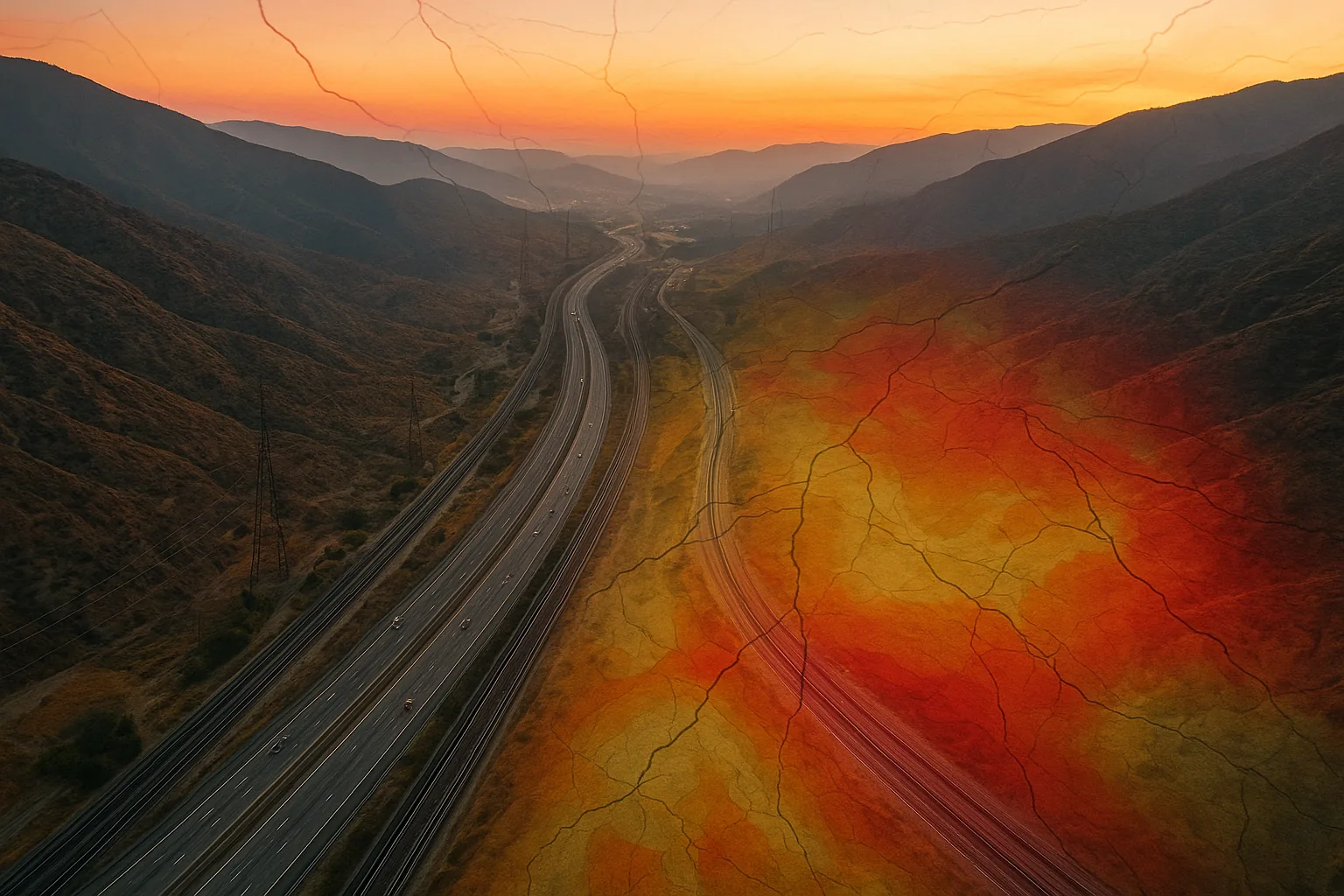
It matters because those stresses sit on and around the Cajon Pass, a narrow, infrastructure-packed gap where the San Andreas and San Jacinto fault systems approach each other. If the wrong piece of fault snaps, the result could be far worse than a single isolated rupture. Scientists aren’t saying the apocalypse is imminent. They are saying the physical conditions that could allow a large quake to jump between faults are closer than at almost any time in the last millennium.
That nuance — new physics-based modelling, not a date on a calendar — is the central tension here. The work redraws the landscape of plausible scenarios and forces planners to revisit older assumptions about where and how a major shock could spread through Southern California.
California primed apocalyptic earthquake: what the model shows
The international team ran a physics-rich simulation that stitched together 1,000 years of earthquake history for southern California’s fault network. The model does three practical things: it calculates how every quake reshuffles stress onto neighboring fault segments, it simulates stress accumulation during quiet intervals, and it lets the deeper crustal layers relax slowly after big ruptures.
Crucially, the model highlights the Cajon Pass as an "earthquake gate" — a choke point that controls whether ruptures stay confined to a single fault or cascade onto its neighbor. Historically, the 1857 Fort Tejon rupture stayed mostly on the San Andreas. In contrast, the 1812 event appears to have jumped between systems. The new runs suggest we are edging toward conditions associated with those cross-fault, larger-extent ruptures.
An 'earthquake gate' at Cajon Pass changes the stakes
The Cajon Pass is a knot of highways, rail, pipelines and power lines sitting where fault geometry lets stress hop from one system to another. That makes it more than a geological curiosity. It is a critical lifeline for freight, commuters and energy moving into and out of the Los Angeles basin. If a major rupture crosses the gate, damage patterns change from local to regional in a matter of seconds.
The researchers coined the term because the pass acts like a valve: closed, a big rupture remains localized and damage stays within a predictable corridor; open, a rupture can sweep across multiple fault strands and multiply impacts. That shift doesn’t just mean stronger shaking in one place. It means multiple bridges, rail lines and backbone electricity feeds could fail simultaneously — exactly the kind of cascading disaster planners fear but rarely model together.
Importantly, the study does not provide a timing forecast. Earthquake science still cannot say when this hypothetical multi-fault rupture will occur. Instead, the model defines ranges of plausible scenarios and highlights where preparedness and resilience investments will buy the most risk reduction.
California primed apocalyptic earthquake: who and what would be hit
Los Angeles and the Inland Empire sit squarely under the shadow of this finding. A large multi-fault event crossing from the San Andreas into the San Jacinto — or vice versa — could send violent shaking into densely populated suburbs, industrial corridors and port facilities. Critical infrastructure that funnels goods and power through the Cajon Pass would be at heightened risk.
Beyond immediate shaking, secondary effects matter. Lifeline failures — collapsed freeway interchanges, snapped high-voltage lines, ruptured gas mains — can turn a single-day disaster into weeks of disruption. The model specifically flags the geography around the Cajon Pass because it concentrates both the geological vulnerability and the socio-economic exposure: millions of people, major freight routes and electrical transmission lines all use the same narrow corridor.
How likely is a megaquake — and when might it happen?
Here’s the blunt truth: scientists still cannot predict the exact timing of earthquakes. The model increases our understanding of the system’s current stress state, but it does not convert that into a calendar date. Probability estimates require different models and observational inputs, and even those carry wide uncertainty bands.
What the study does say is that stress has been building since the last great regional rupture in 1857 and that the system’s current stress distribution approaches values historically associated with ruptures that span multiple faults. That raises the relative odds of a larger multi-fault event compared to a scenario in which stress were lower. But "higher odds" in this domain does not mean imminent. The next major event could arrive tomorrow, in decades, or centuries; the science cannot narrow it further today.
For everyday planning, though, this uncertainty is irrelevant. Cities and utilities cannot wait for a prediction. They must assume the possibility of a very large event and harden systems accordingly.
Practical steps people and governments should take now
There’s a lot individuals can do that doesn’t require a crystal ball. At the household level: secure heavy furniture and gas appliances, keep an emergency kit with water, food and medicines for at least 72 hours, and have a family communication plan. Practice drop-cover-hold and learn how to shut off the main gas valve if local authorities recommend it.
Local governments and utilities, meanwhile, need to think in scenarios. That means seismic retrofits for bridges and critical hospital systems, redundant routing for power and rail corridors, and stockpiles of temporary housing and fuel to keep supplies moving. Planners should prioritize retrofits and backups in the Cajon Pass corridor because its failure modes can cascade rapidly through the region.
Insurance markets, zoning boards and resilience funders will also need to re-evaluate assumptions about which areas are acceptable for dense development. The study is a prompt to move from single-fault planning to system-level resilience.
How this research changes the conversation about earthquake risk
For decades, seismic hazard assessments often treated faults like isolated actors. This work treats the network as an interacting system, allowing stress to transfer, accumulate and sometimes conspire to create larger ruptures. That systems view doesn’t make earthquakes more mysterious; it makes the scenarios more realistic and, therefore, more useful for planners.
Sources
- Journal of Geophysical Research (research paper on multi-century fault stress modelling)
- University of Bern (press materials and research team statements)
- U.S. Geological Survey (technical background on earthquake predictability and hazard assessment)




Comments
No comments yet. Be the first!