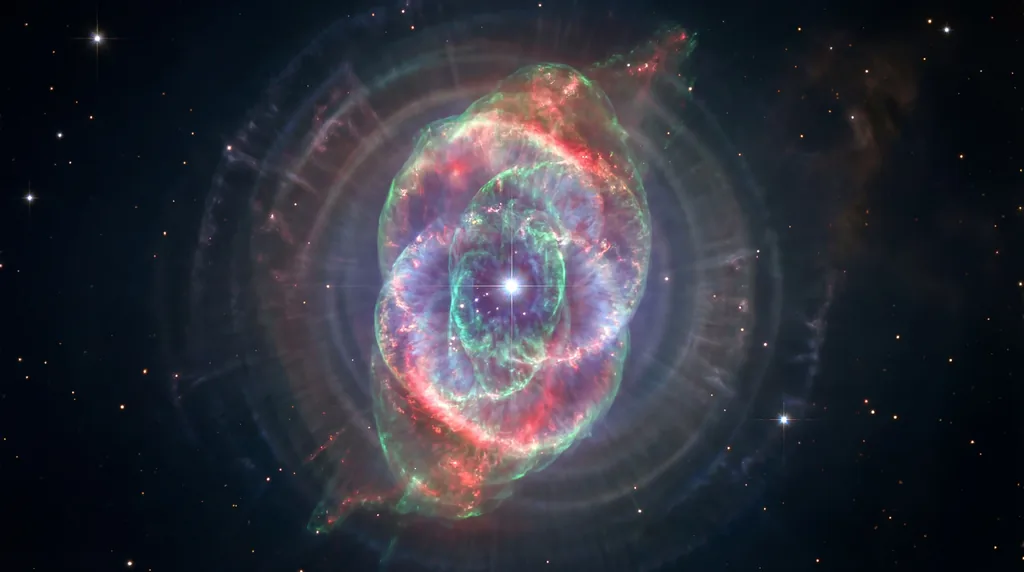

The intricate and surreal architecture of the Cat's Eye Nebula is primarily the result of high-speed stellar winds interacting with older, slower-moving shells of gas ejected by a dying star. As these fast stellar winds collide with previously expelled material, they hollow out a central cavity and create shock-driven bubbles that burst at the poles. Astronomers believe a binary star system may also be at play, using precessing jets to sculpt the nebula’s unique loops and knots, creating what is widely considered one of the most complex planetary nebulae in the known universe.
For the March 2026 ESA/Hubble Picture of the Month, the legendary Hubble Space Telescope joined forces with the European Space Agency’s Euclid mission to produce a definitive portrait of NGC 6543, popularly known as the Cat’s Eye Nebula. This collaboration marks a significant milestone in multi-observatory science, blending Hubble’s unmatched high-resolution optical capabilities with Euclid’s expansive wide-field infrared perspective. Located approximately 4,300 light-years away in the constellation Draco—a distance verified by the ESA’s Gaia mission—the nebula serves as a laboratory for understanding the final evolutionary stages of stars similar to our own Sun.
What causes the complex structures in the Cat's Eye Nebula?
The complex structures in the Cat's Eye Nebula are driven by the interplay of episodic mass loss and powerful stellar winds from a central dying star. These forces create a "fossil record" of the star's final stages, where high-speed gas jets collide with earlier ejections to form the nebula's characteristic nested shells and intricate filaments.
According to researchers at NASA and the ESA, the nebula’s morphology is not the result of a single explosion but a series of distinct physical events. As the central star nears the end of its life, it sheds its outer layers in a process called planetary nebula formation. Despite the name, these structures have nothing to do with planets; they are expanding clouds of ionized gas. In the case of NGC 6543, the central star's luminosity and temperature are so high that they generate radiation pressure and winds that travel at millions of miles per hour. These winds catch up to the slower-moving gas from previous ejections, compressing it into the glowing rings and "eyes" seen in modern imagery.
The Cat's Eye Nebula was the first of its kind to be analyzed via spectroscopy in 1864 by William Huggins, who proved that these nebulae were composed of hot gases rather than distant stars. Modern observations suggest that the star's "wobble" or the presence of a companion star likely contributes to the symmetry-breaking features. These features include the high-speed bipolar jets that have pierced through the inner shells, creating the elongated, almond-like shape that gives the nebula its name. These shock interactions are so violent that they produce X-ray emissions, which have been previously mapped by other flagship observatories.
What is the difference between Hubble and Euclid observations of the Cat's Eye Nebula?
Hubble provides high-resolution visible-light images of the nebula’s core, capturing fine details like concentric shells and dense gas knots. In contrast, Euclid offers a wide-field, near-infrared view that places the nebula within its galactic context, revealing the expansive, colorful halo of gas fragments and distant background galaxies.
While Hubble excels at "zooming in" to resolve features as small as a few billion miles across, Euclid is designed to map the wider universe. In this new joint survey, Hubble’s data reveals a tapestry of concentric shells and jets sculpted by shock interactions in the inner region. These structures are incredibly sharp, allowing scientists to measure the expansion rate of the gas over several decades. Hubble’s contribution is essential for understanding the micro-physics of the nebula, such as how gas clumps together into "knots" that resist the pressure of the stellar wind.
The Euclid Space Telescope, meanwhile, provides the "big picture." Its wide near-infrared and visible light sensors capture a vast halo of colorful fragments that surround the bright central region. This outer ring was ejected from the star at a much earlier stage—thousands of years before the main nebula formed. By seeing both views simultaneously, astronomers can link the star's current state (Hubble) to its history (Euclid). This dual-telescope approach allows the Cat's Eye Nebula to be seen not just as an isolated object, but as a dynamic system interacting with the vacuum of space against a backdrop of thousands of distant galaxies.
Why are concentric shells visible in the Cat's Eye Nebula?
Concentric shells are visible in the Cat's Eye Nebula because the central star experienced episodic pulses of mass loss every 1,500 years. These ejections created a series of nested, spherical bubbles of dust and gas that appear as thin, layered rings when viewed from Earth, resembling the skins of an onion.
The presence of these shells—at least 11 have been identified—remains one of the most intriguing mysteries of the Cat's Eye Nebula. Standard models of stellar evolution do not easily explain why a star would eject its mass in such regular intervals. Some theories suggest that these pulses are caused by thermal oscillations in the star's core, while others point to the gravitational influence of a hidden binary companion. Each shell contains about as much mass as all the planets in our solar system combined, representing a significant loss of material that will eventually seed the galaxy with heavy elements like carbon and oxygen.
These concentric rings are effectively a timeline of the star's death throes. By measuring the distance between the shells, astronomers can calculate that the pulses began roughly 15,000 years ago and ceased about 1,000 years ago when the main, brighter nebula began to form. The Hubble Space Telescope has been instrumental in showing that these shells are remarkably uniform, suggesting that the mechanism triggering the ejections is a precise, periodic physical process. This "fossil record" is crucial for predicting the future of our own Sun, which is expected to undergo a similar transformation in approximately five billion years.
The Future of Deep-Space Collaboration
The successful synthesis of data from Hubble and Euclid sets a new precedent for international space science. As the European Space Agency (ESA) and NASA continue to operate these multi-billion dollar missions, the focus is shifting from individual observations to data fusion. By combining different spectral ranges—from Hubble's ultraviolet and visible light to Euclid's infrared—astronomers can build 3D models of nebular expansion that were previously impossible to visualize. This provides a more holistic understanding of the interstellar medium and how dying stars contribute to the chemical enrichment of their host galaxies.
Looking forward, the study of NGC 6543 will likely involve the James Webb Space Telescope (JWST) to peer even deeper into the dust-shrouded core of the nebula. The goal is to finally confirm whether a binary star system sits at the heart of the "eye." As these flagship missions work together, they continue to reveal that the death of a star is not a quiet fading away, but a spectacular, complex, and highly structured performance that reshapes the cosmos for light-years around it.
- Object: Cat's Eye Nebula (NGC 6543)
- Distance: 4,300 light-years
- Observatories: Hubble (NASA/ESA), Euclid (ESA), Gaia (ESA)
- Significance: First planetary nebula identified via spectroscopy
- Key Features: 11 concentric shells, high-speed polar jets, expansive halo





Comments
No comments yet. Be the first!