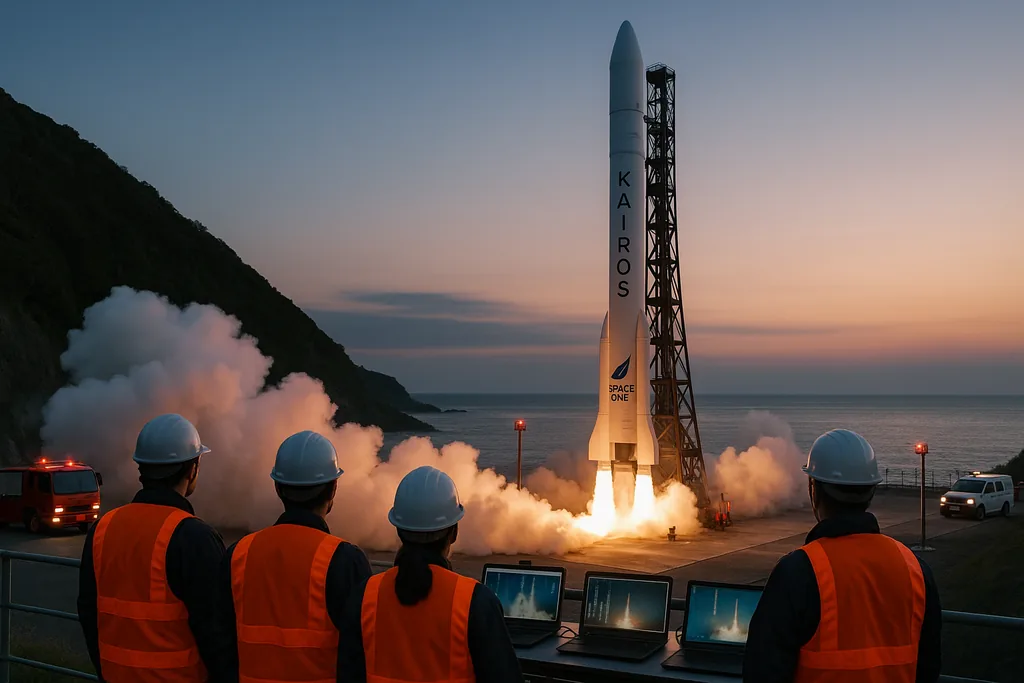
Space One's third rocket failed 69 seconds after liftoff
Space One's third rocket — the 18‑metre solid‑propellant Kairos — terminated its flight 69 seconds after lift‑off on 5 March, failing to achieve what the company had billed as Japan's first entirely commercial satellite launch. Live footage from the Pacific coast launch site on the Kii peninsula showed the vehicle in a wobbling trajectory before an automatic flight termination at about 29 km altitude. The flight carried five experimental small satellites, including customer payloads from Tokyo‑based ArkEdge Space and the Taiwan Space Agency.
space one's third rocket: the immediate technical picture
Space One’s third rocket self‑destructed after its own safety system judged the mission could not be completed. That automatic termination is designed to protect people and property if a vehicle departs its acceptable flight corridor. Company officials, including vice‑president Nobuhiro Sekino, said initial telemetry showed no clear “significant abnormalities” before the termination, a detail that points investigators toward the autonomous flight‑termination logic or transient control issues rather than an obvious hardware breakage before the abort.
Video from the launch showed the Kairos vehicle adopting a noticeably wobbly attitude within the first two minutes — the period that ended with the flight termination. In solid‑propellant small rockets like Kairos, once the motor is ignited there is limited ability to throttle thrust, so guidance, structural stability and separation mechanisms are usually the principal failure modes. The flight‑termination committee will comb telemetry from the rocket’s inertial sensors, the onboard computer, and ground‑based tracking to sequence precisely what led the safety logic to trigger self‑destruct.
space one's third rocket and Japan's widening launch gap
The failed Kairos flight deepens a strategic shortfall: Japan now has no domestic commercial launch provider that has successfully placed satellites into orbit. Beyond Space One's three unsuccessful Kairos attempts, Japan suffered a high‑profile state‑funded H3 rocket failure in December, and the nation launched only three rockets in 2025 — far short of its stated near‑term ambition for dozens of annual missions. That shortfall matters for both commercial customers and national security planners who want assured, sovereign access to space amid rising regional tensions and the strategic competition with China.
In practical terms, Japanese satellite operators and defence planners will continue to rely on foreign launch services. U.S. providers such as SpaceX have dominated the small‑sat and rideshare market because of an extensive flight record and low cost; Rocket Lab and other overseas small‑rocket firms are also available. Tokyo has been subsidising domestic startups and signing defence contracts with them to build capacity, but repeated tests and failures like Kairos show how hard it is to build reliable launch capability quickly.
Who is Space One and what does it do?
Space One is a private Japanese launch venture formed as a joint enterprise that has attracted investment from major industrial names, including Canon and IHI, and construction support from Shimizu. It developed Kairos, an 18‑metre solid‑propellant small launcher designed to lift small experimental satellites from a private pad at the tip of the Kii peninsula in Kushimoto, Wakayama prefecture. The firm’s stated commercial proposition was to offer domestic launch services for small satellites, reducing the need to use overseas providers.
That business model is typical of the new small‑rocket sector: low‑cost, frequent launches for Earth‑observation, communications and technology demonstration satellites. Space One has promoted Kairos as an inexpensive, rapid‑turnaround vehicle for customers in Japan and the region. The third launch’s payload manifest included domestic company satellites and a package for the Taiwan Space Agency, underlining early international commercial interest.
Why the failure matters to Japan’s industry and defence planners
Japan’s government has been actively supporting nascent launch companies with subsidies and defence contracts to accelerate a domestic industrial base. The defence ministry has signed deals with private firms, including Space One, to deploy a constellation of national security satellites. The logic is clear: sovereign launch capability reduces dependence on foreign launchers during crises and supports rapid replenishment of critical space assets.
But the pathway from prototype to reliable service is long. Industry experts note that solid rockets, separation events, avionics and flight‑termination logic must all be exercised in many flights before an operator can claim routine access. The Kairos failure highlights that reality and will likely slow customer confidence and delay the commercial scaling of Japanese launch services, even as companies and the government double down on testing and funding.
What caused Space One's third rocket to fail and what went wrong?
Investigators will examine several elements: the solid motor performance, structural loads, guidance‑control software, stage separation events, and the rocket’s flight‑termination system. The company’s comment that no obvious anomalies were seen on telemetry before termination strongly suggests the abort trigger itself or a secondary guidance issue as a plausible cause. The visible wobbly flight path seen on live feeds supports the possibility of control instability that the onboard safety logic judged unrecoverable.
Until the formal post‑flight review, which Space One has said it is undertaking, a definitive cause will not be public. But the industry’s experience shows that a mix of marginal control authority, unexpected aerodynamic coupling and timing or sensor faults can produce the exact symptoms Reuters described: a rocket that looks off‑axis, then an automated termination to mitigate risk.
How will Space One's failure affect Japan's commercial launch capability and next steps?
Practically, the failure removes any immediate prospect of a Japanese‑built commercial launcher putting satellites into orbit. Customers that had anticipated rapid local options will revert to established international suppliers. For the government and industry, the next steps are predictable: conduct a detailed failure investigation; pause follow‑on flights until root causes are understood; and fund iterative design fixes and further tests. Regulatory and insurance processes will also influence the pace at which flights resume.
The government faces a trade‑off: press hard for quick recoveries to maintain momentum for domestic industry, or accept a slower, more methodical testing cadence to ensure safety and reliability. Both involve fresh costs — direct subsidies, engineering time and the indirect cost of lost business while customers go abroad.
Japan’s options for future launches after the Space One setback
In the short term, Japan’s satellite operators will continue to book lifts on proven foreign rockets — primarily SpaceX for rideshares and Rocket Lab for dedicated small‑sat missions — because they offer flight heritage, predictable schedules and competitive prices. That reliance is the practical option while Japanese companies mature.
Longer term, Tokyo has several routes: keep funding domestic startups and learning through repeated test flights; accelerate partnerships with experienced overseas launch firms for technology transfer; or concentrate on complementary areas such as more advanced satellite manufacturing and ground operations. Carmakers and industrial groups, which have invested in the sector (Toyota in Interstellar Technologies, and experiments from Honda), may be part of that multi‑industry build‑out. Defence contracts that tie capability development to national security missions will also continue to push resources into the domestic launch ecosystem.
What comes next — industry reaction and the investigation timeline
Space One says it is investigating and will host a press conference to share details. Independent analysts and government officials will want a rapid but thorough root‑cause analysis before any further launches. For customers and investors, the timeline to regain confidence will depend on transparent reporting, demonstrable corrective actions and a sequence of successful test flights that prove fixes under flight conditions.
For now, the practical reality is that Japan has been set back in its bid to field a homegrown commercial launcher. The broader national goal of assured, resilient access to space remains intact — but achieving it will require more flights, more testing and likely more time and funding than planners had hoped.
Sources
- Space One press statement (Kairos flight termination)
- Taiwan Space Agency (payload manifest)
- Japan Ministry of Defense (national launch policy and defence contracts)
- Mitsubishi Heavy Industries (H3 programme)




Comments
No comments yet. Be the first!