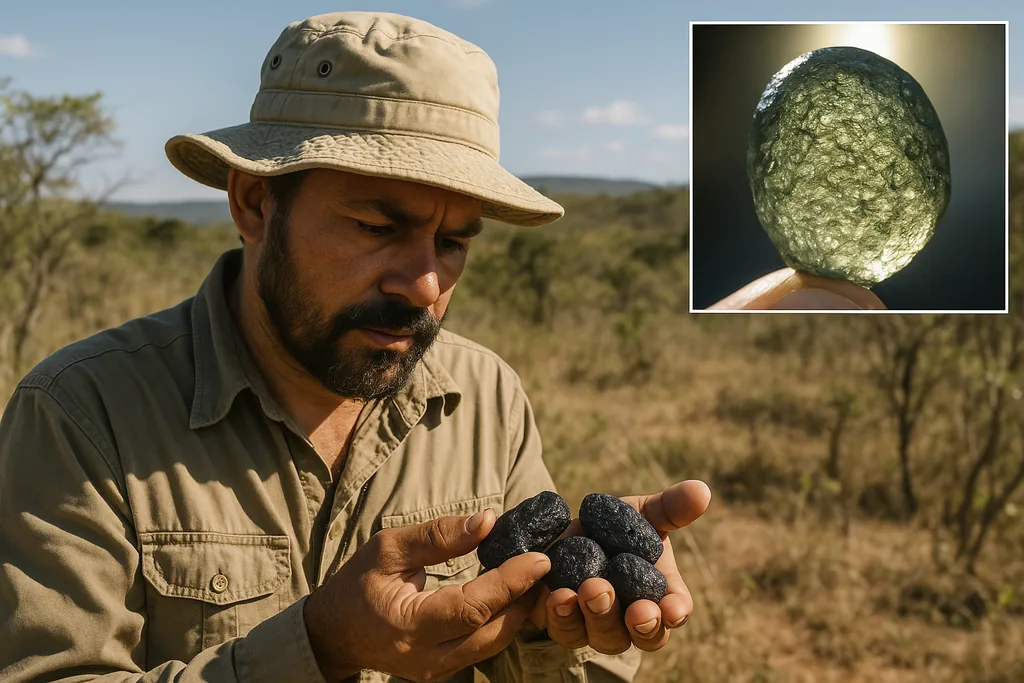
Scientists working in northeastern Brazil have announced the discovery of a previously unknown field of natural impact glass — tektites — that they date to roughly 6.3 million years ago. The material, now given the formal name "geraisites" after the Brazilian state of Minas Gerais where the first samples were collected, is unusually widespread across a corridor that now stretches into Bahia and Piauí. The find is noteworthy not only because tektite fields are globally rare, but because researchers have so far been unable to locate the crater that formed the melt — a puzzle that will shape follow-up surveys and modelling work for years to come.
Discovery: rare glass 6-million-year-old meteorite in Brazil
The discovery began with systematic fieldwork in northern Minas Gerais where researchers collected hundreds of small, glassy fragments from towns such as Taiobeiras, Curral de Dentro and São João do Paraíso. By mid‑2025 the team had gathered about 500 specimens; further prospecting has increased that number to more than 600, and the mapped strewn field now exceeds 900 kilometres in length as finds were reported farther afield in Bahia and Piauí. The pieces share a consistent suite of textures and chemistry, marking them as members of the same strewn field rather than unrelated local glass. That pattern — consistent ages and matching geochemistry across a long corridor — is the classic fingerprint of a tektite field produced by a single impact event.
Dating the rare glass 6-million-year-old meteorite — methods and limits
To place the event in time, the researchers used argon isotope ratios (40Ar/39Ar) measured on the glass, a standard radiometric method for impact melts and volcanic material. The analyses returned closely clustered ages — around 6.78 ± 0.02 Ma, 6.40 ± 0.02 Ma and 6.33 ± 0.02 Ma — which the team interprets as consistent with a single impact near the end of the Miocene epoch. The authors caution, however, that argon ages on melts can include inherited components from the target rocks, so the 6.3 million‑year figure is best read as a robust maximum age for the event rather than an absolute pinpoint. Those dates place the impact well before the Pliocene and long before the present day, making these tektites an important addition to the Pliocene–Miocene impact record.
How impact glass forms and what the geraisites reveal
Impact glass — commonly called tektite when it appears in characteristic, aerodynamic forms — forms when a hypervelocity collision delivers so much energy that local rocks and soils are vaporized and melted, then ejected at high speed. Molten droplets cool rapidly while flying through the atmosphere, producing smooth, bubble‑rimmed bodies that can be round, teardrop, discoid or dumbbell shaped depending on their aerodynamics and cooling history. The new brasileiros tektites are silica‑rich (about 70–74% SiO₂) with elevated sodium and potassium oxides and low water content, chemical traits that match tektites from other fields and argue strongly for an impact origin rather than a volcanic or anthropogenic source. A particularly telling piece of evidence is the presence of lechatelierite — a glassy form of silica that only forms at the extreme temperatures produced by impacts. Those mineral and water‑content fingerprints are why the authors are confident these objects are genuine tektites rather than weathered local glass.
Where's the crater? Geological reasons it can be hidden
Despite the wide distribution of geraisites, field teams have not identified a corresponding crater. That absence is not unprecedented: among the globally known tektite strewn fields, only a subset have an obvious, matched crater. There are several reasons an impact crater may be difficult or impossible to spot at the surface. Over millions of years, erosion can wear away topographic relief while burial by sediment can conceal the structure beneath younger rocks. A crater formed in an ocean or shallow sea will leave no exposed rim on land at all; this is the suspected explanation for at least one very large tektite field. Impact into ancient, hard continental crust — such as the São Francisco craton that underlies large parts of eastern South America — can also produce a subtle, hard‑to‑recognise signature, especially if later tectonic or sedimentary processes mask the geomorphology. In short, a missing crater does not disprove an impact origin; it instead points the search toward geophysical surveying and subsurface imaging.
Search strategies and what scientists will look for next
To find a buried or eroded structure, researchers will turn to remote sensing and aerogeophysical data first. Gravity and magnetic surveys can reveal circular anomalies beneath sediment cover; satellite and airborne imagery may show subtle drainage patterns or vegetation differences that betray a buried basin. The geochemical signature of the geraisites — especially isotopic markers indicating an Archean granitic source rock — narrows the search area to old continental blocks such as the São Francisco craton, because the glass records the composition of the surface rocks that were melted and ejected. If a crater is not preserved at the surface, these geophysical techniques, combined with targeted drilling where anomalies appear, are the likeliest path to a positive identification. Meanwhile, continued fieldwork will refine the strewn‑field map and provide inputs for the impact‑modelling that can estimate impactor size, speed and angle.
Why this matters to planetary science and Earth history
Every confirmed impact field expands our catalogue of Earth’s bombardment history and improves our statistical understanding of how often substantial impacts occur. The geraisite discovery fills a geographic and temporal gap in South America's record of relatively young impacts, and provides new material for laboratory experiments that test how impact melts behave during ejection and atmospheric flight. For planetary defence and hazard studies, detailed reconstructions of specific events inform models of impact energy and frequency; for petrology and geochemistry, the glasses are time capsules that preserve a snapshot of the crust that was melted. Finally, the find is a reminder that recognizable impact products may be hiding in plain sight across continents, misidentified or overlooked until systematic fieldwork and chemical analyses reveal their true origin.




Comments
No comments yet. Be the first!