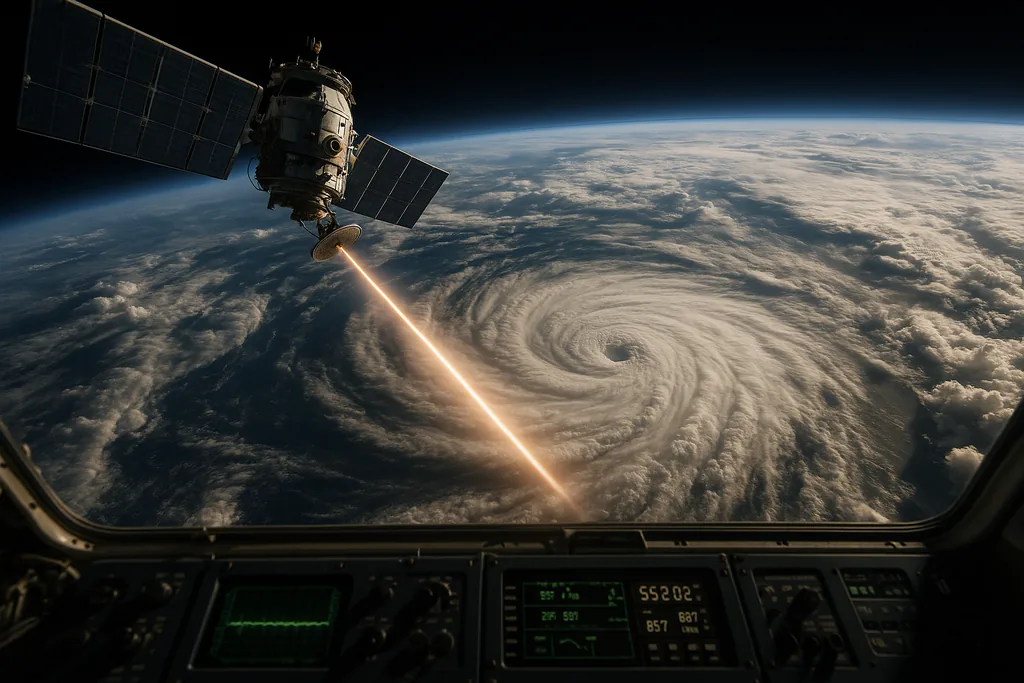
An audacious idea lands in orbit
This week a senior Chinese engineer outlined a dramatic-sounding proposal: china team mulls hitting typhoons with a concentrated energy beam from orbit to "change a typhoon's intensity and path." The idea surfaced as part of public comments about the Zhuri concept — a proposed space-based solar power station that could, in theory, deliver focused microwave or laser energy back to Earth. The remarks have reverberated because they connect two fast-moving threads of Chinese science policy: large-scale space power concepts and recent demonstrations of long-duration laser links to high-orbit satellites.
china team mulls hitting storms: the Zhuri concept and what was said
That framing is important: what was presented publicly is an early-stage conceptual pitch, not a technical demonstration. The same reporting noted separate Chinese advances in space laser communications — teams at the Chinese Academy of Sciences recently sustained a one-gigabit-per-second laser link with a geostationary satellite for hours, showing improved pointing and beam maintenance. Those communication breakthroughs make long-duration, precisely pointed beams more plausible in the narrow sense of tracking and pointing, but they do not close the huge gaps between a data-carrying optical link and the energy levels, atmospheric physics and systems engineering required to affect a tropical cyclone.
china team mulls hitting typhoons: what the physics actually requires
Tropical cyclones are among the most energetic systems on Earth. A mature typhoon can release energy at rates comparable to hundreds of terawatts when accounting for latent heat from condensation and the storm's internal circulation. To alter a typhoon meaningfully would therefore require either a persistent, planet-scale influence on air temperature, humidity or pressure fields, or very precisely targeted perturbations at the storm's core — neither of which is straightforward.
Why experiments and demonstrations so far don't mean weather control is near
There are real, incremental steps in the public record that make elements of the conversation technically credible: laser communication experiments show improved pointing, and small-scale microwave beaming has been tested terrestrially and in near-space for wireless power demonstrations. But those experiments operate at kilowatt or sub-kilowatt scales and for communications purposes, not to alter mesoscale atmospheric circulation.
No peer-reviewed experiments demonstrate that a directed space beam can change a cyclone's track or intensity. Historically, storm-modification research has focused on cloud seeding and modest boundary-layer interventions, with mixed and often contested results. Going from seeding clouds to steering or weakening a mature typhoon is a jump in energy and complexity that would require decades of modelling, terrestrial trials and fully instrumented field campaigns before any high-altitude or orbital tests could be justified.
Technical and logistical barriers that matter
The hurdles fall into several categories. First is energy and platform scale: a meaningful atmospheric impact would likely require sustained megawatt-to-gigawatt-class delivery to the storm area, implying vast space-based collectors, conversion hardware and thermal management systems. Second is beam propagation: atmospheric absorption, scattering by clouds and nonlinear interactions would reduce effectiveness and complicate targeting. Third is pointing and tracking: although laser comm work shows improved stability, energy-beam systems must safely avoid aircraft, satellites and unintended ground impacts while steering through a turbulent atmosphere.
Launch costs, survivability of large orbital structures, maintenance, debris risk and integration with existing satellite constellations add further logistical complexity. Finally, robust numerical forecasts and controlled testbeds would be essential to design any intervention with predictable outcomes; our atmospheric models still struggle with internal storm physics at the level required for directed intervention design.
Ethics, law and geopolitics
Even if the technical obstacles were solved, deliberate modification of storms carries acute ethical, environmental and geopolitical risks. A beam intended to nudge a typhoon away from one coastline might alter rainfall patterns elsewhere, produce unintended intensification, or intersect other states' territories. That raises questions about liability, consent and cross-border environmental impacts.
International law already restricts hostile environmental modification: the Environmental Modification Convention forbids the military or hostile use of environmental modification techniques. But civilian, cross-border use of weather-modification technologies sits in a legal grey area and would almost certainly prompt new diplomatic frameworks, oversight mechanisms and transparency requirements — ideally before any operational capability is developed.
What scientific work would be necessary before any trial
Realistically, progress would need to begin with fundamental atmospheric science and small-scale experiments. That means high-fidelity coupled atmosphere–ocean modelling to predict how local heating or evaporative changes propagate through a storm, carefully instrumented field trials that test low-energy perturbations, and transparent international review of environmental impact assessments. Parallel work on safe beam termination, airspace coordination and satellite deconfliction would be mandatory.
Researchers would also need to demonstrate controllable, reversible effects at small scales before any escalation. Models would need to show that intentional perturbations have predictable outcomes with acceptably bounded risks for populations in all affected regions.
Why the idea surfaced now
China's public discussion of a space-based energy economy — and the technical pieces that feed into it, like longer-duration laser links and improving satellite pointing — have combined with strategic research priorities to produce bold speculative ideas. Beijing is investing heavily in space power concepts, private and state laboratories are refining optical and microwave technologies, and universities report more graduates entering manufacturing and energy fields that will underpin those capabilities. Together, those trends explain why notions like Zhuri and even weather influence have reached public discourse now.
That does not mean operational weather control is imminent. Rather, it signals a nation aiming to explore the full range of applications for spacecraft-based energy and precision-beam technologies — and a need for global dialogue about the limits, governance and ethics of any system that can alter Earth's environment.
Near-term outlook and realistic uses
In the near term, the most plausible and least risky uses of space-based beaming are mundane but valuable: charging satellites, providing emergency power to remote locations, or supporting communications and sensing networks. The Chinese Academy of Sciences' recent long-duration laser link to a geostationary satellite is an example of capability maturation that will improve satellite communications and coordination, not storm control.
Meanwhile, independent scientists, international agencies and policymakers should treat proposals to influence weather from space as topics for open, peer-reviewed research and multilateral discussion. That includes assessments of feasibility, risk quantification and clear rules that prevent unilateral environmental actions with transboundary impacts.
Sources
- Institute of Optics and Electronics, Chinese Academy of Sciences (laser communication experiment)
- Tsinghua University (graduate employment statistics)
- China National research materials and public statements on space-based solar power (Zhuri concept)




Comments
No comments yet. Be the first!