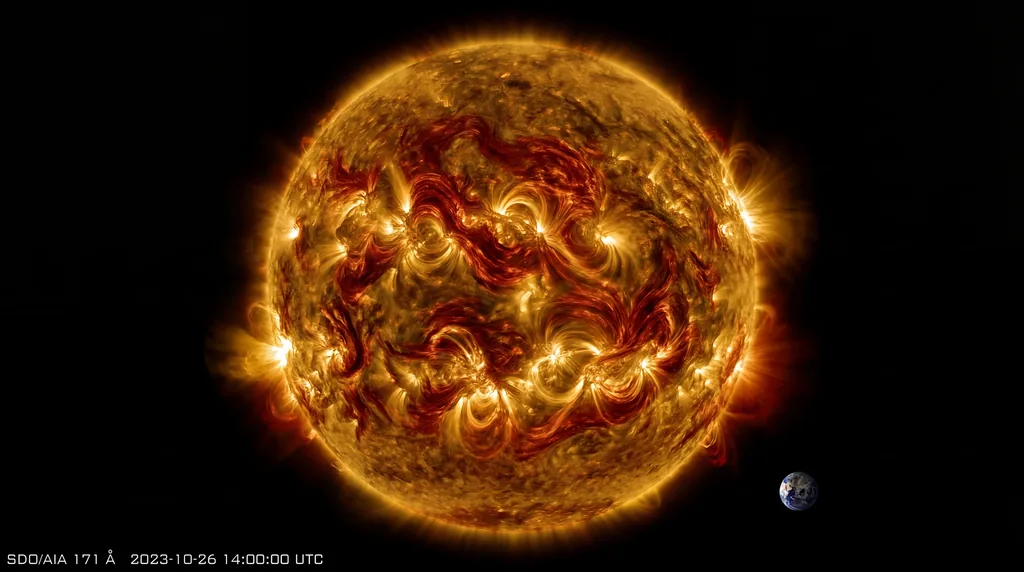

For nearly half a century, astrophysicists operated under the assumption that stars like The Sun undergo a dramatic shift in their internal dynamics as they age. This long-standing theoretical prediction suggested that as a star slows its rotation over billions of years, it eventually flips its rotation pattern, transitioning from an equator-fast "solar-type" rotation to a pole-fast "anti-solar" pattern. However, a landmark study published in Nature Astronomy on February 25, 2026, by researchers at Nagoya University has overturned this 45-year-old paradigm, proving that stars maintain a consistent rotation profile throughout their entire life cycle.
Why did scientists think stars switch rotation patterns as they age?
Scientists previously theorized that stars switch rotation patterns due to the "convective conundrum," a paradox where older, slower-rotating stars were expected to lose the ability to maintain fast equatorial speeds. It was believed that as The Sun and similar stars aged, the transport of angular momentum through thermal convection would fail, causing the poles to eventually rotate faster than the equator. This "anti-solar" rotation was a staple of theoretical models for decades, yet it was curiously never observed in deep-space telescopic data.
This historical reliance on simplified models was largely a byproduct of computational limitations. For forty-five years, the physics governing the interior of stars was simulated at low resolutions that could not fully capture the intricate dance of turbulent plasma and magnetic fields. In these older simulations, magnetic forces would artificially weaken or disappear entirely, leading researchers to conclude that the star’s slowing rotation would inevitably trigger a flip in its differential rotation pattern. This discrepancy between theory and observation remained one of the most significant "missing links" in stellar evolution science until now.
The Long-Standing Theory of Anti-Solar Rotation
Differential rotation is the phenomenon where different parts of a gaseous body rotate at different velocities; on The Sun, the equator completes a rotation in roughly 25 days, while the poles lag behind at 35 days. Standard astrophysical theory suggested that as a star loses angular momentum via stellar winds, the internal forces driving this differential would collapse. The resulting "anti-solar" rotation was considered a fundamental pillar of stellar evolution, predicting a future for our solar system where the solar interior would become increasingly chaotic and inverted.
The research team, led by Hideyuki Hotta, a professor at Nagoya University’s Institute for Space-Earth Environmental Research, and coauthor Yoshiki Hatta, sought to determine if this predicted flip was a physical reality or a computational error. By examining solar-type stars—medium-sized yellow stars similar to our own—they aimed to bridge the gap between what 45 years of math predicted and what astronomers actually saw through their lenses. Their findings suggest that the internal "engine" of a star is far more resilient than previously imagined, resisting the transition to anti-solar rotation even as the star enters its twilight years.
What role does the Fugaku supercomputer play in this discovery?
The Fugaku supercomputer allowed researchers to conduct the most detailed simulations of stellar interiors ever attempted, utilizing 5.4 billion grid points to model turbulent gas and magnetism. By providing the immense processing power necessary for high-resolution modeling, Fugaku revealed that magnetic fields remain strong enough to prevent a rotation flip. Previous, lower-resolution models lacked the fidelity to show how these magnetic fields act as a stabilizing force that keeps the equator spinning faster than the poles.
Using Fugaku, which is housed at RIKEN in Kobe, Japan, the Nagoya team could simulate the "convection zone"—the outermost layer of the solar interior where hot gas rises and sinks. In these high-definition environments, the researchers observed that magnetism and turbulence work in tandem. "We found that these two processes keep the equator spinning faster than the poles throughout the star’s life," explained Professor Hotta. This corrected the long-standing error where magnetic fields were dismissed as insignificant in older, slower stars, finally aligning computer simulations with real-world astronomical observations.
Breaking the Paradox: Stability Over Evolution
The discovery that rotation patterns remain constant has profound implications for our understanding of stellar stability. In the Nature Astronomy paper, the researchers demonstrated that "solar-type" rotation is the universal standard for stars like our own, regardless of age. This stability is maintained by magnetic braking and internal convection currents that do not force a transition to anti-solar rotation as was once feared. Instead, the magnetic field weakens continuously without a sudden "revival" or "flip" in old age.
This finding resolves a major conflict in astrophysics: why astronomers could never find a star exhibiting anti-solar rotation despite decades of searching. By applying the new Fugaku-driven model to various stars, the team found that the simulation perfectly matched the observed rotation patterns of both young, fast-moving stars and older, slower ones. This suggests that the fundamental "blueprints" of a star’s interior dynamics are set early and remain remarkably durable over billions of years of evolution.
How does this discovery impact our understanding of the Sun's 11-year cycle?
This discovery clarifies the mechanism behind the Sun's 11-year cycle by proving that constant differential rotation is the primary driver of magnetic activity. Because The Sun maintains a fast equator and slow poles, its magnetic field lines continue to wrap and twist in a predictable manner, fueling the periodic rise and fall of sunspots. Understanding that this pattern does not flip allows scientists to more accurately model the long-term magnetic health of our star and its impact on the solar system.
- Sunspot Generation: Constant rotation ensures the "solar dynamo" remains active, producing predictable cycles of sunspots.
- Space Weather Forecasting: Accurate models of the solar interior lead to better predictions of Coronal Mass Ejections (CMEs) and solar flares.
- Planetary Habitability: By knowing the rotation stays stable, scientists can better predict how a star's radiation will affect the atmosphere of orbiting planets over eons.
- Stellar Aging: The research provides a new "clock" for measuring how stars age without assuming a catastrophic change in their internal spin.
Predicting Space Weather and Aurora Visibility
The practical applications of this research extend beyond theoretical physics into the realm of Space Weather. As of March 5, 2026, real-time data shows a Kp-index of 5, indicating a Moderate (G1) geomagnetic storm. This activity, driven by the Sun's magnetic field, is currently causing Aurora visibility in northern US states, Canada, and Europe. Regions such as Fairbanks, Alaska, and Tromsø, Norway, are experiencing vibrant displays due to the very magnetic processes that the Nagoya University study has now clarified.
Because we now know the solar-type rotation is permanent, our ability to forecast these geomagnetic events becomes significantly more robust. "The simulation can reproduce the Sun’s observed rotation pattern almost perfectly," noted coauthor Yoshiki Hatta. This accuracy is essential for protecting global satellite networks and power grids, which are increasingly vulnerable to the magnetic outbursts generated by The Sun. For skywatchers in cities like Stockholm or Helsinki, this research confirms that the familiar 11-year cycle of auroral activity is a stable, permanent feature of our star's life, rather than something that will fade or flip as The Sun continues to age.
Conclusion: Redefining the Future of Astrophysics
The Nagoya University study represents a turning point in stellar physics, requiring a significant update to textbooks that have taught the anti-solar rotation theory for nearly half a century. By proving that magnetic fields act as the ultimate stabilizers, researchers have moved us one step closer to solving the most persistent mysteries of the solar interior. This work highlights the indispensable value of high-performance computing, as the Fugaku supercomputer was the only tool capable of revealing the truth hidden within the Sun's turbulent plasma.
Ultimately, the discovery offers a more stable and predictable vision of our solar system's future. While The Sun will continue to slow down as it ages, its fundamental rotation pattern—the engine that drives our weather, our climate, and our spectacular auroras—is locked in for life. This newfound clarity not only improves our models of distant stars but also deepens our appreciation for the consistent, life-sustaining behavior of our own home star.





Comments
No comments yet. Be the first!