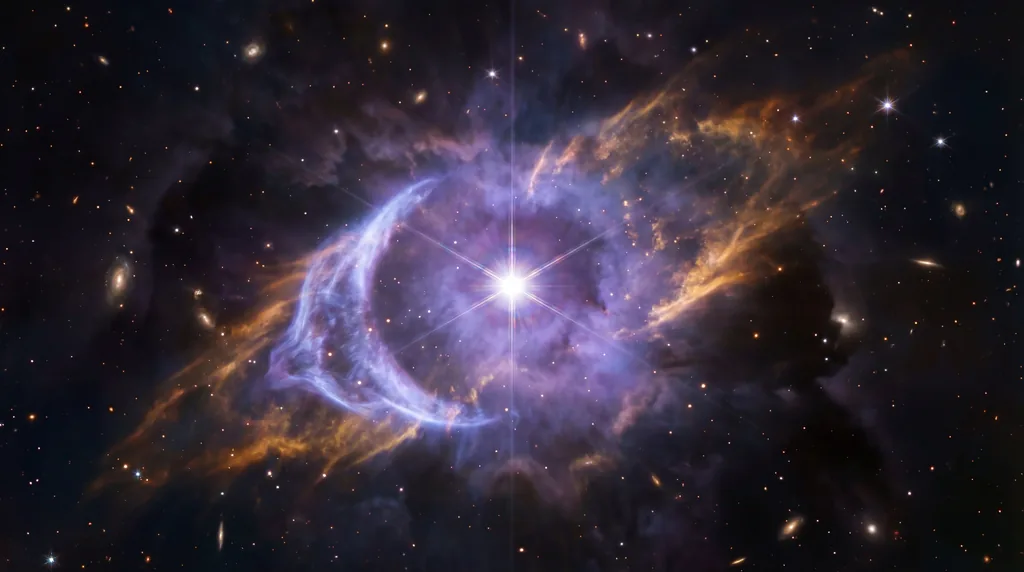

On February 23, 2026, astronomers using the NASA Chandra X-ray Observatory announced the first-ever direct observation of an astrosphere surrounding a young, Sun-like star named HD 61005. This "stellar bubble" is created by powerful winds blowing from the juvenile star’s surface, which collide with the surrounding galactic gas to form a protective envelope of million-degree plasma. This breakthrough, published by researchers including C.M. Lisse of Johns Hopkins University and Lee Mohon, provides a rare, direct look at the high-energy environments that likely defined our own solar system’s infancy.
What is the difference between an astrosphere and the heliosphere?
An astrosphere is the general term for the bubble-like region of space surrounding any star, formed by its stellar wind interacting with the interstellar medium. The heliosphere is specifically the astrosphere of our Sun, created by the solar wind and shaped like a comet with a tailed structure. While astrospheres apply to all stars, the heliosphere is the only one we can study in detail as it encompasses our solar system.
Stellar winds are comprised of a constant stream of charged particles ejected from a star's atmosphere. When these particles encounter the gas and dust that fills the space between stars—the interstellar medium (ISM)—they create a shock boundary. In the case of HD 61005, the NASA Chandra X-ray Observatory detected the X-ray emissions from the hot gas filling this bubble, allowing scientists to see the structure of the astrosphere for the first time in such vivid detail around a G-type star similar to our own.
Why is this discovery by the NASA Chandra X-ray Observatory important for understanding our Sun?
This discovery is vital because it provides a "temporal proxy" or snapshot of our Sun during its violent infancy billions of years ago. By observing HD 61005, scientists can better understand how early stellar winds and X-ray activity shaped the environments of young planets. These observations help researchers model the transition our Sun made from an active "bubble-blower" to its current, more stable state.
Young stars are significantly more active than mature stars like the Sun. By using the NASA Chandra X-ray Observatory to study HD 61005, the team led by C.M. Lisse observed how intense radiation and high-velocity winds impact protoplanetary disks. This research suggests that the early heliosphere played a dual role: while its radiation could strip away early planetary atmospheres, its structure simultaneously provided a necessary shield against even more destructive galactic cosmic rays, potentially facilitating the conditions necessary for life to eventually emerge on Earth.
Can we see HD 61005 with binoculars?
No, HD 61005 cannot be seen with standard binoculars as it is a 10th-magnitude star located in the southern constellation Puppis. While high-end binoculars can resolve objects at this magnitude under perfect dark-sky conditions, a dedicated amateur telescope is typically required for reliable viewing. The star is famous among professional astronomers for its distinctive asymmetric debris disk, which earned it the nickname "The Moth" nebula.
- Constellation: Puppis (The Poop Deck)
- Apparent Magnitude: 10.2
- Distance: Approximately 115 light-years from Earth
- Viewing Requirement: 4-inch aperture telescope or larger recommended
The unique shape of "The Moth" is caused by the star moving rapidly through a dense patch of interstellar gas. This motion "sweeps back" the stellar bubble and the surrounding dust, creating the wing-like appearance that the NASA Chandra X-ray Observatory and the Hubble Space Telescope have both mapped. While it remains a difficult target for backyard observers, its scientific profile is now among the highest in stellar astrophysics.
Does the astrosphere protect the star like the heliosphere protects Earth?
Yes, the astrosphere protects the star and its surrounding planets in a manner analogous to how the heliosphere protects the Earth. Both act as massive magnetic and plasma shields against high-energy galactic cosmic rays from interstellar space. By deflecting or absorbing these particles through their plasma pressure and magnetic fields, these bubbles create a habitable "cavity" within the galaxy.
The protective nature of these bubbles is currently a major topic of interest for space weather researchers. As of early March 2026, Earth is experiencing a Kp-index of 5, indicating moderate (G1) geomagnetic storm activity. This terrestrial event—causing visible auroras in regions like Fairbanks, Alaska and Reykjavik, Iceland—is a direct result of our own heliosphere interacting with solar particles. Observing HD 61005 allows scientists to see this same process on a much grander, more prehistoric scale, illustrating how stellar bubbles act as the first line of defense for any planetary system.
Technical Feat: Imaging the Invisible with X-rays
The detection of the astrosphere around HD 61005 represents a significant technical achievement for the NASA Chandra X-ray Observatory and the Smithsonian Astrophysical Observatory (SAO). Typically, the central glare of a star is so bright that it masks the faint X-ray emissions from the surrounding bubble. Researchers utilized Chandra’s superior angular resolution to separate the million-degree gas of the astrosphere from the star itself.
Data processing performed by N. Wolk at the SAO combined Chandra's X-ray data with infrared imagery from the Hubble Space Telescope's STIS instrument. This multi-wavelength approach revealed that the bubble is not a perfect sphere but is instead elongated due to the star’s "supersonic" travel through the local interstellar cloud. This interaction creates a "bow shock," similar to the wave formed at the front of a ship moving through water.
Future Directions in Stellar Research
Moving forward, the discovery of HD 61005’s astrosphere sets a new benchmark for exoplanetary science. Astronomers now aim to use the NASA Chandra X-ray Observatory to survey other nearby G-type stars to determine if these bubbles are common features or unique to stars passing through dense interstellar regions. Identifying more astrospheres will provide a broader dataset for understanding the habitability of planets orbiting young, active stars.
With the success of the HD 61005 mission, future X-ray missions will likely focus on the chemistry of the gas within these bubbles. Understanding the composition of the plasma within an astrosphere can reveal how much material a star "recycles" back into the galaxy, contributing to the chemical evolution of our stellar neighborhood. For now, HD 61005 remains the definitive model for a star "caught red-handed" shaping its own cosmic environment.





Comments
No comments yet. Be the first!