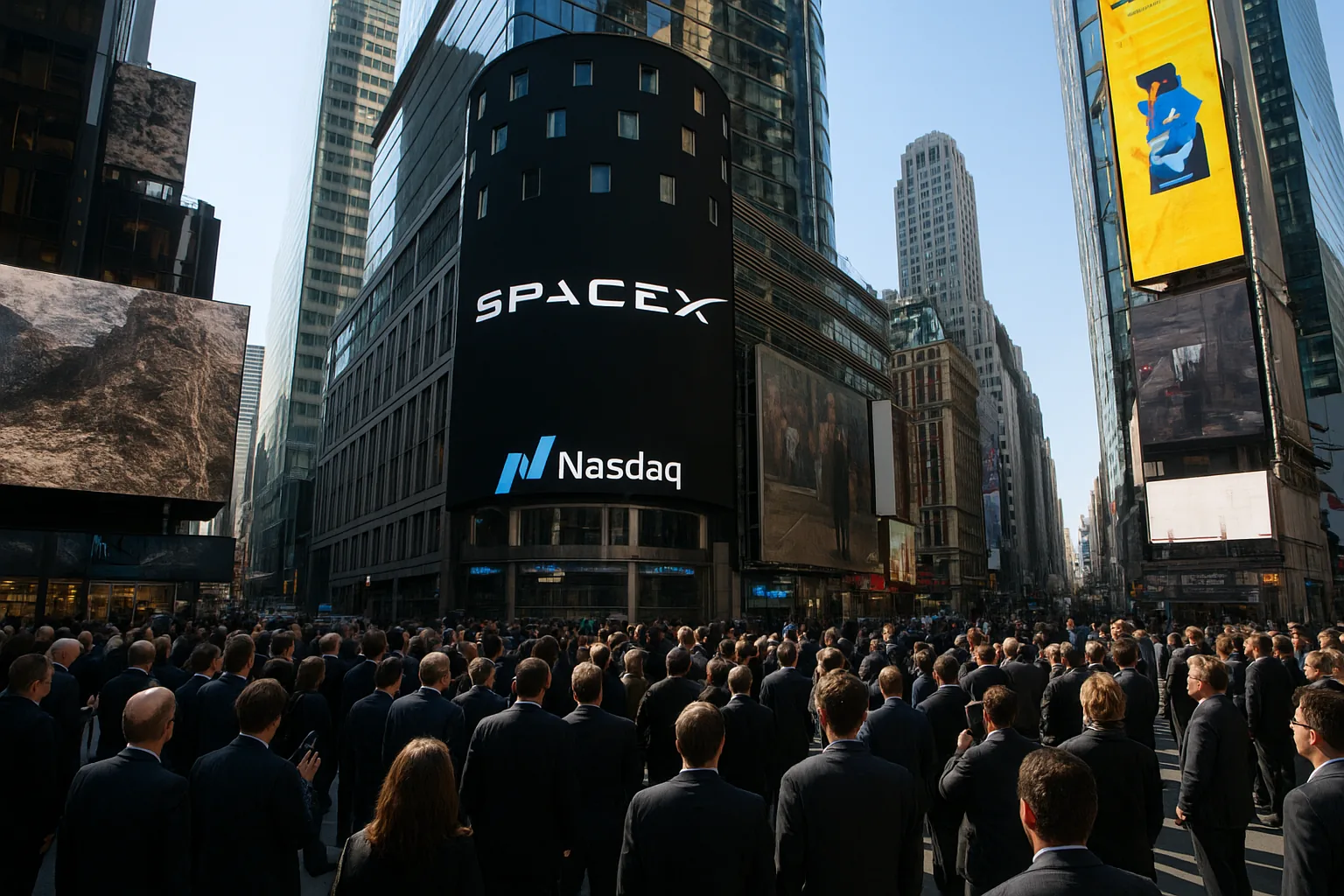
SpaceX stock rises after IPO: the math behind Musk’s trillion-dollar milestone
Musk entered the day already the world’s richest person, but the IPO pricing vaulted him across a line that had been purely theoretical. He holds roughly 4.8 billion Class B shares—about 42% of SpaceX’s economic interest—plus 350 million stock options struck at $8.39. At the $135 offer price, that stake was worth nearly $692 billion, bumping his total net worth to roughly $1.005 trillion before a single share changed hands. By midday, when SPCX printed $168.75, his fortune had swelled to about $1.1 trillion. Every dollar the stock moves adds or subtracts roughly $5.2 billion from his personal balance sheet.
SpaceX stock rises after Nasdaq debut, but European space firms lose altitude
The first-day surge sent tremors far beyond American exchanges. While Goldman Sachs shares rose more than 2% on its lead-left bookrunner role, specialist space stocks took a beating. Redwire fell 11.5%, Rocket Lab dropped 10%, and the Procure Space ETF slid 7%. The message was clear: institutional portfolios are making room for a $2 trillion gorilla, and they are doing it by selling the smaller names that had represented the sector until today.
European space players were not spared. Shares of Airbus and Safran edged lower in Paris, and the continent’s flagship Ariane 6 launcher—still working to ramp up a commercially viable cadence—now faces a competitor whose market cap is larger than the entire European space industry’s combined valuation. The IPO also jolted European retail investing, with platforms like Trade Republic and Scalable Capital reporting a surge in account openings and buy orders for SPCX. “Musk has done what years of financial literacy campaigns couldn’t,” one Frankfurt-based broker remarked dryly. The question for Brussels is whether this capital frenzy translates into more funding for homegrown launch startups or simply deepens the continent’s dependence on a single American supplier for critical space infrastructure.
The $2 trillion puzzle: a company with $18.7 billion in revenue and $5 billion in losses
For all the excitement, determining what SpaceX is actually worth remains a divisive exercise. The company reported $18.7 billion in revenue for 2025—largely from its Starlink satellite broadband business and launch services—but it also posted a net loss of nearly $5 billion. Cumulative losses from the start of 2025 through March 2026 reached $8.7 billion. At Friday’s closing price, SpaceX trades at roughly 110 times trailing revenue, a multiple that makes even the frothiest AI stocks look restrained. Morningstar’s discounted cash flow model pegs the fair value at $780 billion, less than half the IPO valuation, while CFRA initiated coverage with a sell rating on the day of the debut.
Supporters argue that Starlink’s subscriber growth—already over 4 million users globally—and the company’s dominance in orbital launch (more than 80% of mass launched in the last three years) create a foundation that is difficult to replicate. SpaceX also claims a total addressable market of $28.5 trillion, a figure that encompasses space-based communications, earth observation, and the as-yet-unrealized promise of interplanetary transport. “This is not a name you’re buying based on fundamentals,” said Nancy Tengler of Laffer Tengler Investments. “For me, the analogy is Amazon. This was a company that changed the way we live.”
Retail traders, Japanese institutions, and a greenshoe waiting to be exercised
Retail investors received about 20% of the allocation, far more than the typical IPO, but less than many had hoped given Musk’s massive following among small traders. CNBC reported that some individuals were allocated a single share. The scramble to buy in the open market helped drive volume above 500 million shares—roughly $80 billion in notional value—making SPCX the most actively traded debut in memory. Japanese institutional investors alone sought more than $6.2 billion worth of shares at the IPO price, Reuters reported, underscoring global demand.
The greenshoe option, which lets underwriters sell an additional 83 million shares at the $135 offer price, remains unexercised. Given the stock’s closing level, bankers at Goldman Sachs, Morgan Stanley, and the rest of the syndicate are almost certain to activate it, adding roughly $11.2 billion to the total proceeds. That decision will be made within 30 days. In the meantime, options on SPCX are expected to launch next week, adding another layer of volatility to a ticker that is already the talk of WallStreetBets and Reddit’s investing forums.
From paper trillionaire to the next wave of AI IPOs
Musk’s new status as the world’s first trillionaire is, for now, a paper achievement. If the stock falls below roughly $134 per share, his net worth slips back below the thirteen-figure mark. The milestone also drew sharp criticism: Oxfam’s Nabil Ahmed called it “a new Gilded Age” and noted that Musk is now wealthier than the bottom 46% of humanity—about 3.8 billion people. Within SpaceX, executives estimate that roughly 4,400 employees have become millionaires on paper since the IPO, a wealth creation event unmatched in the aerospace sector.
The debut sets the stage for a procession of mega-listings from AI heavyweights. Anthropic and OpenAI have both confidentially filed prospectuses with regulators, and market participants worry that a flood of multi-hundred-billion-dollar IPOs could drain liquidity from other sectors. For now, though, the SpaceX trade is absorbing whatever capital the market can throw at it. “We have to go back 100 years to get comparable entrepreneurs,” said Joel Shulman, CEO of ERShares. Europe has the engineers. It just hasn’t decided which country gets to pay them.
Sources
- Space Exploration Technologies Corp. amended S-1 registration statement, filed with the U.S. Securities and Exchange Commission
- Morningstar equity analyst report on SpaceX valuation, June 2026
- CFRA Research initiation note on SpaceX (SPCX), June 12, 2026
- Nasdaq listing data and trading volumes for SPCX, June 12, 2026




Comments
No comments yet. Be the first!