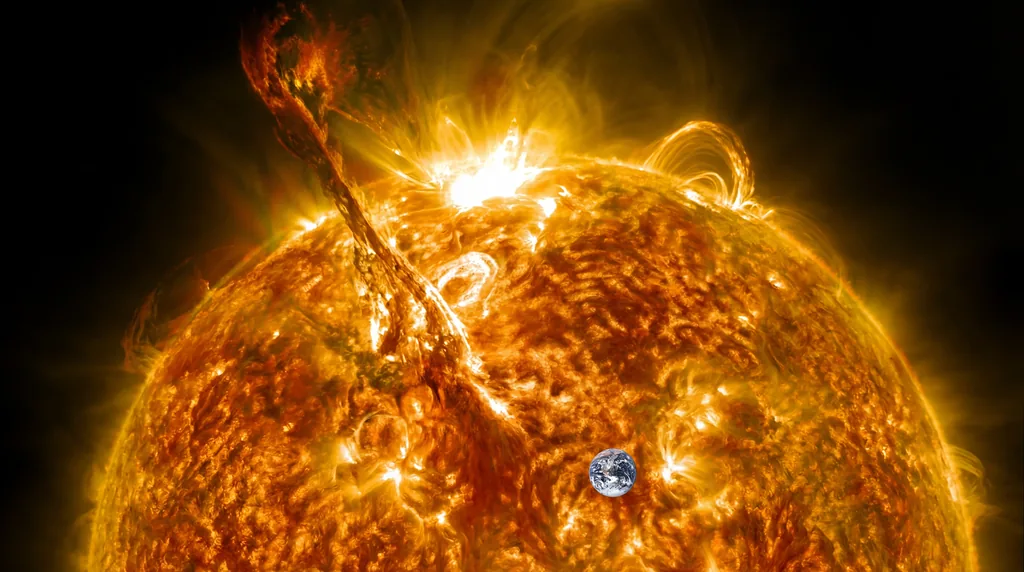

The recent X4.2 solar flare captured by NASA on February 4, 2026, is expected to trigger moderate auroral displays, classified as a G1-level geomagnetic storm, across several northern regions. While the flare itself is a burst of light and radiation, the associated solar activity has increased the Kp-index to 5, making the aurora borealis visible in locations such as Fairbanks, Alaska, and Stockholm, Sweden.
Will the recent solar flare cause auroras?
Yes, the solar activity following the X4.2 flare is likely to produce visible auroras in high-latitude regions. According to current space weather data, the storm reaches an intensity of Moderate (G1), with a visibility latitude of approximately 56.3 degrees. This level of activity means the aurora may be visible overhead in many northern areas rather than just on the horizon.
Observations from the Space Weather Prediction Center indicate that the best viewing times will occur between 10 PM and 2 AM local time. Enthusiasts are encouraged to find locations away from city light pollution and monitor local cloud cover for the best experience. The following regions are currently identified as primary viewing zones:
- Fairbanks, Alaska, USA (64.8° N)
- Reykjavik, Iceland (64.1° N)
- Tromsø, Norway (69.6° N)
- Stockholm, Sweden (59.3° N)
- Helsinki, Finland (60.2° N)
Can solar flares disrupt power grids?
Strong solar flares, particularly those in the X-class category, can significantly disrupt electric power grids and satellite operations. These eruptions release massive amounts of energy that, upon reaching Earth, can induce geomagnetically induced currents (GICs) in long-distance power lines, potentially damaging transformers and causing localized or widespread electrical outages if not properly managed.
The impact of the X4.2 flare extends beyond the power grid to the very fabric of modern communication. NASA researchers, including Monika Luabeya and Abbey Interrante, note that these bursts can interfere with high-frequency (HF) radio signals and GPS navigation. The sudden ionization of the upper atmosphere disrupts the timing of GNSS signals, which can lead to positioning errors critical for maritime and aviation navigation. Additionally, spacecraft in low-Earth orbit face increased radiation risks, requiring operators to monitor sensitive electronics and shield astronauts.
What does NASA’s Solar Dynamics Observatory show about the flare?
NASA’s Solar Dynamics Observatory (SDO) provides high-resolution imagery that reveals the X4.2 flare as a brilliant flash of extreme ultraviolet light. By observing the Sun in specific wavelengths, the SDO can highlight extremely hot material within the solar atmosphere, allowing scientists to track the movement of plasma and the reconfiguration of magnetic fields during an eruption.
The SDO mission is designed to measure the Sun’s properties and solar activity to improve our understanding of the star’s magnetic variability. The X4.2 classification represents the most intense category of flares, where the number 4.2 indicates its specific magnitude within that class. These observations are vital for heliophysics, as they provide the data necessary to model how solar energy travels through the heliosphere and affects the Earth’s magnetosphere.
The Progression of Solar Cycle 25
Solar activity is currently trending upward as Solar Cycle 25 approaches its predicted solar maximum. This 11-year cycle governs the frequency and intensity of sunspots, flares, and coronal mass ejections. The occurrence of an X4.2 event in early 2026 suggests that the Sun is entering a highly active phase, characterized by more frequent and powerful eruptions compared to the solar minimum observed several years ago.
Continuous monitoring by NASA and the National Oceanic and Atmospheric Administration (NOAA) is essential during this period. As the solar cycle peaks, the likelihood of super-flares increases, necessitating robust mitigation strategies for orbital infrastructure. The data collected from the February 4 event serves as a critical benchmark for refining solar weather models and improving lead times for future alerts.
Mitigation and Technological Resilience
Preparing for space weather events involves a multi-layered approach to protecting critical infrastructure on Earth and in orbit. Power grid operators utilize SDO data to implement load-shedding protocols or adjust voltages to accommodate induced currents. Meanwhile, satellite operators may put spacecraft into "safe mode" during peak radiation periods to prevent permanent hardware failure caused by high-energy particles.
The Solar Dynamics Observatory remains the primary sentinel in this defensive strategy, offering the early warning capabilities needed to safeguard the global economy. As our reliance on satellite-based technology and interconnected power systems grows, the insights gained from studying events like the X4.2 solar flare become increasingly vital. Future research will focus on the correlation between surface magnetic changes and the eruptive potential of active sunspot regions.
Future Directions in Heliophysics
Looking ahead, NASA aims to integrate SDO observations with data from other missions, such as the Parker Solar Probe and Solar Orbiter, to create a holistic view of solar physics. By studying the Sun from multiple vantage points, researchers hope to predict the onset of X-class flares with greater precision. This predictive capability is the "holy grail" of space weather science, potentially offering days of advance notice before a major eruption impacts Earth.
In the coming weeks, scientists will continue to analyze the magnetograms and spectral data from the February 4 eruption. These analyses will help determine whether the flare was accompanied by a significant Coronal Mass Ejection (CME), which could lead to further geomagnetic activity. For now, the focus remains on the breathtaking auroral displays and the continued resilience of our technological systems in the face of our star's immense power.




Comments
No comments yet. Be the first!