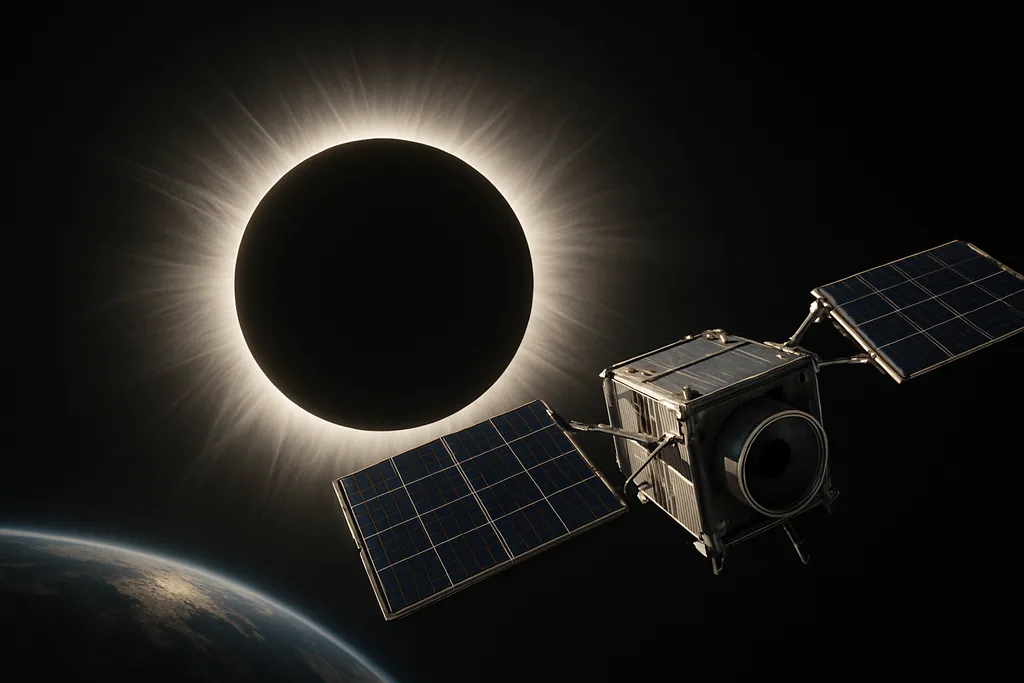
This week, new footage from a European demonstrator and a UK‑led mission concept sketched the near future of solar observation: artificial eclipses in space that let scientists watch the Sun’s outer atmosphere in long, steady light. On 21 January 2026 the European Space Agency shared a time‑lapse from Proba‑3 — twin satellites flying in tight formation to create a five‑hour artificial eclipse — showing three dramatic plasma eruptions. Two days later, researchers behind a concept called Mesom published a feasibility study proposing to use the Moon as a natural occulter to hold the bright solar disk out of view for almost an hour at a time, month after month.
Why blocking the Sun is the key to understanding storms
The Sun’s corona, a diffuse halo of million‑degree plasma, is the birthplace of the most dangerous space‑weather events: coronal mass ejections (CMEs) that hurl magnetised plasma into space and can disrupt satellites, GPS, power grids and communications on Earth. The corona is faint compared with the blinding light of the photosphere (the Sun’s visible surface), so to study the corona in detail observers need to remove that glare. Total solar eclipses on Earth do this naturally but briefly and unpredictably; coronagraphs — telescopes with internal disks that block the photosphere — reproduce the effect electronically but have limits in how close to the Sun they can reliably image.
Both approaches leave unanswered questions about how magnetic fields in the low corona create and release CMEs, and about the long‑standing coronal‑heating paradox: why the corona is hundreds of times hotter than the solar surface. Better, longer, higher‑resolution views of the inner corona would feed physical models and materially improve forecasting capability for events that can cost millions to billions of dollars when they strike critical systems on Earth.
Proba‑3: a formation‑flying proof of concept
Mesom: using the Moon as a perfect occulter
Mesom (Moon‑enabled Sun Occultation Mission) takes a different tack. Rather than relying on a deployed occulting disk or two formation‑flying satellites, Mesom proposes to put a small science satellite into the permanent shadow cast by the Moon as seen from a carefully chosen orbit. Because the Moon is nearly spherical and has no atmosphere to scatter light, it is an almost ideal natural occulting disk. The concept, led by teams at University College London’s Mullard Space Science Laboratory with partners at the Surrey Space Centre and other institutions, argues that lunar occultation can yield continuous, clean observations of the inner corona down to the chromosphere for observation windows up to 48 minutes — far longer than any terrestrial eclipse.
What new data could deliver
Longer, cleaner access to the low corona would help untangle how magnetic fields braid and reconnect, releasing stored energy as flares and CMEs. Observations that reach down into the chromosphere — the layer between the photosphere and corona where much of the CME initiation physics takes place — could connect surface magnetic maps with evolving coronal loops and eruptive events. That, in turn, would improve the physical inputs to operational space‑weather models used by satellite operators, power companies and aviation planners.
There are practical incentives. Historical events such as the 1989 Quebec blackout and the Carrington event of 1859 remind us how vulnerable modern infrastructure is. More recent episodes during 2024 and 2025 led to satellite altitude losses and GPS outages with substantial economic cost. Better forecasting grounded in direct observations of CME birth would allow earlier protective measures: reorienting satellites, powering down transformers, and warning operators to alter critical activities.
Technical and programmatic hurdles
Both formation flying and lunar occultation bring engineering challenges. Proba‑3 depends on centimetre‑level relative positioning and tight control of stray light inside the coronagraph; its success demonstrates the technique, but scaling a mission to full science operations requires larger payloads, longer mission durations and robust, autonomous control. Mesom has to thread a narrow needle in orbital design: finding repeatable windows in the complex Sun‑Earth‑Moon dynamics that permit stable occultation while supplying power, thermal control and communications.
Thermal management near the Sun, radiation shielding, precision pointing and data downlink capacity are all non‑trivial. Mesom’s proponents say these problems are solvable on a small‑sat budget if the mission is carefully designed and internationally partnered. The concept has already been submitted to the European Space Agency for consideration as a future mission in the 2030s, but funding, technical maturation and integration with other observatories remain to be resolved.
Complementary approaches across the solar fleet
Mesom and Proba‑3 would not replace other solar assets but complement them. Missions such as NASA’s Parker Solar Probe and ESA’s Solar Orbiter sample the near‑Sun environment from different vantage points; ground telescopes such as the Daniel K. Inouye Solar Telescope provide ultra‑high resolution of the photosphere and chromosphere; instruments mounted on low‑Earth orbit platforms (for example CODEX on the International Space Station) add further measurement modes. Combining data across these platforms, especially with prolonged eclipse‑quality views of the inner corona, is what scientists say will break through current limits.
Proba‑3’s recent images offered a preview of what extended clean views can reveal; Mesom promises an order of magnitude more time at those critical heights. If funded and built, a Moon‑occultation mission could transform how physicists study CME initiation and the coronal heating problem, and provide terrestrial operators with better warnings against disruptive space weather. The path ahead requires careful engineering, international cooperation and sustained investment, but the potential payoff — shielding modern infrastructure from rare but catastrophic solar storms — is clear.
Sources
- Surrey Space Centre (University of Surrey) — Mesom feasibility study
- UCL Mullard Space Science Laboratory — Mesom lead institution and proposal materials
- European Space Agency — Proba‑3 mission and coronagraph demonstrations
- UK Space Agency — feasibility funding for Mesom
- NASA — Parker Solar Probe and CODEX mission context
- Daniel K. Inouye Solar Telescope (national solar observatory partner institutions)




Comments
No comments yet. Be the first!