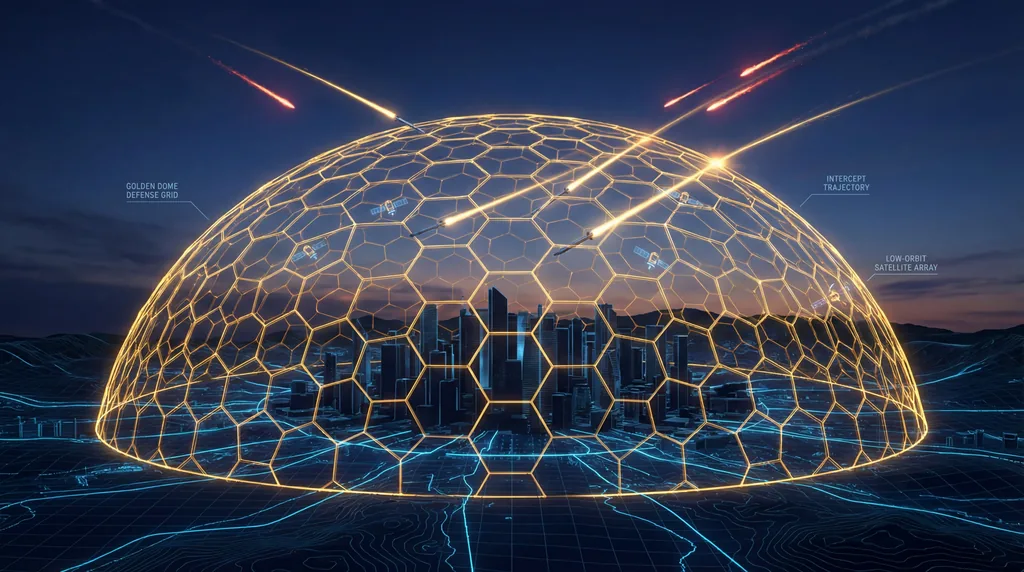

The Pentagon is adopting risk-tolerant buying for the Golden Dome program to overcome critical affordability hurdles and accelerate the development of defensive technologies in response to urgent hypersonic missile threats. This strategic pivot involves extensive acquisition reform, leveraging commercial technologies, and utilizing AI-driven command and control systems. By encouraging private sector investment and streamlining procurement, the Department of Defense aims to foster a "whole of industry" effort comparable to the scale of the Manhattan Project to restore strategic deterrence.
Why is the Pentagon adopting 'risk-tolerant' buying for Golden Dome?
The Pentagon is adopting risk-tolerant buying for Golden Dome to solve the dual challenges of cost and speed in the face of rapid adversary advancements in hypersonic and cruise missile technology. This model prioritizes iterative prototyping over multi-decade development cycles, allowing the military to integrate commercial-off-the-shelf (COTS) solutions while incentivizing private capital and startup innovation to achieve mass-producible defense architectures.
Marcia Holmes, the deputy program manager for Golden Dome, emphasized during the Miami Space Summit on February 5, 2026, that the initiative serves as a proving ground for Trump administration acquisition reforms. The traditional procurement culture, often criticized for being overly cautious and slow, is being replaced by a framework that rewards calculated risk-taking. By aligning with private capital markets, the Pentagon intends to expand the defense industrial base beyond traditional "prime" contractors to include agile startups and SmallSat Alliance members.
Affordability remains a central pillar of this new strategy, particularly regarding the cost per interceptor. General Michael Guetlein has noted that a large-scale missile defense architecture is only viable if the private sector can produce components at a significantly lower price point than legacy systems. This financial pressure necessitates a shift away from bespoke, government-only designs toward dual-use technologies that benefit from the economies of scale found in the commercial space sector.
Risk Tolerance in Defense Procurement
Defense acquisition reform is being tested through the Golden Dome initiative by moving away from "all-or-nothing" delivery models toward iterative prototypes. By accepting early-stage technical failures as part of the learning process, the Missile Defense Agency (MDA) can identify viable technologies faster. This approach minimizes long-term waste by terminating underperforming projects early while doubling down on high-performance innovations that meet modern battlefield requirements.
- Prize-based incentives are being utilized by Space Systems Command to attract non-traditional participants.
- Streamlined contracting models aim to reduce the bureaucratic burden on small businesses and tech startups.
- Regular communication with industry leaders ensures that government requirements align with current commercial capabilities.
- Modernizing the workforce involves restructuring the defense acquisition team to include experts in private equity and venture capital.
Commercial firms are already making strategic bets on this new model, investing in advanced propulsion and distributed sensor networks before formal requirements are even finalized. This proactive investment is encouraged by the Pentagon’s promise to be "easier to work with," as stated by Holmes. The shift represents a fundamental change in the public-private partnership, where the government acts as a high-volume customer rather than the sole funder of research and development.
How does Golden Dome differ from Israel's Iron Dome?
Golden Dome differs from Israel's Iron Dome by functioning as a global, multi-layered homeland defense network designed to intercept long-range ballistic, hypersonic, and cruise missiles. While Iron Dome is a tactical, short-range system optimized for localized rocket threats with high success rates, Golden Dome integrates space-based sensors and interceptors to defend the entire U.S. homeland and its interests from transcontinental threats.
The Golden Dome architecture is envisioned as a "layered" shield that operates across multiple altitudes and ranges. Unlike the point-defense nature of Iron Dome, this system utilizes a sophisticated web of ground-based interceptors, airborne sensors, and orbital tracking assets. The goal is to create a seamless integrated air and missile defense (IAMD) network that can engage threats during the boost, midcourse, and terminal phases of flight.
Legacy systems currently managed by the Missile Defense Agency will be integrated into the Golden Dome framework, but they will be augmented by a proliferated satellite layer. This orbital component is critical for tracking hypersonic glide vehicles that can maneuver within the atmosphere to evade traditional radar. By leveraging the Space Force’s emerging capabilities, Golden Dome provides a level of global situational awareness that short-range systems like Iron Dome are not designed to achieve.
Will Golden Dome include space-based interceptors?
Yes, Golden Dome will include space-based interceptors as a primary component of its layered defense strategy to enable boost-phase intercepts. Current executive orders and Pentagon planning documents call for a proliferated space layer consisting of hundreds of satellites capable of detecting, tracking, and physically destroying incoming missiles before they can release multiple reentry vehicles or decoys.
The orbital layer is essential because it provides the "high ground" necessary for early warning and tracking of advanced threats. According to Marcia Holmes, the use of space-based sensors allows for a data backbone that supports high-speed interception. These assets are being designed to work in tandem with AI-driven command and control systems, which can process massive amounts of telemetry data in milliseconds to coordinate a response across multiple domains.
Future directions for the program include the development of directed energy weapons and space-based intercept modules that align with commercial satellite manufacturing models. By producing interceptors in high volumes—similar to how companies like SpaceX or Kuiper produce communication satellites—the Department of War hopes to achieve the cost-efficiency required to sustain a permanent orbital defensive presence. This move toward mass manufacturing in space marks a significant departure from the expensive, one-off satellite programs of the past.
The Future of National Defense Acquisition
National defense acquisition is entering a new era where speed of relevance outweighs traditional risk avoidance. The Golden Dome model suggests that the future of the defense industrial base will rely heavily on dual-use technologies that serve both commercial and military purposes. This evolution ensures that the Pentagon can leverage the rapid innovation cycles of the private sector while maintaining the taxpayer accountability required for massive government programs.
The long-term implications of this shift could extend far beyond missile defense. If the Golden Dome acquisition model proves successful, it may be applied to other sectors such as cybersecurity, autonomous systems, and quantum computing. By lowering the barriers to entry for non-traditional firms, the Pentagon is revitalizing a defense industrial base that has long been dominated by a few large entities, thereby fostering a more competitive and resilient national security ecosystem.
Ultimately, the Golden Dome initiative represents a strategic bet on American innovation. By embracing private capital and risk-tolerant procurement, the Pentagon is attempting to outpace global competitors who are also investing heavily in next-generation weaponry. As the program moves from concept to deployment, the success of this "shining example" of acquisition reform will be measured not just by its technical efficacy, but by its ability to deliver peace through strength in an increasingly volatile global landscape.





Comments
No comments yet. Be the first!