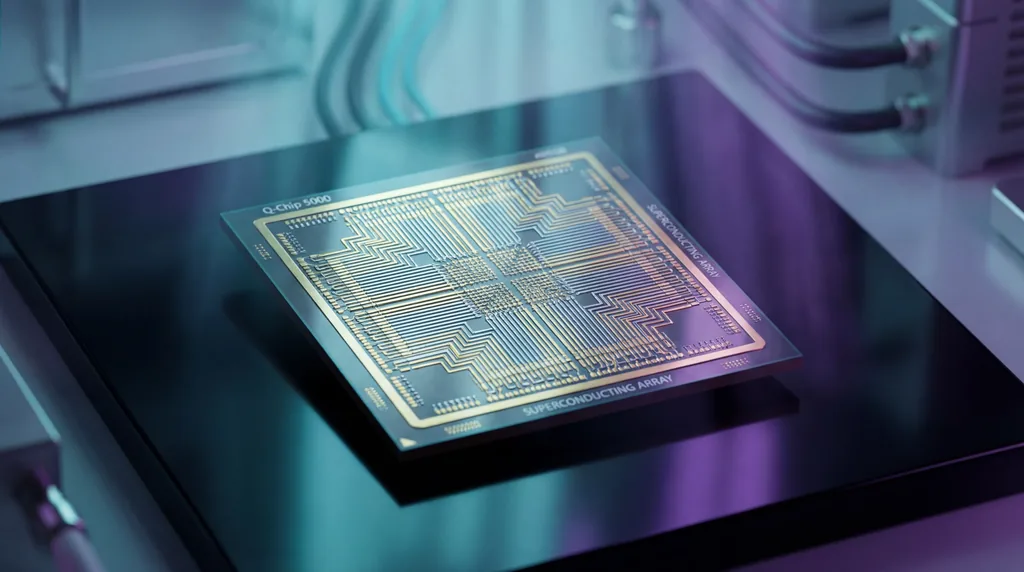

Resource-efficient digitized adiabatic quantum factorization works by mapping the mathematical problem of prime factorization onto a gate-based quantum processor using a modified digitized adiabatic protocol. By encoding the solution in the kernel subspace of a problem Hamiltonian rather than the traditional ground state, researchers Juan José García-Ripoll, Felip Pellicer, and Alan C. Santos have simplified the process into two-body interactions. This method reduces the circuit complexity and total gate count, allowing Quantum Computing systems to identify factors with higher fidelity and lower hardware overhead than previously possible.
The security of modern global communications relies almost entirely on the mathematical difficulty of factoring large integers, a principle known as RSA encryption. For decades, the complexity of this task has provided a robust shield against classical computational attacks. However, the emergence of quantum logic has introduced a theoretical threat to this standard. While Shor’s algorithm is the most famous quantum method for breaking RSA, its requirements for error-corrected, large-scale hardware remain out of reach for current technology. This has led researchers to explore adiabatic quantum computation as a more immediate, resource-efficient alternative for tackling factorization.
Current limitations in classical and standard quantum methods have necessitated a hybrid "middle ground" known as digitized adiabatic evolution. While Quantum Computing hardware is rapidly advancing, we currently reside in the NISQ (Noisy Intermediate-Scale Quantum) era, where qubit counts are low and noise levels are high. Standard adiabatic approaches often require long evolution times or complex multi-qubit interactions that the hardware cannot yet sustain. The new research addresses these hurdles by utilizing digitized gate sequences to simulate the continuous evolution of an adiabatic process, making the algorithm compatible with universal quantum computers.
What is the difference between analog adiabatic quantum computing and digitized versions?
Analog adiabatic quantum computing relies on the continuous-time evolution of a physical system to remain in its lowest energy state, while digitized versions use discrete quantum gates to approximate that same path. This digitization enables the implementation of adiabatic algorithms on universal gate-based Quantum Computing processors, such as those from IBM or Google, rather than being restricted to specialized quantum annealers like D-Wave.
The transition from analog to digital logic is more than just a change in hardware; it involves a fundamental shift in how the problem is encoded. The standard adiabatic factorization approach, pioneered by Peng et al. in 2008, utilizes Polynomial Unconstrained Binary Optimization (PUBO). This method often results in high-order interactions between qubits, which are incredibly difficult to implement in a digital circuit. In contrast, the methodology proposed by García-Ripoll and colleagues shifts the encoding from the ground state to the kernel subspace of the problem Hamiltonian. This shift allows the problem to be expressed through Quadratic Unconstrained Binary Optimization (QUBO), which only requires two-body interactions.
By moving to a QUBO formulation, the researchers have effectively "flattened" the complexity of the quantum circuit. In a PUBO model, a single gate might need to act on three or four qubits simultaneously to represent a mathematical term. In the refined QUBO model, these are broken down into simpler, pairwise operations. This reduction in complexity is vital for maintaining quantum coherence, as every additional qubit interaction increases the likelihood of environmental noise decohering the system and ruining the calculation.
Is digitized adiabatic quantum factorization feasible on current NISQ hardware?
Digitized adiabatic quantum factorization is feasible on current NISQ hardware because it significantly lowers the total number of gates and qubit connections required for execution. By demonstrating the factorization of integers up to 8 bits on existing systems, the research proves that simplified QUBO models can overcome the noise and connectivity limitations inherent in today's Quantum Computing devices.
Resource efficiency is the primary metric of success for algorithms operating on NISQ hardware. The gate-demanding costs of standard quantum factorization often exceed the "coherence budget" of modern processors, meaning the system loses its quantum properties before the calculation finishes. The new algorithm mitigates this by drastically reducing the total gate count required for the adiabatic evolution. According to the study, the reduction in circuit depth—the number of sequential operations—directly correlates with increased fidelity, or the accuracy of the final answer.
The researchers illustrated the performance of their algorithm by implementing the factorization of integers up to 8 bits, showing a substantial improvement over the PUBO formulation. The key highlights of their findings include:
- Reduced Circuit Complexity: Fewer gates are required to reach the solution, minimizing the window for error.
- Two-Body Interactions: The shift to QUBO eliminates the need for complex, multi-qubit gates that are prone to high error rates.
- Improved Solution Fidelity: The algorithm more consistently identifies the correct prime factors compared to traditional adiabatic methods.
- Scalable Encoding: The kernel subspace approach provides a blueprint for tackling larger integers as hardware improves.
What are the implications for future cybersecurity?
The timeline for RSA vulnerability is accelerating as these optimized resource requirements lower the barrier for quantum attacks. While we are not yet at the stage where 2048-bit RSA keys can be cracked, the shift toward resource-efficient algorithms suggests that the "quantum threat" may arrive sooner than classical estimates predicted. This research reinforces the urgent need for post-quantum cryptography (PQC) standards to protect global data infrastructure.
Future directions for this research involve applying shortcuts to adiabaticity (STA) to further compress the time required for the quantum system to reach the correct answer. By speeding up the evolution, researchers can "outrun" the noise that plagues NISQ hardware. As Juan José García-Ripoll and his team continue to refine these digitized protocols, the landscape of Quantum Computing will likely move toward these hybrid models that combine the best of adiabatic theory with the precision of digital gate logic. The era of quantum-resistant encryption is no longer a distant theoretical concern; it is a current engineering necessity.




Comments
No comments yet. Be the first!