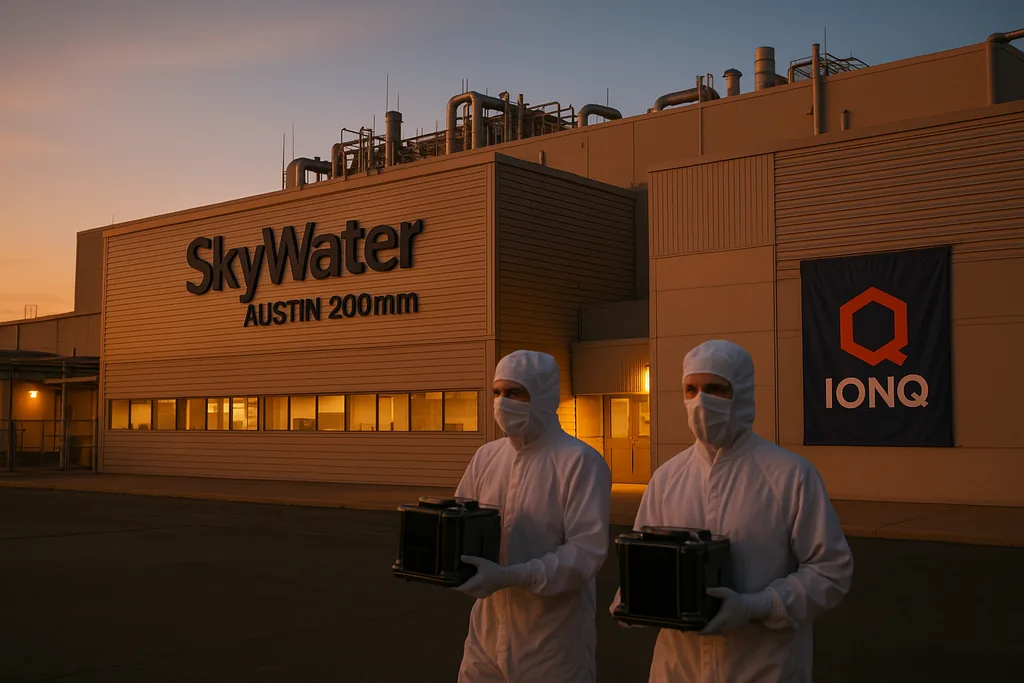
IonQ's big bet on chips — the deal
On Monday, Jan. 26, 2026, College Park, Maryland–based quantum computing company IonQ announced it will acquire Minnesota contract manufacturer SkyWater Technology for $1.8 billion in a cash-and-stock transaction. The companies said SkyWater shareholders will receive $35 per share — a package composed of $15 in cash and $20 in IonQ stock — and that SkyWater will continue to operate under its current name with Thomas Sonderman remaining as CEO. The acquisition is expected to close in the second or third quarter of 2026.
Deal terms and market reaction
The structure — part cash, part equity — signals IonQ's willingness to issue stock to finance a rapid expansion of industrial capability. SkyWater shares traded up as much as about 6.5% after the announcement, reflecting the premium in the offer. IonQ stock, by contrast, finished the day lower: the company's shares ended the session down roughly 8.2% after an initial small rally, a reaction analysts and investors often interpret as concern about purchase price, dilution, or integration risk when a technology acquirer pays a sizable premium for manufacturing capacity.
Company statements framed the move as strategic rather than opportunistic. Niccolo de Masi, IonQ's chairman and CEO, said the deal "enables IonQ to materially accelerate its quantum computing roadmap and secure its fully scalable supply chain domestically." Bloomberg's reporting includes on-camera comments from de Masi describing the acquisition as a step to bring more of IonQ's hardware supply chain under company control.
Why a quantum company is buying a chipmaker
At first glance the purchase looks like a branch-line merger of two different industries: one a developer of trapped-ion quantum systems, the other a specialty semiconductor foundry. But the gap between quantum hardware and advanced semiconductor manufacturing has been narrowing for several years. Quantum systems require custom control electronics, bespoke application-specific integrated circuits (ASICs), precision packaging and, in some architectures, microfabricated ion traps or photonic components — all areas where reliable, steady-volume domestic manufacturing matters.
SkyWater is not a consumer-chip brand; it operates as a contract manufacturer and foundry. In 2025 the company bought a 200mm semiconductor manufacturing facility in Austin from Infineon Technologies, and it now employs roughly 1,000 people there. That facility — and SkyWater's broader speciality-process capabilities — gives IonQ a foothold in U.S. wafer production and packaging infrastructure without building a greenfield fab from scratch.
Put bluntly, owning a foundry reduces the operational friction and geopolitical exposure that can slow the scaling of quantum hardware. For companies pursuing low-latency supply lines, proximity to fabrication, test and packaging shortens the calendar between design and deployment — a crucial advantage when companies race to improve qubit count, fidelity and system reliability.
Policy context and onshoring pressure
The deal lands in a policy environment that places a premium on domestic semiconductor capacity. U.S. federal and state initiatives over recent years have pushed to onshore more chip production on national-security and industrial-policy grounds. States like Texas have also moved to cultivate quantum and semiconductor ecosystems: last year, Texas enacted a law creating a Texas Quantum Initiative that supporters including IonQ's de Masi publicly back. The White House and legislative momentum around subsidies, procurement and industrial policy have turned ownership of production assets into a strategic asset for technology firms working with government customers.
IonQ already holds U.S. government contracts, including work for the Department of Defense, and the company has framed this transaction as a way to secure "a fully scalable supply chain domestically." For a firm that sells to corporate, academic and government research labs, that argument is both commercial and political.
What this means for Austin and SkyWater
SkyWater's Austin site — the former Infineon 200mm fab — is central to the local angle of the deal. The facility opened under SkyWater ownership in 2025, and most of the company's local workforce is based there. IonQ's CEO Niccolo de Masi also maintains ties to Austin: he is an Austin resident who has publicly advocated state-level support for quantum investment. With the acquisition, IonQ gains immediate access to a U.S. mid-scale wafer line and the staff and process knowledge that come with a working fab.
SkyWater will remain a named operating entity after the acquisition and keep its CEO, according to the announcement. That preserves continuity for customers and employees and suggests IonQ sees value in keeping the foundry's commercial relationships and technical know-how intact while moving to align production priorities with its quantum roadmap.
Risks, integration challenges and the financial picture
Manufacturing is capital-intensive, operationally complex and subject to long lead times. Turning a contract fab into a reliable, scale-up engine for a quantum systems company won't be instantaneous. Analysts caution that the market's initial negative reaction to IonQ shares reflects familiar concerns: whether IonQ overpaid, how much capital and management attention the integration will require, and whether IonQ's shareholders will accept the trade-off between near-term dilution and longer-term control of supply.
IonQ has already been active on the deal front: the company struck a major agreement last year to acquire Oxford Ionics for more than $1 billion and announced earlier purchases including Lightsynq Technologies and Capella Space. That acquisition streak signals an aggressive growth strategy but also raises the normal questions about execution risk when a technology company moves into industrial-scale manufacturing.
What to watch next
Key milestones to monitor over the coming months include regulatory approvals, the precise timeline for integrating SkyWater's Austin operations with IonQ's hardware supply chain, and whether IonQ can demonstrate faster hardware iteration or cost improvements that justify the acquisition premium. For Austin and the broader U.S. chip ecosystem, the deal will be a test case in whether vertical integration between quantum hardware developers and contract manufacturers accelerates commercial deployment.
For investors and policymakers alike, the acquisition will be judged on outcomes rather than intent: will IonQ use SkyWater to reduce supply-chain risk, speed product upgrades and protect sensitive capabilities from foreign-market volatility? Or will the integration divert cash and attention from the core science and systems engineering that underpins quantum advantage? The answers will emerge through production reports, contract wins and — ultimately — the performance of IonQ's quantum systems in the field.
Sources
- IonQ (company announcement and press materials)
- SkyWater Technology (company materials)
- Infineon Technologies (previous owner of the Austin 200mm facility)
- U.S. Department of Defense (contracting context)




Comments
No comments yet. Be the first!