

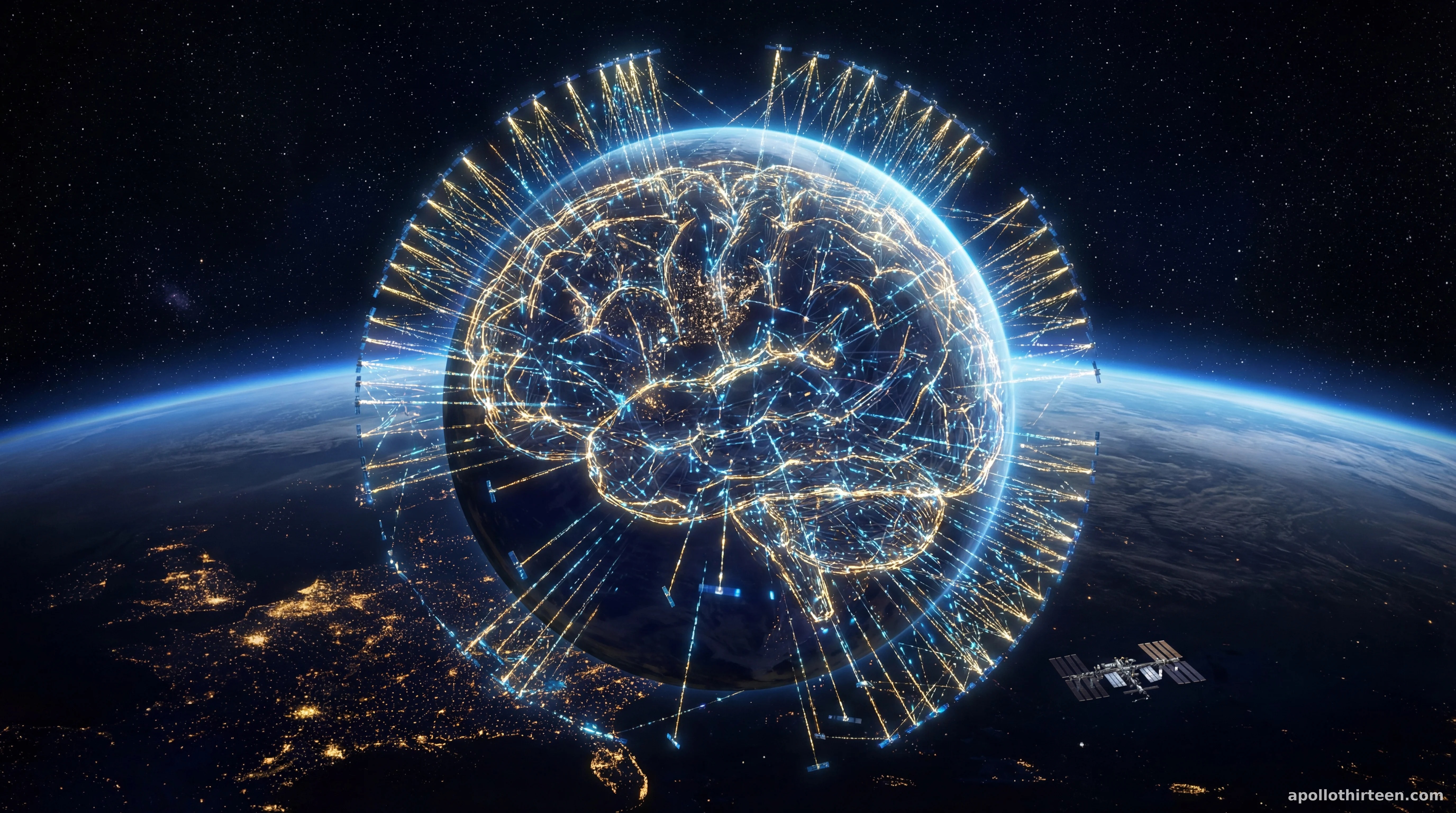
On February 2, 2026, SpaceX officially announced the acquisition of xAI, marking a paradigm shift in the aerospace industry by integrating advanced artificial intelligence with orbital infrastructure. This strategic merger aims to deploy a one-million satellite constellation that functions as a decentralized "orbital brain," providing the massive computational power required for artificial general intelligence (AGI). By leveraging the rapid launch capabilities of Starship, the new entity intends to bypass the physical and environmental limitations of terrestrial data centers to create a globally accessible, space-based superintelligence.
How many satellites does SpaceX currently have vs the 1 million goal?
SpaceX currently operates approximately 6,000 Starlink satellites in low-Earth orbit, meaning the new goal of 1 million satellites represents a 166-fold increase in fleet size. This unprecedented expansion will transition the company from a telecommunications provider to a global high-performance computing powerhouse. To achieve this scale, the company will rely on the Starship launch system, which is designed for high-frequency, heavy-lift missions capable of deploying hundreds of satellites per launch.
The progression from the current Starlink architecture to a million-unit constellation reflects a fundamental change in SpaceX's business model. While the existing fleet focuses on broadband connectivity, the proposed "v3" or "AI-class" satellites will be equipped with specialized GPU-accelerated hardware and high-bandwidth optical inter-satellite links. According to senior space editor Eric Berger of Ars Technica, the integration of xAI into SpaceX allows for a vertically-integrated engine that combines space-based internet with real-time information processing. This massive scale is necessary to support the "next book" of the company’s mission, which seeks to extend the light of consciousness through a sentient sun of computing power.
Managing a constellation of this magnitude requires a revolutionary approach to satellite manufacturing and orbital logistics. SpaceX plans to utilize its Texas-based "Starbase" and Florida launch sites to maintain a near-continuous launch cadence, effectively treating satellite deployment as a commodity. The transition to a million units will be phased, starting with orbital data center prototypes that test the thermal and radiation resilience of AI chips in the harsh environment of space. This roadmap suggests that the company is no longer just building a network, but a planetary-scale computer.
Can AI be powered by a satellite constellation?
Yes, artificial intelligence can be powered by a satellite constellation by utilizing high-speed optical laser links to create a distributed neural network across thousands of orbital nodes. This architecture allows for decentralized processing, where individual satellites act as neurons in a global "orbital brain," minimizing the need for data to return to Earth for computation. By processing information in low-Earth orbit (LEO), the system can provide low-latency AI services to any point on the globe simultaneously.
The technical feasibility of space-based AI hinges on optical inter-satellite links (OISLs), which allow satellites to communicate at the speed of light in a vacuum. This satellite mesh networking bypasses the congestion and physical distance limitations of undersea fiber-optic cables, enabling xAI’s models to aggregate data from disparate sources—such as direct-to-mobile devices and real-time sensor arrays—instantly. The acquisition announcement highlights that this integration will support the world’s foremost real-time information platform, providing xAI with a proprietary hardware advantage that no terrestrial competitor can match.
Furthermore, shifting AI training and inference to orbit addresses the "compute bottleneck" currently facing the tech industry. As large language models (LLMs) and AGI research require exponentially more power, terrestrial grids are struggling to keep up with demand. A million-satellite constellation offers a unique solution: distributed high-performance computing that scales linearly with the number of satellites launched. By spreading the computational load across a massive orbital fleet, SpaceX can achieve a level of hardware redundancy and global coverage that ensures the AI remains resilient against local infrastructure failures or geopolitical interference.
What are orbital data centers?
Orbital data centers are specialized satellites designed to host high-performance computing hardware in space, utilizing the vacuum for passive cooling and solar arrays for direct energy harvesting. Unlike Earth-bound facilities that require massive amounts of water and electricity for cooling, these units leverage the thermal sink of deep space to dissipate heat. This makes them an environmentally sustainable alternative for power-hungry AI training processes.
The transition to orbital data centers represents a significant engineering shift for SpaceX. Traditional data centers on Earth face massive "heat-rejection" challenges; however, in the vacuum of space, satellites can use large-scale radiators to beam infrared heat away from the sensitive electronics. This allows for higher power density in the chips themselves. The primary advantages of this approach include:
- Direct Solar Energy: Satellites can harvest solar power nearly 24/7 without atmospheric interference or weather disruptions.
- Passive Cooling: The ambient temperature of space provides a natural heat sink, reducing the mechanical complexity of cooling systems.
- Environmental Decoupling: Moving heat loads off-planet prevents the localized warming and water consumption associated with terrestrial AI hubs.
- Global Proximity: Orbital data centers in LEO are physically closer to mobile users in remote areas than traditional server farms.
By integrating xAI's software with SpaceX's hardware, the company intends to create a "sentient sun" of compute—a metaphorical description of a massive, glowing shell of intelligence surrounding the Earth. In an email to employees, Elon Musk emphasized that these data centers will build upon proven space sustainability designs, ensuring that the hardware is as efficient as it is powerful. This move signals the beginning of an era where the "cloud" is no longer a metaphor for terrestrial servers, but a literal description of orbital assets.
How will a 1 million satellite constellation affect space debris?
A 1 million satellite constellation raises significant concerns regarding the Kessler Syndrome, but SpaceX plans to mitigate this through automated collision avoidance and stringent end-of-life disposal protocols. Each satellite will be designed to de-orbit naturally using atmospheric drag or active propulsion at the end of its operational lifespan. This ensures that the orbital environment remains sustainable despite the unprecedented density of the proposed fleet.
Critics of large constellations often point to the risk of space debris and the potential for a chain reaction of collisions that could render LEO unusable. To counter this, SpaceX has implemented an autonomous collision avoidance system that uses real-time tracking data to nudge satellites out of harm's way without human intervention. The acquisition of xAI likely enhances this capability, as machine learning algorithms can predict orbital perturbations and potential conjunctions with far greater accuracy than traditional ballistic models.
Furthermore, the "sustainability design" mentioned by SpaceX includes using materials that completely burn up upon reentry into Earth's atmosphere. This "zero-debris" philosophy is critical for a constellation of one million units. As satellites reach the end of their five-to-seven-year life cycles, they will be replaced by newer, more efficient AI-compute nodes, creating a continuous cycle of hardware evolution. By maintaining a vertically-integrated supply chain, SpaceX can ensure that every component launched is accounted for, from deployment to disposal, minimizing the long-term impact on the space environment.
The Strategic Roadmap to Global AI Sovereignty
The merger of SpaceX and xAI is not merely a corporate consolidation; it is a move toward technological sovereignty on a planetary scale. By controlling both the launch vehicle (Starship) and the computational platform (the satellite constellation), the combined entity can operate independently of national power grids and terrestrial internet regulations. This vertically-integrated innovation engine allows for the rapid deployment of Artificial General Intelligence that is accessible to anyone, anywhere, potentially democratizing superintelligence while concentrating immense power in a single private entity.
The roadmap for this project involves several key technical milestones over the next decade. Initial phases will focus on launching Starlink v3 satellites equipped with the first generation of xAI's orbital chips. These will serve as a proof-of-concept for the satellite mesh networking required for distributed AGI. As Starship reaches its full operational capacity, the launch volume will scale exponentially, aiming to hit the one-million mark by the mid-2030s. This timeline reflects Musk's vision of "extending the light of consciousness," suggesting that the ultimate goal is to provide the intelligence needed for future Mars colonization and deep-space exploration.
Regulatory hurdles remain the primary challenge to this vision. Organizations such as the Federal Communications Commission (FCC) and the International Telecommunication Union (ITU) will need to navigate the complexities of licensing a million-satellite fleet. Issues ranging from astronomical interference to radio frequency allocation will require intense negotiation. However, with the acquisition of xAI, SpaceX has signaled that it views these challenges as secondary to the goal of creating the "most ambitious innovation engine on and off Earth." The "next book" in the SpaceX saga has begun, and its pages are written in the code of orbital intelligence.




Comments
No comments yet. Be the first!