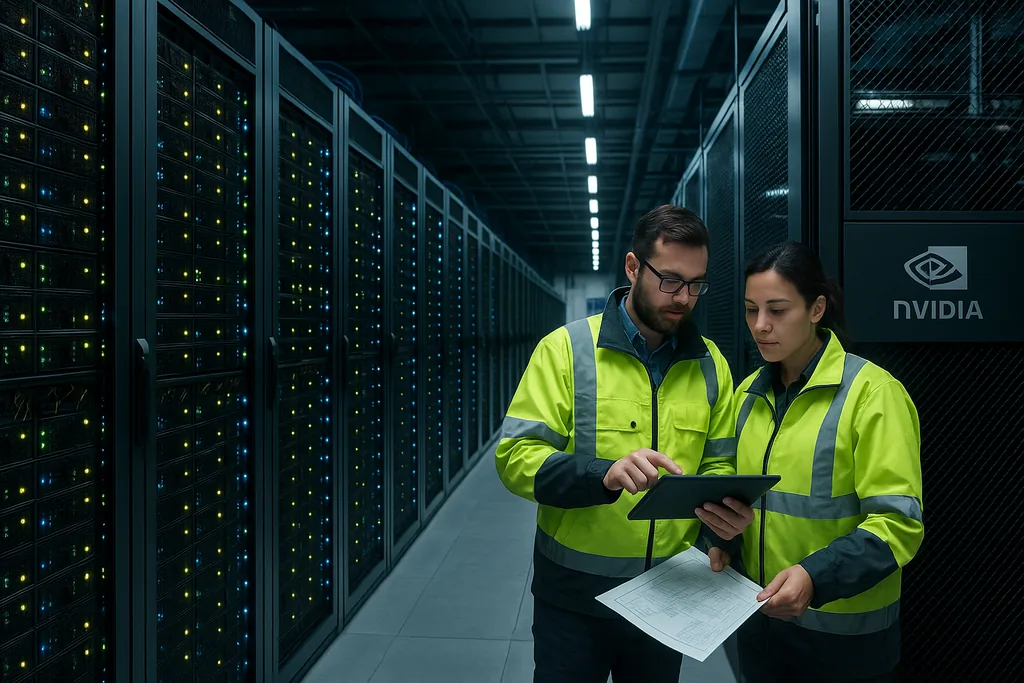
Nvidia’s $2 billion push lands on CoreWeave
On January 26, 2026, Nvidia announced a fresh, high‑profile extension of its relationship with CoreWeave — a $2 billion commitment intended to accelerate the speciality cloud provider's buildout of what Bloomberg described as multi‑gigawatt AI factories. Alongside the cash, broadcasters and market summaries flagged that Nvidia is offering new chips and closer operational collaboration to get capacity online faster. The package comes amid a broader scramble for data‑centre GPU capacity, tighter memory supply dynamics and investor scrutiny as earnings season for large tech companies gets under way.
The $2B arrangement and its stated goals
Public summaries of the deal say Nvidia’s money is earmarked to help CoreWeave scale tens of thousands of training GPUs and add roughly 5 gigawatts of data‑centre power capacity dedicated to AI workloads. That scale is significant: modern training rigs and the associated cooling and power infrastructure consume hundreds of kilowatts per rack, so a five‑gigawatt buildout implies thousands of racks and a global installation program rather than a single data centre.
Bloomberg’s coverage notes that Nvidia also offered new chips as part of the broader commercial relationship, while other outlets and market commentary tied the announcement to recent moves across the supply chain — for example, new high‑bandwidth memory production ramps that affect how quickly GPU makers can ship complete systems. CoreWeave’s business model is specialised: it operates a GPU‑first cloud focused on training and inference for large AI models, which makes it a strategic partner for companies that need flexible, GPU‑dense capacity without relying on the hyperscalers’ public clouds.
What 5GW of AI compute actually means
When industry participants talk about gigawatts in this context they are referencing installed electrical capacity rather than raw compute FLOPS. A 5GW target is mostly about power provisioning — substations, transformers, uninterrupted power feeds and cooling — that permit dense racks of GPUs to run for model training and inference. Translating watts into GPUs depends on the generation and power envelope of the accelerators deployed, but the headline figure signals a buildout on the scale typically associated with major cloud regions rather than a single campus.
That matters operationally and politically: large power draws require permits, long‑lead electrical work and often local utility negotiations. It also matters commercially because capital flows into long‑lived infrastructure create durable advantages — whoever controls pockets of tightly integrated compute, power and software tooling will be harder to dislodge.
Chips, memory and the supply chain squeeze
But it interacts with persistent supply constraints. High‑bandwidth memory (HBM) — the stacked DRAM packages that sit next to GPUs — is a recurring bottleneck. Recent industry announcements pointing to mass production ramps for HBM4 and other memory generations have cropped up in the same conversations, and analysts say memory availability will determine how quickly whole systems can ship regardless of GPU wafer output. If a GPU arrives without HBM availability, it cannot be assembled into a server‑class unit suitable for training.
Market reaction and strategic incentives
Financial markets reacted quickly. Commentary across trading desks and post‑market updates noted a mixed reaction: the deal highlights Nvidia’s dominance in the AI supply chain, but investors also parsed the timing against upcoming earnings and the capital intensity of large infrastructure projects. In some sessions Nvidia’s share price moved modestly lower after the announcement as traders weighed short‑term macro pressures against the longer‑term thesis that Nvidia captures an outsized share of AI‑related spending.
Strategically, the investment advances two objectives for Nvidia. First, it locks in a high‑volume, high‑visibility customer that will take new GPU generations and likely expose more enterprise workloads to Nvidia’s full stack — hardware, drivers and management tools. Second, it helps create distributed capacity beyond the hyperscalers, which can reduce single‑point dependency risks in the market and create new end‑points for model developers who prefer or need a specialist GPU cloud.
Competition, consolidation and the cloud landscape
CoreWeave is one of several specialist providers that have emerged to offer GPU‑dense infrastructure. Hyperscalers — Amazon, Microsoft and Google — continue to expand their own offerings, and there are chip challengers pursuing different performance and cost points. Nvidia’s capital infusion blurs the line between vendor and customer, raising questions about vertical integration and competition: will other cloud providers accept a Nvidia‑affiliated supplier for capacity, and how will competing silicon vendors respond?
Beyond vendor dynamics, the move is part of a wider trend where hardware vendors, cloud operators and memory suppliers form tight, long‑term partnerships to avoid the stop‑start cycles of past GPU ramps. That effort also connects to unrelated consolidation in adjacent hardware markets: quantum firms announcing large M&A moves, and memory manufacturers signing production schedules, all influence the timing and economics of AI deployments.
Risks and the regulatory angle
Investing in a customer or partner at this scale invites scrutiny. Observers will watch antitrust regulators and institutional customers for signs of concern about preferential access to chips, pricing advantages, or unfair exclusion of competitors. On the operational side, building 5GW of capacity requires local permits and sustained capital; cost overruns, utility limits or community objections are common project risks.
There is also a reputational element: as AI compute becomes concentrated, questions about who controls large pools of model training infrastructure — and the governance around how models are trained and deployed — gain prominence. Those governance questions are still nascent in policy forums but are moving toward the attention of regulators and large corporate customers.
What to watch next
In the near term, three things will determine whether the deal shifts the market: first, how quickly CoreWeave converts the capital into deployed racks and live GPU capacity; second, whether Nvidia truly supplies priority access to new GPU classes or merely accelerates the cash flows; and third, whether memory and other supply‑chain constraints — particularly HBM production ramps — keep pace.
For investors and competitors, the broader implication is clear: AI infrastructure is now a strategic battleground where silicon, memory, power and real estate intertwine. Deals like this accelerate one winner’s business model while forcing others to re‑evaluate partnerships, pricing and capacity strategies.
The coming quarters will show whether this kind of vertically integrative play becomes standard practice in the AI economy or whether counter‑moves from hyperscalers, regulators or rival chipmakers reshape the field.
Sources
- Nvidia — investor relations and corporate press materials (January 2026)
- CoreWeave — corporate announcements regarding capacity buildout and partnerships
- Samsung Electronics — statements on HBM4 production ramp and memory supply
- IonQ and SkyWater Technology — corporate transaction filings and press release on acquisition terms




Comments
No comments yet. Be the first!