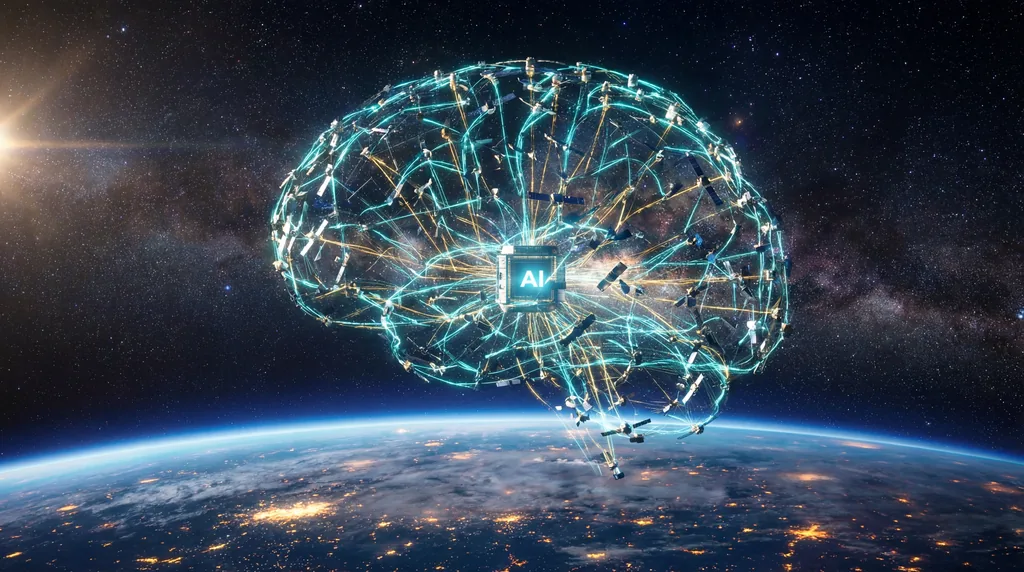

In a move that could redefine the global infrastructure of the digital age, SpaceX filed plans with the Federal Communications Commission (FCC) on January 30, 2026, to launch a massive constellation of one million satellites dedicated to orbital data processing. This unprecedented proposal aims to solve Earth's escalating power and cooling crises by relocating high-intensity Artificial Intelligence (AI) compute tasks into low Earth orbit (LEO). By utilizing near-constant solar energy and the natural thermal sinks of the space environment, the company intends to build a distributed "orbital data center" that bypasses the limitations of terrestrial electrical grids.
How will the orbital data centers solve Earth's power and cooling problems?
SpaceX orbital data centers solve Earth’s power and cooling problems by harnessing unfiltered solar radiation for energy and utilizing the vacuum of space for passive thermal management. This approach eliminates the massive water consumption and carbon footprint associated with cooling land-based server farms. By moving compute-heavy workloads to orbit, the system reduces the strain on aging terrestrial electrical grids currently struggling to meet AI demands.
According to the filing authored by Jeff Foust for SpaceNews, the proposed system would operate at altitudes between 500 and 2,000 kilometers. The satellites are designed to reside in sun-synchronous inclinations, ensuring they remain in sunlight more than 99% of the time. This constant exposure allows for uninterrupted solar power generation, a feat impossible for ground-based facilities restricted by weather patterns and the day-night cycle. The company argues that the "lowest cost to generate AI compute" will soon shift from Earth to space due to these inherent environmental advantages.
The environmental impact of traditional data centers has become a critical bottleneck for tech giants. Terrestrial facilities require millions of gallons of water for cooling and gigawatts of electricity, often sourced from non-renewable grids. SpaceX claims that its orbital alternative will achieve "transformative cost and energy efficiency" while significantly reducing the ecological footprint of the digital economy. This shift represents a fundamental pivot from using satellites merely for data transmission to using them as the primary engines of data processing.
The Kardashev Scale and Humanity's Future
In a striking piece of scholarly justification, the SpaceX filing frames this million-satellite constellation as a vital step toward becoming a Kardashev Type II civilization. This classification refers to a society capable of harnessing the total energy output of its parent star. By placing a million processors in orbit, the company seeks to maximize the utilization of the sun’s energy before it even reaches Earth’s atmosphere. This long-term vision aligns with Elon Musk’s broader goals of ensuring a multiplanetary future for humanity.
- Solar Efficiency: Direct harvesting of solar power without atmospheric interference.
- Thermal Management: Passive cooling in the vacuum of space reduces mechanical complexity.
- Grid Independence: Decouples AI growth from the constraints of the U.S. and global electrical grids.
Will the million satellites cause orbital clutter or visual pollution?
SpaceX intends to mitigate orbital clutter by deploying the million-satellite constellation in "largely unused orbital altitudes" and utilizing automated de-orbiting protocols. The company argues that its experience with the Starlink mega-constellation provides the necessary operational expertise to manage a fleet of this scale safely. However, the sheer volume of hardware raises significant concerns regarding collision avoidance and the impact on ground-based astronomy.
The scale of this project is truly historic, dwarfing all previous satellite proposals. For context, China recently filed for two constellations totaling nearly 200,000 satellites, and Rwanda previously proposed a 300,000-satellite system. SpaceX's leap to one million satellites represents a five-fold increase over the largest competing plans. To manage this density, the company plans to use intersatellite optical links (lasers) to maintain a seamless mesh network, allowing the satellites to communicate and coordinate positions with millisecond precision.
To address regulatory hurdles, SpaceX has requested a waiver of the standard FCC milestone requirements. Typically, operators must deploy half of their constellation within six years. Given the scale of a million units, the company argues that these rules—originally designed to prevent "spectrum warehousing"—should not apply, as they will use Ka-band spectrum on a non-interference basis. This regulatory maneuvering is essential for a project that lacks a definitive deployment schedule but requires massive initial authorization.
How much computing power will the million-satellite constellation provide?
The million-satellite constellation is projected to provide AI processing capacity that could eventually surpass the total electricity consumption of the entire United States economy. By leveraging the massive payload capacity of the Starship launch vehicle, SpaceX plans to deliver unprecedented "tonnage to orbit" in the form of high-density compute hardware. This infrastructure would support real-time Edge Computing and AI-driven applications for billions of users globally.
Integration with existing Starlink infrastructure is a cornerstone of the technical plan. While the new data center satellites will perform the heavy computational lifting, the current Starlink fleet will act as the high-speed relay system, carrying processed data back to ground stations. This two-tier architecture allows for low-latency processing, as data can be computed in orbit and "downlinked" to the nearest user, rather than traveling halfway around the world to a terrestrial server farm.
The strategic timing of this filing coincides with rumors of SpaceX pursuing an initial public offering (IPO) in the summer of 2026. Analysts suggest that the shift toward orbital compute could raise tens of billions of dollars in capital. Furthermore, the convergence of SpaceX hardware with Elon Musk’s other ventures, such as xAI and Tesla, suggests a future where autonomous vehicles and AI models are trained and powered by a proprietary celestial supercomputer.
Technical Specifications and Infrastructure
While the FCC filing was light on specific mass and dimensions, several technical pillars were identified as essential for the success of the orbital data center:
- Optical Laser Links: Primary method for high-throughput, low-latency communication between compute nodes.
- Ka-Band Backup: Used primarily for telemetry, tracking, and command (TT&C) on a non-interference basis.
- Starship Deployment: The only launch system capable of the volume and frequency required to orbit a million units.
- Sun-Synchronous Orbits: Specialized paths that keep satellites in the "dawn-dusk" transition for maximum power.
What’s Next for Orbital Compute?
The transition from a "data transmission" company to a "data processing" powerhouse marks a new era for SpaceX. If the FCC grants the requested waivers and authorizations, the next phase will involve test deployments of specialized "compute-heavy" Starlink variants. These satellites will likely feature larger solar arrays and advanced liquid-to-radiator thermal systems to handle the heat generated by AI processing chips. As terrestrial data centers face increasing regulatory and environmental pushback, the vacuum of space may become the new silicon valley.
The implications for the Artificial Intelligence industry are profound. By moving the "brains" of AI into orbit, SpaceX could offer compute-as-a-service at a price point that undercuts terrestrial giants like Amazon and Google. This project not only addresses the physical limits of Earth's resources but also establishes a strategic high-ground for the next century of digital evolution. As the filing concludes, this is the "first step" toward a future where the constraints of Earth no longer dictate the speed of human innovation.




Comments
No comments yet. Be the first!