A market report forces a new reality this week
On 29 January 2026 ResearchAndMarkets published a wide-ranging forecast that places artificial intelligence (ai)-driven battery systems at the centre of a fast-growing industry. The report projects the specialised AI-enabled battery technology market to climb from roughly $3.6 billion in 2025 to $8.4 billion by 2030, and it arrives alongside an earlier ResearchAndMarkets energy-storage study and a larger battery-market analysis that together sketch a crowded, strategic field.
The number crunching is stark but the story behind it is concrete: electric-vehicle adoption, utility-scale storage for renewables, pressure to extend battery life and new rack-level energy designs for AI data centres are all demanding software as much as cells. That convergence is where artificial intelligence (ai)-driven battery systems move from lab demos to commercial value—optimising charge cycles, spotting anomalies and scheduling maintenance in ways hardware alone cannot.
Artificial intelligence (ai)-driven battery market outlook
The forecasts differ in scale but not in direction. ResearchAndMarkets expects an 18.4% CAGR for the narrowly defined AI-driven battery technology market through 2030; a separate ResearchAndMarkets study focused on AI in energy storage estimated the broader AI-enabled energy-storage market at $8.82 billion in 2025, rising toward the mid-double digits by the end of the decade. Meanwhile, Precedence Research — looking at the entire battery-technology market — frames a larger context: battery technology as a whole is set to pass $250 billion by 2034.
These layered projections underscore two things. First, AI is a value layer that can be applied to many existing battery products and markets — from consumer electronics to megawatt-scale grid storage — rather than a single new product. Second, investment is following the problem: vendors and utilities are paying for software that reduces costs and risk at system scale. That is why 2026 deals and standardisation conversations are likely to have outsized impact on how quickly vendors win customers.
Artificial intelligence (ai)-driven battery applications and mechanics
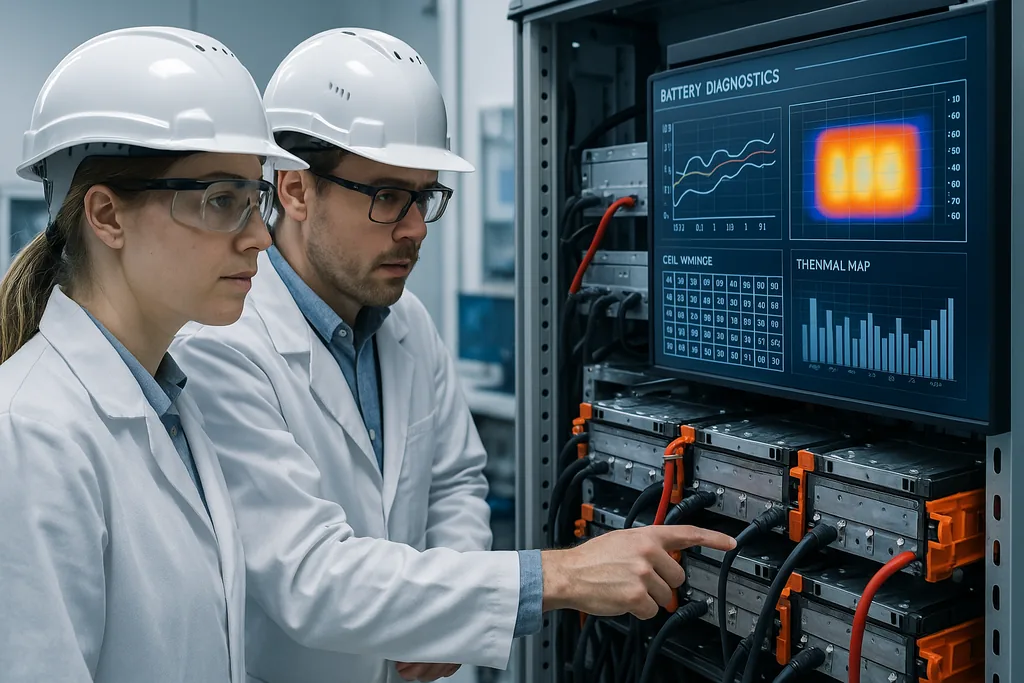
How does AI improve batteries in practice? The techniques fall into several recurring buckets: cell- and pack-level prognosis, charge-curve optimisation, anomaly detection for safety, and materials discovery. On the operations side, machine learning models consume telemetry from hundreds of cells and predict capacity fade days, weeks or months ahead. That capability drives predictive maintenance—replacing modules before they fail, scheduling formation and calibration steps in manufacturing to lift yield, and tailoring charging protocols to extend calendar life.
AI also helps with charging speed and safety. Adaptive charging algorithms balance fast-charge expectations with thermal limits: instead of applying the same aggressive current profile to every pack, an AI-driven battery management system (BMS) measures internal impedance, temperature gradients and usage history, then computes the fastest safe charge. For electric vehicles this reduces range anxiety without increasing fire risk; for grid assets it improves usable energy throughput and reduces degradation costs.
On materials and design, generative models and high-throughput experiments accelerate discovery of electrode formulations and separators with better safety margins or lower reliance on constrained critical minerals. Companies and labs use these methods to screen chemistries that would be costly or slow to evaluate by trial alone.
Standards, safety and hyperscale data centres
Industry moves in late 2025 and early 2026 show how AI-enabled battery systems are reaching beyond vehicles and home storage. KULR Technology joined the Open Compute Project as a Platinum member and is pitching rack-level Battery Backup Units engineered for 800V AI racks and strict thermal-propagation control. The OCP ORV3 roadmap formalises moving energy storage closer to AI compute — a radical architectural shift that places safety, telemetry and energy intelligence inches from multi-million dollar GPU systems.
Those developments matter because hyperscalers set de facto standards for scale and reliability. If rack-integrated storage becomes common, operators will demand BBU-level diagnostics, continuous telemetry and AI-based orchestration that coordinates batteries across racks and sites. That is precisely the product space where artificial intelligence (ai)-driven battery solutions can add recurring value: energy quality, transient response and lifecycle cost savings.
Who’s building what — players and strategies
The market maps are familiar: OEMs and cell makers — Tesla, Panasonic, BYD, CATL, LG, Samsung SDI — still dominate cell supply, but a thriving software and systems ecosystem is forming around BMS, prognostics and orchestration. ResearchAndMarkets and Precedence Research both list major automotive and battery firms alongside software specialists and start-ups focused on diagnostics and second-life solutions.
Corporates are buying capabilities: earlier acquisitions (for example General Motors' 2023 purchase of an anomaly-detection start-up) and supplier partnerships show OEMs want direct control over pack diagnostics. New entrants, such as specialist BMS vendors and energy-platform companies, compete on models that turn telemetry into service revenues — longer warranties, performance guarantees and second-life programmes for retired EV packs used as grid storage.
How AI helps predict degradation, extend life, and optimise charging
Extended-life gains come from smarter charge scheduling, cell balancing and dynamic derating during stressful operating conditions. For fleets and utilities, this translates into deferred replacement capex and more predictable residual value for second-life markets. For consumers and EVs, the benefit is a combination of longer usable battery life and better day-to-day range management.
Markets, risks and policy frictions
Regulation and standards matter too: moving storage into server racks creates new safety and interconnection rules. Companies that combine thermal engineering with AI-based monitoring will be better positioned to meet those requirements and earn the trust of hyperscalers and utilities.
What to watch next
Expect three near-term inflection points. First, standardisation around rack-integrated BBUs and ORV3-like specifications will determine whether hyperscalers adopt distributed rack storage at scale. Second, commercial pilots that quantify warranty extension and LCOE improvements for AI-managed packs will decide whether customers pay for AI features as a subscription. Third, continued progress in AI-driven materials screening could shift the chemistry landscape, lowering cost and improving safety.
For decision-makers the takeaway is pragmatic: artificial intelligence (ai)-driven battery solutions are not a speculative overlay but a cost-and-risk toolset. Where telemetry and compute integrate with manufacturing and lifecycle programmes, the technology delivers measurable returns — and that is why market forecasts are clustering on rapid growth in the years ahead.
Sources
- ResearchAndMarkets (Artificial Intelligence (AI)-Driven Battery Technology Market Report 2026)
- ResearchAndMarkets (Artificial Intelligence (AI) Energy Storage Solution Global Market Report 2025)
- Precedence Research (Battery Technology Market report)




Comments
No comments yet. Be the first!