survival prevention: rethinking bike — a new safety posture on two wheels
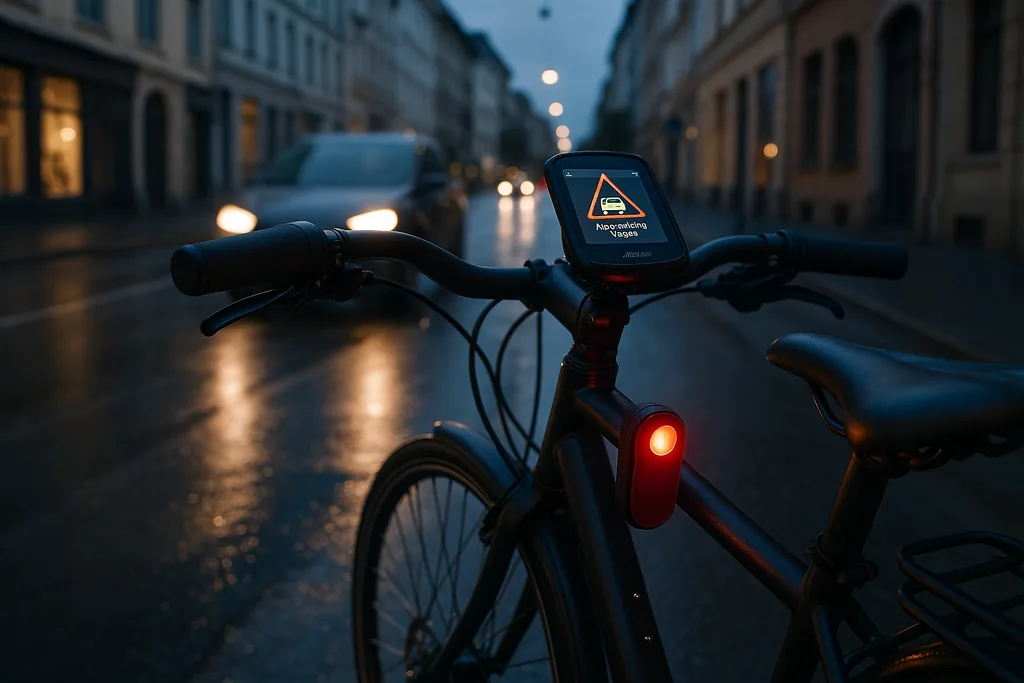
On a damp weekday morning in Cologne a commuter hears a short chime from a small red bar on her seatpost and slows without turning her head. The bar’s radar has already flagged a fast-approaching car from 80–150 metres behind, increased its light output, and sent the alert to the bicycle computer on her handlebars. That single, split-second nudge — the moment between awareness and reaction — captures an industry shift neatly summarised as survival prevention: rethinking bike safety with radar. Consumer radar lights that used to be niche have matured into a practical layer of collision prevention, while larger players and city authorities are testing radar at scale to nudge the balance of risk away from reactive survival and toward proactive prevention.
survival prevention: rethinking bike — consumer radars, how they help
Over the last few years radar has moved from military and automotive niches into the pack-mounted taillight. Modern units combine a short-range FMCW radar with LEDs and a low-power compute stack. Devices from established cycling brands now advertise vehicle detection out to roughly 120–150 metres under ideal conditions and pair with bike computers or phones to give audio and visual alerts; some newer systems even provide light and audio cues without a head unit. Reviews and product testing show these units routinely detect vehicles early enough to give riders extra reaction time while also boosting visibility through brighter tail and brake patterns when a vehicle approaches.
How does that translate into safety on the road? Radar improves situational awareness in two concrete ways. First, it extends the rider’s “sense” behind them without the need to look over the shoulder during complex traffic manoeuvres — useful for commuters, cargo-bike riders and e-bike users who frequently carry loads. Second, it augments conspicuity: the light output or flash pattern can change automatically when a vehicle is closing, making the cyclist more visible to drivers who might otherwise not notice them. Independent gear tests and buyer guides now list radar among essential safety accessories for on-road riders.
Commercial availability and product forms
There are broadly two product approaches. One is compact radar-taillights that rely on an external cycling computer or smartwatch to show approaching-vehicle icons; the other packages radar with interactive front and rear lights that produce audible or visual alerts directly on the bike, removing the need for a screen. Recent entrants have focused on longer runtimes, USB‑C charging and firmware over-the-air updates — practical improvements that help adoption by everyday riders. Real-world reviews note comparable detection performance among the market leaders, while feature differences (battery life, mounting, companion app capabilities) are now a major purchase factor.
Engineering limits and urban challenges
Radar is not a magic bullet. The physics that make radar powerful also impose limits that matter on a bicycle. Radar systems detect reflections — their ability to ‘see’ an object depends on radar cross-section (RCS), relative speed (Doppler), antenna aperture and the signal‑to‑noise environment. Small form factors on bikes restrict antenna size and so limit angular resolution; in dense urban street canyons multipath reflections from buildings and parked cars produce ghost targets and false positives. Rain and other adverse conditions lower signal strength and make detections less consistent. Engineers compensate with signal filtering, multi-frame tracking and, increasingly, machine learning tuned to radar signatures — but trade-offs remain between sensitivity (don’t miss a car) and specificity (don’t overwhelm riders with false alarms).
Other practical issues matter for cyclists on the street. Carbon-fibre frames and light alloy wheels change the reflection profile compared with steel or aluminum, and some infrastructure detectors (like inductive loops at traffic lights) can fail to register cyclists because they rely on conductive mass rather than movement signatures. The upshot is familiar: technology can improve awareness, but a device’s limits — and how riders use it — shape its real-world safety value.
Common failure modes and mitigations
From devices to systems: industry and infrastructure
Beyond standalone accessories, radar is moving into vehicle and infrastructure ecosystems. Mobility suppliers are using forward-facing radar in motorcycles and larger two-wheelers to provide adaptive cruise, collision warnings and emergency braking aids — a sign that radar-based prevention is gaining traction across vehicle classes. Bosch, for example, has announced a new generation of radar-based rider assistance features for motorcycles that the company says could help prevent a meaningful fraction of accidents when widely deployed. That momentum matters: if vehicle systems and cyclist devices share detection semantics or standardised alerts, the whole system becomes more forgiving of human error.
Cities are experimenting too. Co-operative detection systems — from in-road piezo or loop detectors to camera and radar installations at junctions — are being piloted to give cyclists priority at lights or warn drivers of a cyclist’s presence. Glasgow’s deployment of cycle-activated detection and warning signs is one practical example where detection tech was used to reduce vehicle–cycle conflicts at key junctions. Those projects illustrate that prevention requires both on-rider sensors and infrastructure redesign.
Why sensor fusion is the next stage
Engineers and researchers increasingly see a hybrid approach as the path to reliable prevention: combine radar’s robustness in poor lighting and adverse weather with camera vision for classification and LiDAR or map priors for geometric precision. Academic groups working on radar object-detection and cross-modal fusion show that combining radar with image data and semantic 3D-model priors can improve cyclist and pedestrian detection in complex urban scenes — research that points to more dependable alerts and fewer false alarms when implemented on efficient edge platforms.
Practical advice for riders and cities
For individual riders, radar is best understood as another defensive layer: it doesn't replace road awareness, good positioning or protective infrastructure, but it does reduce the cognitive load and catch threats you might miss. Choose a device that fits your ride style: commuters benefit from stand‑alone radar+light kits that don’t require a head unit, while sport riders might prefer strap-on radar that integrates with an existing computer. Expect firmware updates and incremental improvements — these units get smarter with better software and datasets.
For cities and planners, the lesson is systemic: prevention scales when fast, low-cost rider sensors are paired with smarter intersections and better driver awareness campaigns. Detection at the infrastructure level — from higher-resolution loops to cooperative roadside sensors — remains a practical, sometimes overlooked, part of moving from survival to prevention.
Where this technology goes next
Expect three converging trends over the next five years. First, device improvements: longer battery life, better antennas, and more efficient SoCs will raise the baseline reliability of consumer radars. Second, smarter fusion: lightweight neural models trained on larger, multimodal datasets will reduce false alarms and better separate pedestrians, cyclists and cars. Third, ecosystem alignment: vehicle manufacturers, accessory makers and city traffic systems will increasingly share interfaces and alert standards, making warnings more consistent and easier to act on. None of this eliminates the need for safer road design, but the combination of on-body detection and system-level prevention could materially reduce a large class of rear-end and lateral collisions.
Radar for bicycles is now less an exotic gadget and more a practical tool in an expanded safety toolbox — one that reframes the problem from surviving crashes to preventing them. The technology still has limits, and it will fail without better infrastructure, clearer standards and continued research. But when radar alert becomes as ordinary as a reflector at the back of a bike, the chances of turning near-misses into uneventful commutes go up considerably.
Sources
- Bosch press materials (radar-based rider assistance systems)
- TU Delft — Intelligent Vehicles Group (publications on radar-based road-user detection)
- Glasgow City Council / Q-Free cycling safety project materials (city-level detection pilots)
- New South Wales Government guidance on bicycle detection at traffic lights (inductive loop behaviour)




Comments
No comments yet. Be the first!