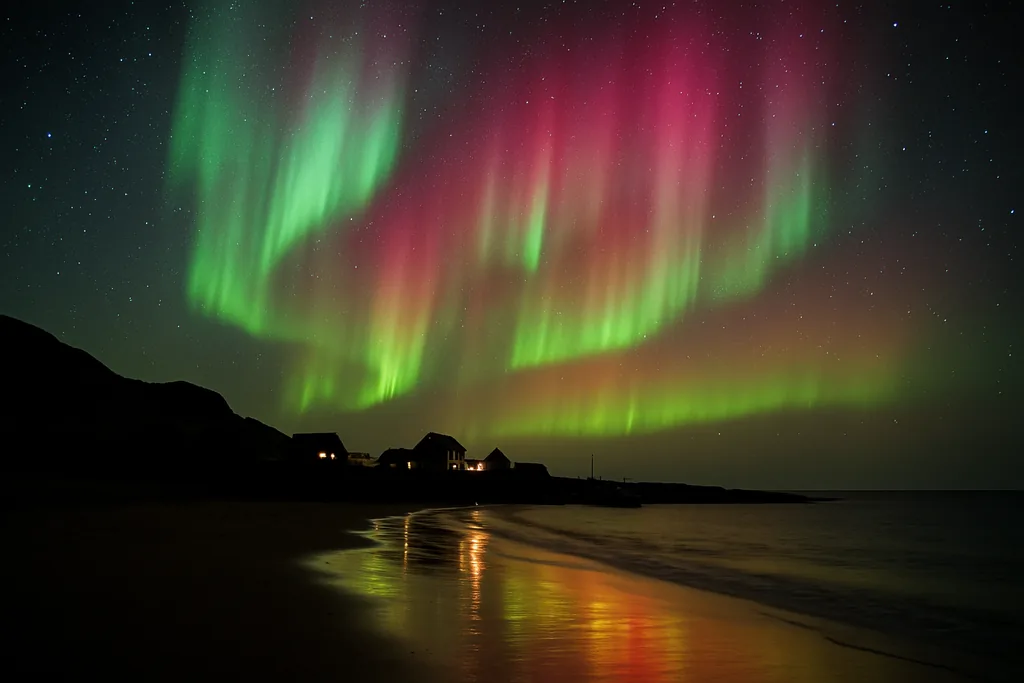
Monday's vivid aurora across Britain
On the evening of 20 January 2026, skies from Scotland to the south coast were painted in bands of green, pink and even scarlet as the Aurora Borealis staged one of the brightest displays seen in the UK in years. Amateur photographers and security cameras recorded sweeping curtains and diffuse glows over coastal towns, moorland and the Channel Islands; social feeds flooded with images from Haddington in East Lothian to Formby and Meols on the Merseyside coast. Many viewers described an intense, surreal twilight as the usual stars and streetlights were briefly upstaged by an otherworldly skyline.
Solar cause: a strong coronal mass ejection
The spectacle was the visible side effect of a coronal mass ejection (CME) — a vast cloud of charged particles hurled out from the Sun — that struck Earth's magnetic environment earlier in the day. Meteorological and space-weather services reported the event as a severe geomagnetic storm, with some monitoring scales rating the disturbance at G4 on a 1-to-5 scale. This kind of storm pushes the auroral oval — the usual high-latitude belt where aurorae occur — equatorward, making the lights visible at much lower latitudes than usual.
Space weather forecasters say the display is a symptom of the current solar maximum, the more active phase of the Sun's approximately 11-year cycle. Solar maximum means more sunspots and a higher probability of CMEs and large flares aimed toward Earth. Forecasters in the Channel Islands and the UK noted that the present maximum has produced an above-average number of sunspots and energetic eruptions, increasing the chances of dramatic aurora events over the next months.
Why the aurora glowed pink, green and red
The colours photographed over Britain arise from very familiar atomic physics playing out tens to hundreds of kilometres above our heads. When charged solar particles spiral along Earth's magnetic field and collide with atoms in the upper atmosphere, those atoms are excited and release light as they return to lower energy states. Oxygen, at altitudes around 100–300 km, commonly emits the familiar emerald-green hue. Nitrogen interactions can produce deep reds and magentas and sometimes blue or pink edges depending on the energies involved and the altitude.
Photographers noted particularly vivid pinks and scarlets in places — evidence that nitrogen excitation was unusually strong in parts of the auroral curtain. Camera sensors can also be more sensitive to faint colours than the human eye at night, which is why some scenes appear even richer in long-exposure images.
Where the lights were seen
Observers reported sightings across northern and western Scotland, Northern Ireland, Wales and broad swathes of England, with particularly striking images coming from the Merseyside coast and parts of the south-west. The Channel Islands saw strong coloured displays too; meteorological officials there highlighted that such equatorward incursions are more likely during particularly active solar maxima. In some parts of continental Europe the aurora reached as far south as northern Italy, southern Spain and the French Côte d'Azur during the peak of the storm.
That geographical reach is significant: under normal conditions the aurora is confined to high latitudes near the Arctic and Antarctic circles. Only the largest geomagnetic storms push the lights into mid-latitudes, and when they do, the event becomes a rare and widely visible sky show for many urban areas.
Technology, safety and potential impacts
Although aurora displays are harmless to people on the ground — our atmosphere blocks the dangerous high-energy radiation — geomagnetic storms can interfere with technology. Power grids can experience induced currents, high-frequency radio communications and long-range navigation systems like GPS can be degraded, and satellites can be affected by charged-particle bombardment and by disturbances in the near-Earth plasma environment. Aviation authorities and satellite operators routinely monitor space weather alerts and may take operational precautions during strong storms.
National meteorological and space-weather services issued advisories around the event; they stressed that while the lights themselves are a spectacle, the underlying storm warranted attention from infrastructure operators. For most people the practical consequence was simply a spectacular sky and, at worst, some short-term glitches to radio or positioning services that utility and communication managers are trained to handle.
How to watch and photograph an aurora
For anyone chasing aurora, experienced observers recommend heading to dark locations away from city lights and looking northward for a faint glow before the colours intensify. Clear skies are essential; a thin veil of cloud can wash out the view. Cameras frequently reveal colours that are barely perceptible to the naked eye, so using a tripod, a wide-angle lens and long exposures will increase the chance of capturing what your eyes might miss.
Timing matters too. Forecasters often point to the late-night hours — around midnight local time — as the optimum window because that is when Earth’s night-side magnetic connection to the impinging solar wind often favours brighter, more structured aurora. However, very strong storms can produce vivid shows earlier in the evening, which is what many UK photographers recorded on 20 January.
Why this period is unusual
We are in the thick of a solar maximum that has already produced several high-profile eruptions and active periods. Forecasters in the Channel Islands and in UK services noted that this particular maximum has been especially lively. That makes the next months an unusually rich stretch for aurora hunters in Europe and at mid-latitudes worldwide, until the Sun gradually relaxes toward the next solar minimum.
Events like this also provide a reminder of how closely coupled our planet is to solar activity. The same physical process that creates a breathtaking light show can, under different circumstances, create technical challenges for a highly electrified, satellite-dependent society — which is why continued monitoring of the Sun and coordination between space-weather services and infrastructure operators remains important.
For now, residents on both sides of the Irish Sea and in island communities had a rare, memorable night: ordinary streets and beaches briefly became the stage for magnificent curtains of light driven by activity 150 million kilometres away on the surface of the Sun.
Sources
- Met Office (UK national meteorological service)
- University of Lancashire (solar-physics commentary)
- Jersey Meteorological Section
- Roscosmos (spacecraft/cosmonaut observations)




Comments
No comments yet. Be the first!