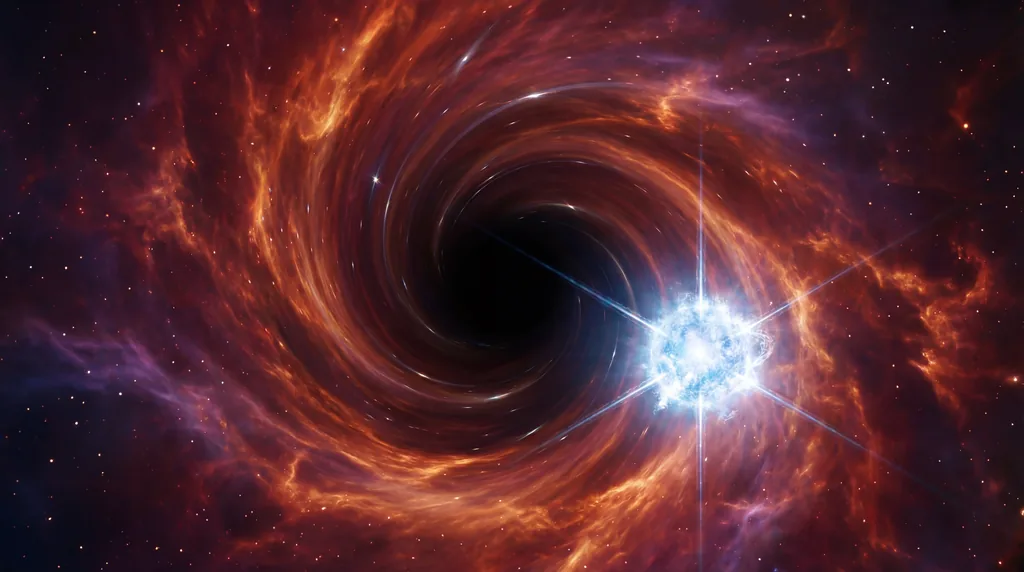

M31-2014-DS1 is a massive, hydrogen-depleted supergiant star in the Andromeda Galaxy that brightened in mid-infrared light in 2014, then faded dramatically by factors of over 10,000 in optical light by 2023, becoming undetectable. Observations indicate its core collapsed directly into a stellar-mass black hole in a failed supernova event, with most of the stellar envelope falling back rather than exploding outward, leaving a faint infrared glow from surrounding dust and gas.
The discovery of M31-2014-DS1 marks a pivotal moment in observational astrophysics, as it provides the strongest evidence yet for a phenomenon that has long remained theoretical. Kishalay De, an astrophysicist and professor at Columbia University and researcher at the Flatiron Institute, led the team that stumbled upon this "astronomical unicorn." Published in the journal Science on February 12, 2026, the study suggests that the universe may be populated by far more "silent" black holes than previously estimated, created by stars that skip the traditional, cataclysmic supernova explosion entirely.
What is M31-2014-DS1 and what happened to it?
M31-2014-DS1 is a red supergiant located approximately 2.5 million light-years from Earth in the neighboring Andromeda Galaxy that transitioned from a visible star to a black hole without a supernova. After a decade of monitoring, researchers observed the star experience a "dying gasp" of infrared brightening before vanishing from optical view. This serendipitous discovery suggests that massive stars can bypass the explosive phase of stellar death.
The team’s investigation began not as a search for stellar death, but as a survey of infrared light in Andromeda. Using data from NASA’s NEOWISE mission, which utilizes a space telescope to characterize near-Earth objects and distant stellar bodies, the researchers identified an unusual object that exhibited a distinct brightening-then-dimming pattern. According to Kishalay De, the project shifted focus when they realized they were witnessing the sudden disappearance of a massive stellar body, an event that defied the standard expectations of supernova behavior.
Detailed archival analysis revealed that the star had remained stable for years before its 2014 infrared surge. By 2023, the star had effectively disappeared from the visible spectrum, a shift that Kishalay De described as the "mystery" that launched the deeper study. Because the event occurred in the Andromeda Galaxy, the closest major galaxy to the Milky Way, the researchers had access to high-resolution data that allowed them to rule out more common explanations, such as simple stellar variability or obscuration by passing debris.
Why did this star fail to explode as a supernova?
This star failed to explode as a supernova because its neutrino-driven shockwave was too weak to eject the outer envelope, causing the core to collapse inward under gravity. As a hydrogen-depleted star with an initial mass around 13 solar masses, it experienced a total cessation of nuclear fusion, leading to a direct implosion into a black hole without the typical luminosity associated with a supernova outburst.
Standard stellar evolution models dictate that when a massive star exhausts its nuclear fuel, the iron core collapses, triggering a rebound shockwave that tears the star apart in a brilliant explosion. However, in the case of a "failed supernova," this shockwave stalls. Instead of an outward blast, the gravitational pull of the collapsing core becomes insurmountable, dragging the star's outer layers inward. This results in the formation of a black hole with minimal visible fireworks, a process that Daniel Holz, a University of Chicago astrophysicist, refers to as catching a star "in the act" of disappearing.
The mass of M31-2014-DS1 at the time of its collapse was approximately five times the mass of the Sun. This measurement is particularly significant because it is smaller than the mass nominally expected to undergo such a transition. Kishalay De noted that this finding suggests the "landscape of stars that turn into black holes might be much wider" than previously anticipated. The observation challenges current constraints on which stars are destined for explosions and which are destined for a silent, gravitational collapse.
- Initial Mass: Approximately 13 solar masses.
- Final Mass: Approximately 5 solar masses at the point of collapse.
- Distance: 2.5 million light-years (Andromeda Galaxy).
- Detection Method: Mid-infrared brightening followed by optical disappearance.
Will JWST observations confirm the black hole formation?
While JWST observations are not explicitly confirmed in the initial study, the James Webb Space Telescope offers the precision required to detect the residual infrared glow of a failed supernova. Current evidence from NEOWISE and the Hubble Space Telescope provides strong indirect support for the black hole theory by showing the star's disappearance. Future JWST data could definitively rule out alternative theories like long-term dust obscuration.
The role of infrared technology has been central to this discovery, as visible light telescopes are often unable to see through the thick shells of dust shed by dying stars. Kishalay De emphasized that the "infrared brightening" associated with the star's final moments provides a completely new method for identifying disappearing stars. By utilizing the James Webb Space Telescope, astronomers could potentially observe the faint, lingering heat from the material that was not swallowed by the black hole, providing a "fingerprint" of the failed explosion.
The serendipitous nature of the discovery, as Daniel Holz pointed out, means there is a massive backlog of data to analyze. This "backlog of images" acts as a collection of "baby pictures" for the star, allowing scientists to reconstruct its lifecycle with unprecedented detail. The JWST could provide the final piece of the puzzle by confirming that no surviving star remains at the coordinates of M31-2014-DS1, solidifying the case for a direct collapse event.
What are the implications for black hole evolution?
The successful identification of M31-2014-DS1 suggests that a significant portion of the universe's black hole population may form without the light of a supernova. This discovery forces astrophysicists to recalibrate their census of black holes and adjust stellar evolution models to account for "missing" supernovae that were previously assumed to be the only path to core collapse. It opens a new frontier in "dark" stellar remnants.
Historically, the "failed supernova" was an astronomical theory with very few candidates to support it. One other prime candidate was identified nearly a decade ago, but the proximity of M31-2014-DS1 makes this new observation far more robust. Daniel Holz described the research as an "exciting step" in teasing out the true role of black holes in the cosmos, confirming that these elusive objects are "really out there" and forming in ways we are just beginning to understand through modern infrared surveys.
Future research will likely focus on searching for similar "dying gasps" in other nearby galaxies. By monitoring for specific infrared signatures rather than waiting for a visible explosion, astronomers can more effectively hunt for these black hole progenitors. This shift in methodology could lead to a dramatic increase in the detection of failed supernovae, ultimately solving the mystery of why we observe fewer supernova explosions in the local universe than our current models predict.
- New Detection Strategy: Monitoring infrared "gasps" instead of visible explosions.
- Stellar Models: Inclusion of lower-mass stars in direct collapse theories.
- Galaxy Census: Accounting for "invisible" deaths of massive stars in Andromeda and beyond.
In conclusion, the chance glimpse of M31-2014-DS1 has fundamentally altered our understanding of how stars die. As Kishalay De and his colleagues continue to mine archives from NASA and other international observatories, the "astronomical unicorn" of a failed supernova is becoming a cornerstone of modern black hole research. The vanishing star of Andromeda serves as a reminder that in the vastness of space, sometimes the most profound events are those that happen in total silence.





Comments
No comments yet. Be the first!