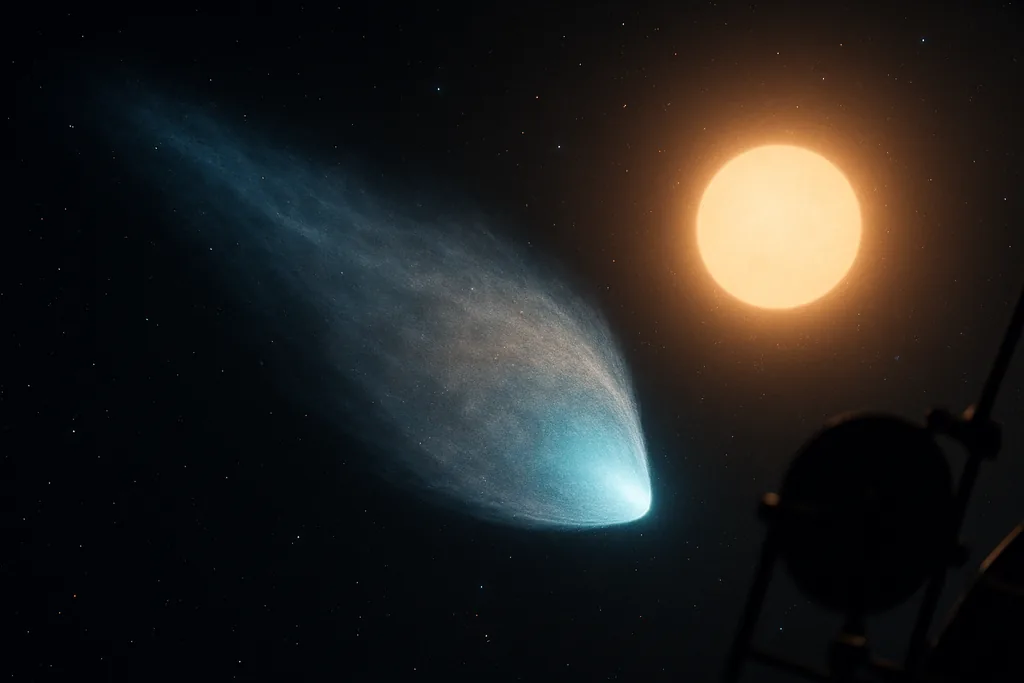
Strange light from a stranger: the opening sighting
When the interstellar object known as 3I/ATLAS was first tracked in early July 2025 it behaved oddly enough to attract attention; a Hubble image taken on July 21 showed a concentrated brightening on the sun‑facing side of the body with little or no classic cometary tail. That sequence of images — combined with detections from wide‑field survey cameras and infrared spectroscopy — has left scientists baffled interstellar object observers and the wider astronomy community alike. The simplest reading from some commentators is dramatic: the object appears to be producing its own light. Most researchers, however, treat that claim as provisional and ask a different question first: is the glow truly intrinsic emission, or is it an understandable consequence of sunlight, dust and measurement geometry?
Scientists baffled interstellar object: Observational puzzle from four telescopes
Several space observatories have contributed to the puzzle. The Hubble Space Telescope produced the striking images of a teardrop or sunward ‘‘cocoon’’ of brightness; NASA missions — including the Transiting Exoplanet Survey Satellite (TESS) and the infrared survey instrument SPHEREx — and the James Webb Space Telescope (JWST) have supplied supporting photometry and spectroscopy. Those datasets show three provocative facts: the object activated at large heliocentric distances where sunlight is weak, it exhibits an unusually high carbon‑dioxide to water ratio in its coma, and it lacks the long, dust‑rich tail that most active comets display.
How astronomers detect and characterise such behaviour matters. Imaging reveals morphology and brightness changes, time‑series photometry tracks whether brightness follows a rotating or transient pattern, and spectroscopy separates reflected sunlight from photons produced by atoms, molecules or hot material. SPHEREx and JWST look in the infrared and can detect molecular signatures — the very lines and bands that revealed the high CO2/water ratio — while Hubble and TESS provide high‑resolution optical imaging and lightcurves. Taken together, the instruments supply the kind of cross‑checked data necessary to test whether a glow is intrinsic emission or a reflection effect amplified by geometry or dust scattering.
Scientists baffled interstellar object: What "self‑luminosity" would mean
Saying an object "emits its own light" can mean several, very different physical things. At one extreme it could be thermal emission: the body is hot and radiates in the infrared because of internal heat sources. At another, it could be line emission and fluorescence: molecules or atoms excited by solar ultraviolet light or charged particles re‑emit photons at characteristic wavelengths. A third possibility is anthropogenic or artificial — a power source on board generating visible light — a hypothesis that has received attention in part because of past debates over other interstellar visitors.
Distinguishing between these possibilities requires spectroscopy: intrinsic, thermal emission tends to produce a smooth, continuum spectrum whose peak wavelength shifts with temperature, while fluorescent or atomic emission produces narrow lines at well‑known wavelengths. Reflected sunlight carries the solar continuum modified by absorption features. So astronomers examine the object's spectrum across visible and infrared bands to detect the telltale fingerprints of thermal emission, molecular fluorescence, or sunlight reflection. Until that spectral separation is unambiguous, claims that 3I/ATLAS is self‑lit remain unproven.
How the glow could appear without a nearby star
It’s natural to ask how any object could glow away from a star: the sun is far, and interstellar space is cold. There are several non‑mystical mechanisms that produce light without a luminous star nearby. Cometary outgassing can release molecules that fluoresce when struck by ultraviolet sunlight, producing emission lines that make the coma seem to ‘‘glow’’ even when there is little dust forming a tail. Dust grains that are very small or unusually shaped can strongly scatter sunlight forward toward the observer, causing a bright, sunward hotspot. Energetic processes — for example, particle interactions in a thin plasma — can also power emission in ultraviolet or X‑ray bands.
Instrumental and geometric effects also matter. Observers viewing an object at a particular phase angle (the angle between the Sun, object and telescope) can see dramatically enhanced brightness through forward‑scattering from dust. Likewise, a compact, sharp reflection from a sunward face will register differently on imaging detectors than an extended tail, so an object that looks ‘‘headlight‑like’’ in one exposure may simply be reflecting sunlight from a concentrated patch of surface or a small, dense dust cloud.
Leading explanations and the debate in the community
How astronomers test whether the light is intrinsic
Testing the self‑luminosity hypothesis is methodical and slow. Astronomers are using time‑series spectroscopy to see whether emission features evolve in ways expected for outgassing, and polarimetry to estimate the size and structure of dust grains responsible for scattering. Thermal infrared observations search for a continuum peak that would indicate a hot surface or internal heat. Observations at multiple phase angles and wavelengths can separate reflected light from emission because each mechanism follows a different wavelength and geometry dependence.
Teams also compare the object's lightcurve — how its brightness changes over hours and days — with models for rotation, jetting and fragmentation. If an object is artificially emitting light, its spectrum and variability pattern should differ from cometary outgassing and dust‑scattering models in identifiable ways. So far, data from Hubble, TESS, SPHEREx and JWST provide pieces of the puzzle but not a complete picture.
What happens next and why this matters
Beyond the specific explanation, the episode matters because it exposes the scientific process in real time: how instruments, models and healthy scepticism combine to separate unfamiliar but natural phenomena from genuinely new physics or technology. Interstellar visitors are rare; each one teaches us about planet formation and the chemistry of distant systems. Whether 3I/ATLAS turns out to be an eccentric comet, a fragment with unusual properties, or something weirder, it will push astronomers to refine observational strategies for the next stranger to arrive.
Sources
- Space Telescope Science Institute / Hubble Space Telescope observations
- NASA (James Webb Space Telescope, TESS, SPHEREx mission data and analysis)
- Harvard University (Avi Loeb commentary)
- International astronomy preprint and observing teams reporting on 3I/ATLAS




Comments
No comments yet. Be the first!