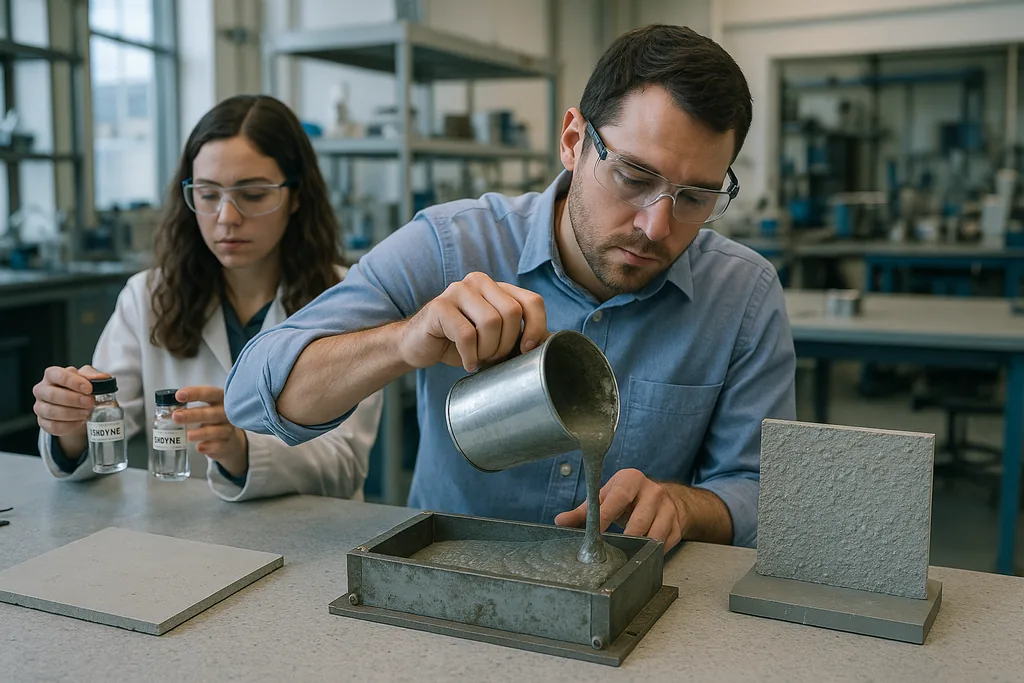
In a laboratory at Worcester Polytechnic Institute this week, researchers demonstrated a paste that does something ordinary concrete cannot: it pulls carbon dioxide out of the air and locks it into rock-like particles as it hardens. Published in the journal Matter and led by civil engineer Nima Rahbar, the team calls the product an "enzymatic structural material" (ESM). The claim is striking: under the methods reported, a cubic metre of ESM can sequester more than 6 kilograms of CO2 during production, while conventional concrete typically emits on the order of 330 kilograms for the same volume.
Enzyme-driven mineralization
ESM is built around a biological shortcut. Instead of firing raw materials at high temperatures—as the cement industry does—or hauling captured CO2 to underground reservoirs, the WPI team uses an enzyme to accelerate the chemical reactions that turn dissolved carbon dioxide into solid mineral particles. Those particles act as the load-bearing phase inside a capillary-suspension mixture, a materials-processing approach that yields a strong, fast-curing matrix. According to the paper's authors, the enzymatic step lowers the energy required to make a structural binder and shifts the carbon balance from net positive to net negative.
Performance and carbon accounting
Science and engineering claims about new building materials hinge on two measurements: mechanical performance and lifecycle carbon. On both fronts, the WPI team says their material is competitive. The capillary-suspension technique produces a dense microstructure with high strength and toughness, while the enzymatic mineralization supplies a route to stable, insoluble mineral carbon that is unlikely to re-enter the atmosphere over useful timescales.
Crucially, the researchers provide a straightforward comparison with ordinary concrete: whereas making a cubic metre of Portland cement‑based concrete typically releases roughly 300–400 kg of CO2, producing the same volume of ESM according to their lab protocol results in net sequestration of several kilograms of CO2. That difference comes from avoiding high-temperature calcination and from trapping carbon chemically in a solid form during manufacture.
Beyond global carbon numbers, the material offers operational benefits the team emphasises: repairability, recyclability and lower embodied energy. Because ESM cures under gentle conditions and relies on a mineral phase formed in situ, the researchers argue it can be dismantled and reprocessed at end of life, reducing construction and demolition waste compared with many modern concretes and composites.
Practical hurdles and scale-up
Laboratory promise is not the same as industrial reality. The WPI paper and press materials are candid about the next steps: scaling production, securing stable enzyme supplies, and adapting the manufacturing chain to deliver consistent feedstocks and quality control. Enzymes can be sensitive to temperature, pH and impurities, and industrial processes will need to protect catalytic activity while remaining cost-effective.
Regulatory issues also loom. Structural materials must meet building codes, wind and seismic standards, fire regulations and long-term durability tests. The team reports encouraging strength and durability in lab tests, but field trials, weathering studies and certification campaigns will be necessary before ESM could be specified by architects or mandated in procurement. There is also the question of raw materials: the capillary-suspension chemistry relies on particular particle and binder distributions that must be reliably sourced or generated from local industrial by-products to be affordable at scale.
Finally, the carbon accounting in any real-world roll-out will depend on the full supply chain. If enzymes or precursors are shipped long distances, or if ancillary processing requires fossil‑fuel energy, the net climate benefit may erode. The researchers highlight that low-energy manufacturing and renewable biological inputs are part of their design philosophy, but independent lifecycle analyses—and pilots run in different climates and with different supply chains—will be needed to validate the carbon-negative claim outside the lab.
How ESM could alter construction choices
If the material's advantages hold up in pilots, ESM could sit alongside an expanding set of low-carbon or carbon-storing building options: recycled-aggregate concretes, mineral‑carbonation blocks, geopolymer binders, and even upcycled plastics that act as sorbents in industrial settings. The WPI team points to near-term applications where rapid production and light weight are valuable—roof decks, wall panels, and modular units for affordable housing or rapid-repair infrastructure following storms and earthquakes.
The potential systemic effect is worth emphasising. Concrete is ubiquitous: global production of Portland cement alone constitutes a substantial share of industrial emissions. Even partial substitution of carbon-negative structural elements in non-load-bearing and semi-structural applications would cut emissions and create demand for new manufacturing pathways. The researchers estimate that even modest adoption could reduce construction-sector emissions significantly, because the material avoids the high-temperature steps that dominate cement's carbon footprint.
Context within carbon-capture innovation
That integration raises interesting policy and market questions. Buildings last decades; embedding sequestered carbon into durable components—if validated—creates a route for long-term storage that doesn't rely on geological reservoirs. At the same time, it shifts the locus of carbon policy into building standards, procurement rules and circular-economy frameworks. Governments, insurers and standards bodies will need to weigh material lifetimes, reparability and recyclability as they consider incentives or mandates.
Next steps and a cautious optimism
WPI's team and collaborators have taken the critical step of peer review and publication; the next moves will be partnership-driven. Industry pilots to test manufacturing scale, site-specific durability trials, and independent lifecycle assessments are the logical follow-ups. If enzyme production can be industrialised at low cost and the manufacturing chain localised, ESM could move from academic demonstration to commercial product within a few years.
The broader lesson is pragmatic: decarbonisation will not come from a single silver-bullet technology but from many materials, processes and policies that add up. ESM offers a promising piece of that puzzle—an engineered route to lock CO2 into the very fabric of buildings. The promise is real; the path to widespread use will be measured in engineering, logistics and the patient work of standards and markets aligning with novel chemistry.




Comments
No comments yet. Be the first!