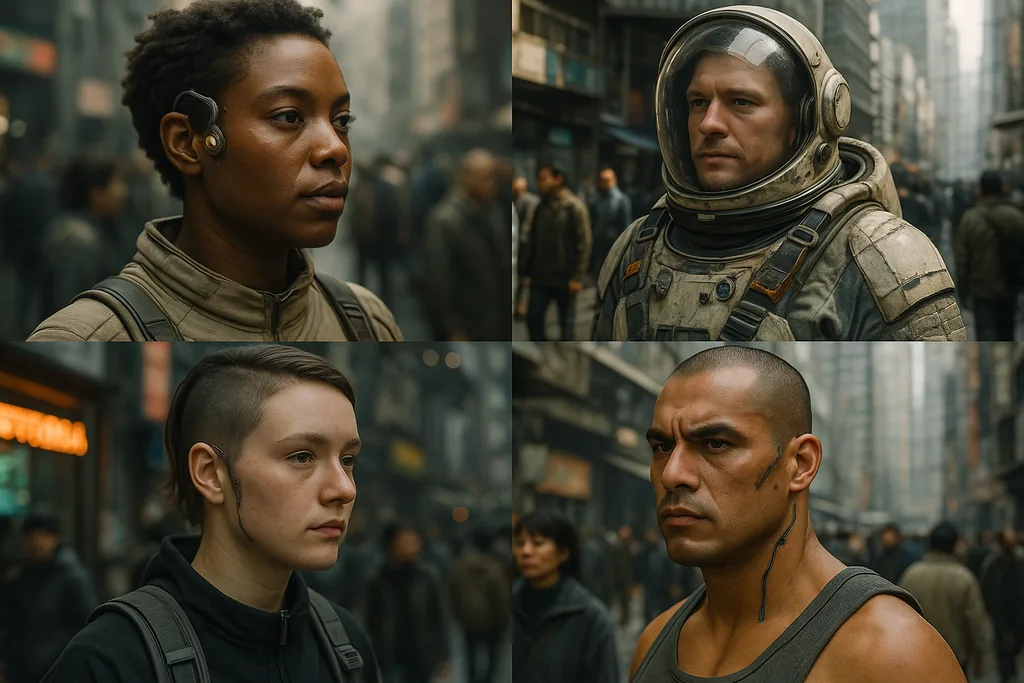
A long view: why asking 'will humans look like' matters now
Ask the question will humans look like something recognisably Homo sapiens a million years from today and the answer is immediate and unsettling: probably yes — and also probably very different. The question forces us out of sci‑fi fantasy and into the practical sciences of genetics, demography, medicine and environment; those disciplines already leave fingerprints on bodies and populations. Fossils and ancient DNA show that our species’ shape, skin tone and bone structure have shifted repeatedly in response to climate, diet, disease and migration, and the same drivers — now amplified by technology and global population shifts — will continue to act.
Will humans look like smaller, denser urban bodies
One plausible, demographically driven direction is toward smaller, more compact bodies in heavily urbanised populations. In evolutionary terms, cities are a brand‑new ecosystem: thousands of people living cheek by jowl, with lower physical activity demands and constant social contact. Over generations, selection pressures linked to energy budgets, disease exposure and social cognition may favour individuals who need less caloric intake or who tolerate crowding and chronic stress more effectively.
Archaeology and recent human history give a precedent. The shift from foraging to farming changed stature and body composition within a few thousand years; so too can rapid cultural change remodel selective landscapes. Crucially, demographic effects — which genes become common simply because populations grow faster in some regions than others — will also alter global appearance. Where birth rates remain high, local traits can spread widely even in the absence of strong natural selection.
Will humans look like tech–bio hybrids and enhanced minds
Biology is no longer the only route to change. Medical implants, prosthetics and sensory devices are already commonplace; the next step is enhancement. Brain‑machine interfaces, retinal prostheses and genetic tweaks are moving from laboratory prototypes into clinical trials. If such technologies become widespread and heritable interventions become socially accepted, exterior appearance could increasingly reflect engineered hardware as much as flesh.
This is a profound shift because it separates reproductive fitness from survival fitness. Where once disease or injury removed people from the mating pool, modern medicine keeps them alive and fertile. Where once physical strength or endurance might have been a determinant of reproductive success, networked cognition or compatibility with augmentative hardware could become more important. The result is likely to be uneven: wealthy and well‑connected groups could diverge in phenotype from less resourced ones, producing a mosaic of human forms rather than a single trajectory.
Population flows, skin tone and the arithmetic of change
Demography is an underappreciated engine of appearance. Over long timescales, traits that are neutral or only weakly selected can change simply because of who has more descendants. Rapid population growth in some regions, combined with global migration, will reweight genetic diversity across the species. Scientists modelling these shifts suggest that, absent strong opposing pressures, population dynamics alone could make certain traits — including average skin tone distributions — more common globally.
That outcome is not a biologically deterministic march to uniformity. Cultural practices, mate choice, assortative mating and migration all mediate which alleles travel. Still, where numbers and connectivity favour particular gene pools, the visible effects can accumulate surprisingly quickly on evolutionary timescales.
Space settlement: how low gravity and radiation reshape bodies
Humanity’s move off Earth would open new evolutionary experiments. Extended living on low‑gravity worlds like Mars or in microgravity dramatically alters bone density, muscle mass and cardiovascular function within months for a single individual. Over many generations, those physiological stresses could select for bodies that are lighter‑built, with different skeletal proportions, or for biological solutions that mitigate radiation damage.
Adaptation in space is not just a matter of weaker bones. Environments with different day/night cycles, oxygen levels and ultraviolet exposure change selective pressures on skin, circadian biology and metabolism. The cumulative effect is that a population raised off Earth, subject to reproductive isolation and different selective regimes, could diverge markedly from terrestrial humans — but that divergence would take many generations and would be shaped heavily by deliberate human choices about habitat design and medical care.
The role of natural selection, genetic engineering and chance
Natural selection still matters, but its role is now intertwined with deliberate intervention. Classical processes — mutations, selection, gene flow and drift — continue to operate, so environmental pressures like climate, pathogens and diet will nudge allele frequencies. However, gene editing offers a shortcut. If societies accept germline editing for health or enhancement, we could see targeted changes that bypass the slow sieve of natural selection.
That raises the question of predictability. Random genetic drift, founder effects and rare, high‑impact events (pandemics, climate shocks) make long‑term forecasting hazardous. The fossil record warns against overconfident predictions: when palaeobiologists analyse teeth, bones or isotopes, they can reconstruct diets and ecologies, but the same evidence can mislead if interpreted without context. The lesson for forecasting our own future is humility: multiple plausible paths exist, and policy and technology choices will steer which are realised.
Social selection, cognition and the shape of future traits
Humans are social animals, and social selection — mate preferences, cultural prestige, and technologies that reshape social structures — will be powerful. Traits that influence communication, memory and stress tolerance may become more consequential in dense, information‑rich societies. In other words, brains and behaviours may be under stronger directional pressure than limbs or shoulder breadth.
At the same time, human behaviour feeds back into biology. If artificial intelligence and humanoid robots take on physical labour, the selective value of strength and stamina could decline. Surveys of attitudes toward domestic robots show mixed acceptance and real concerns about safety and privacy; how societies incorporate machines into daily life will therefore affect which human traits remain essential and which become vestigial.
Could humans become taller, stronger or develop new traits?
Natural selection can produce new traits over a million years, but cultural and technological evolution can produce functional change — and sometimes visible change — much faster. Think of hearing aids turned into cochlear implants, now conceived as enhancements rather than mere repairs. Over long timescales, a mixture of selection, demography and human choice will determine which potential traits become common.
Why certainty is the wrong takeaway
The clearest scientific conclusion is not a single portrait of the future human, but a set of tightly constrained uncertainties. Evolution will continue, and the drivers are familiar: environment, disease, diet, migration and reproduction. What is new is the scale of human agency — medicine, genetic engineering, habitat engineering and global migration — all acting faster and with more intent than in the past.
So when people ask will humans look like something specific in a million years, the honest reply is: we will still be recognisably human in many ways, but our diversity will be greater, our forms will reflect cultural and technological choices as much as natural selection, and pockets of highly modified people may exist alongside largely unchanged populations. The future will be a mosaic, not a single image.
Sources
- Earth and Planetary Science Letters (zinc‑isotope study on ancient marine predators)
- IEEE (surveys and technical reporting on humanoid robots and human–machine interaction)
- Population genetics and ancient‑DNA research groups (human evolution and migration studies)




Comments
No comments yet. Be the first!