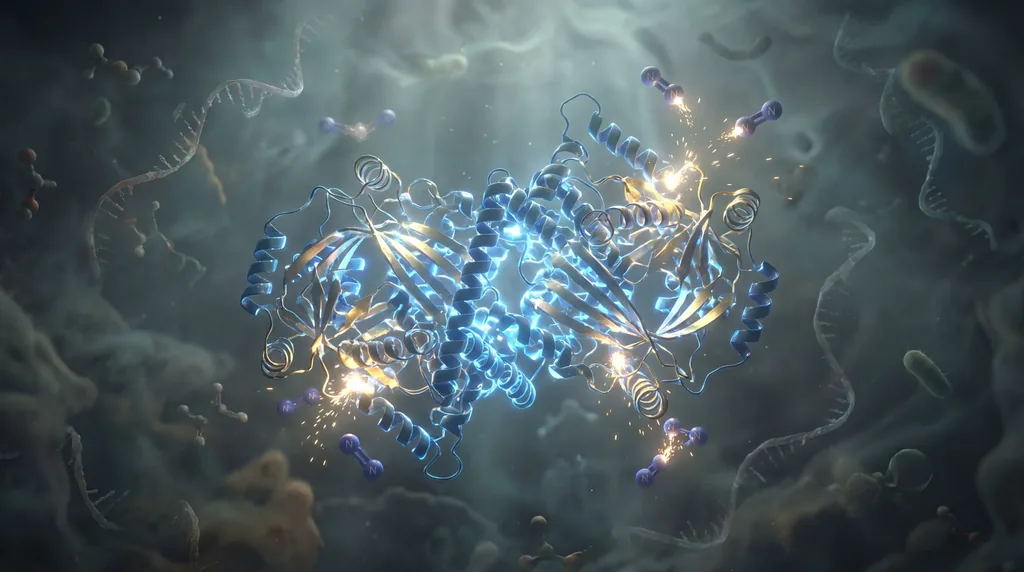

By resurrecting a 3.2-billion-year-old enzyme and testing its functionality within modern living microbes, a team of researchers has bridged a multi-billion-year gap in our understanding of the Archaean Eon. This experimental milestone, led by scientists at the University of Wisconsin-Madison and supported by NASA’s astrobiology program, offers a rare, functional glimpse into the metabolic processes that sustained life on a young, oxygen-poor Earth. The research, recently published in Nature Communications, utilizes the cutting-edge field of synthetic biology to reconstruct ancient biochemistry, providing a new framework for identifying signs of life on other worlds.
The Molecular Time Machine
The study centers on ancestral sequence reconstruction, a technique that allows scientists to navigate the evolutionary tree in reverse. By analyzing the genetic sequences of modern organisms, researchers can statistically infer the DNA of their long-extinct ancestors. In this instance, the team focused on nitrogenase—an enzyme of paramount importance to the history of biology. Nitrogenase is responsible for nitrogen fixation, the chemical process that converts atmospheric nitrogen into bioavailable forms like ammonia, which are essential for building proteins and DNA. Without this enzyme, the biosphere as we know it would likely never have developed.
Led by Professor Betul Kacar, a prominent figure in the NASA-funded MUSE (Metal Utilization and Selection across Eons) consortium, the project represents a collaboration between molecular biologists, geologists, and astrobiologists. Kacar describes nitrogenase as an enzyme that "helped set the tone for life on this planet." Because enzymes do not leave physical fossils, the team’s ability to rebuild a functional version from 3.2 billion years ago provides a "molecular time machine" that bypasses the limitations of the geological record. This synthetic biology approach transforms theoretical evolutionary models into tangible laboratory experiments.
Testing Ancient Life in Modern Hosts
The methodology involved more than just digital reconstruction. Once the ancient nitrogenase sequence was inferred, the researchers synthesized the DNA and inserted it into contemporary microbial hosts. This process, often referred to as "paleo-experimental evolution," allows scientists to observe how an ancient protein interacts with the machinery of a modern cell. Doctoral researcher Holly Rucker, a key author of the study, notes that the experiment was designed to see if these ancient blueprints could still drive the essential functions of life in a controlled, modern environment.
Remarkably, the resurrected nitrogenase proved to be functional, successfully fixing nitrogen within the host microbes. This success allowed the team to measure the metabolic efficiency and chemical outputs of the enzyme directly. One of the primary challenges in this field is maintaining biological function across billions of years of divergent evolution; however, the ancient enzyme's ability to integrate into modern metabolic pathways suggests that the core mechanism of nitrogen fixation has remained surprisingly robust despite the radical changes in Earth’s environment over the last three eons.
Decoding the Early Earth Environment
To understand the significance of a 3.2-billion-year-old enzyme, one must consider the conditions of the Archaean Earth. Long before the Great Oxidation Event, the atmosphere was a thick haze of carbon dioxide and methane, with almost no free oxygen. Life was dominated by anaerobic microbes that had to survive in a high-radiation, low-nutrient environment. By testing the resurrected enzyme, the UW-Madison team could validate geochemical models that suggest how these early organisms accessed nitrogen when the planet’s chemistry was vastly different from today.
The study also addressed a long-standing assumption in geobiology: that ancient enzymes produced the same isotopic signatures as their modern descendants. Geologists look for specific ratios of nitrogen isotopes trapped in ancient rocks to determine if biological activity was present billions of years ago. Rucker and her colleagues compared the isotopic "fingerprints" generated by the reconstructed ancient nitrogenase with those of modern versions. Their findings confirmed that the signatures match, providing experimental evidence that the isotopic records found in 3.2-billion-year-old rocks are indeed accurate reflections of ancient biological metabolism.
Conservation Amidst Change
One of the most striking revelations of the study is the stability of the enzyme’s isotopic signature. Over billions of years, the DNA sequences that code for nitrogenase have undergone significant mutations and structural changes. Yet, the underlying mechanism that controls the nitrogen isotope ratio has remained conserved. This suggests that while the "packaging" of the enzyme evolved to suit changing environmental pressures, the core chemical reaction—the very heart of the enzyme's function—was perfected early in life’s history and has not shifted since.
This conservation is a boon for scientists attempting to map the history of life. If the isotopic signal had changed significantly over time, interpreting the rock record would be a matter of guesswork. Instead, the stability of this signal confirms that we can use modern observations to reliably interpret the distant past. Rucker is now focused on investigating why this specific feature remained so stable while other aspects of the enzyme's structure were allowed to drift, a question that could reveal fundamental truths about protein evolution and chemical constraints on life.
The Search for Alien Biosignatures
The implications of this research extend far beyond Earth’s history, reaching into the burgeoning field of astrobiology. NASA is heavily invested in defining "biosignatures"—measurable indicators that life is or was present on a planetary body. Historically, the search has focused on oxygen-centric markers, but as this study shows, life on Earth flourished for billions of years in the absence of oxygen. By confirming that nitrogenase-derived isotopes are a robust and stable biosignature, the researchers have provided NASA with a more reliable tool for evaluating extraterrestrial samples.
As missions like the Perseverance rover on Mars or future probes to the icy moons of Jupiter and Saturn collect data, scientists can now look for these specific nitrogen isotope patterns with greater confidence. If a spacecraft detects a matching chemical signature in the soil of another planet, it would suggest a metabolic process analogous to the one that sustained the earliest life on Earth. This moves the search for alien life away from "Earth-like" (meaning modern Earth) and toward "life-like" (meaning the fundamental chemical processes of any living system).
A Template for Future Exploration
The success of the nitrogenase study serves as a proof-of-concept for the MUSE consortium and the wider scientific community. Kacar and her team envision this approach as a template for resurrecting other ancient enzymes tied to critical planetary processes, such as carbon fixation or photosynthesis. By rebuilding these pathways, researchers can refine their models of early Earth and broaden the range of chemical markers they can search for in the atmospheres of exoplanets.
Ultimately, this work demonstrates that the history of our planet is written not just in stone, but in the genetic code that has survived through the ages. By combining the tools of synthetic biology with the questions of geobiology, scientists are finally beginning to read the oldest chapters of life’s story. As we prepare to analyze samples from other worlds, understanding the primitive metabolic foundations of our own planet remains the most vital step in recognizing life elsewhere in the cosmos.
Key Research Highlights:
- Interdisciplinary Leadership: The study was led by Betul Kacar and doctoral researcher Holly Rucker at the University of Wisconsin-Madison, as part of the NASA-funded MUSE consortium.
- High-Impact Findings: Published in Nature Communications, the research provides experimental validation for isotopic biosignatures found in the rock record.
- Biological Stability: The study found that nitrogenase isotopic signatures have remained consistent for over 3 billion years, despite significant DNA sequence evolution.
- Astrobiological Utility: The results provide a stronger framework for detecting metabolic biosignatures on Mars, icy moons, and exoplanets.





Comments
No comments yet. Be the first!