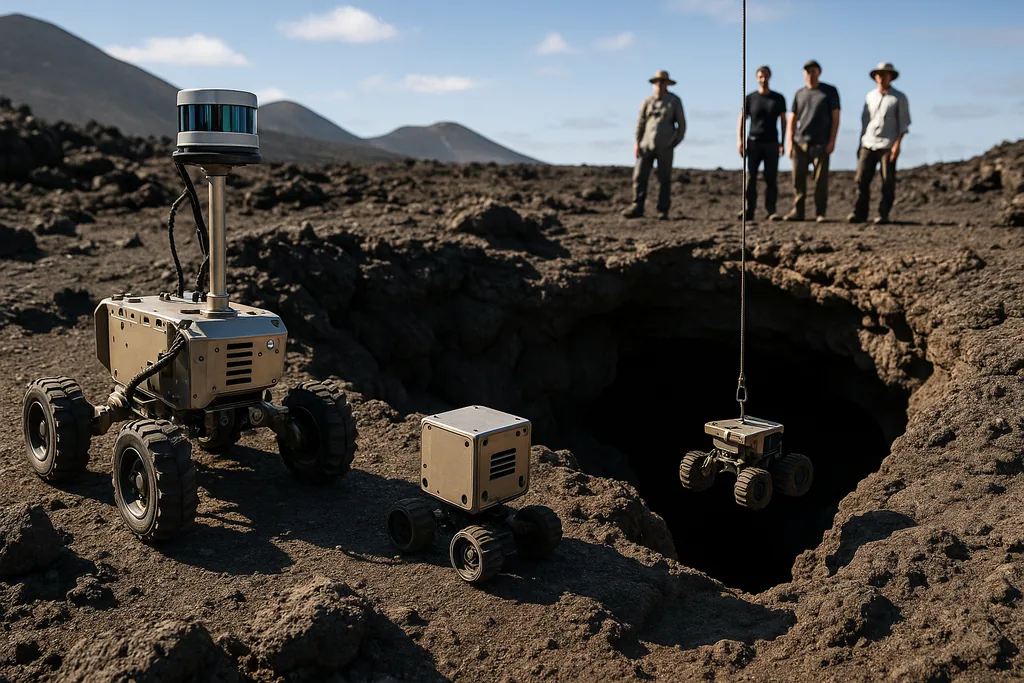
Robots descend into lava — a test for future lunar bases
On 2 February 2026 a European research consortium published results showing that teams of autonomous machines can scout and map the dark, steep entrances to lava tubes — a capability summed up in the simple phrase robots descend into lava. In field trials on the volcanic island of Lanzarote, scientists demonstrated a coordinated system of three robots that together map skylights, drop sensor packages, lower a scout rover by rope into cave mouths and produce dense 3D models of the interiors. The experiment, described in a Science Robotics paper from 2025 and led by partners including the Space Robotics Laboratory at the University of Malaga and the German Research Center for Artificial Intelligence (DFKI), frames lava tubes on the Moon and Mars as realistic targets for future sheltered habitats.
robots descend into lava: mission architecture and phases
The concept is deliberately low-tech in outline and high-tech in execution: the mission unfolds in four autonomous phases that chain together heterogeneous robots. First, surface vehicles cooperate to build a survey map of the terrain around a skylight or cave entrance and identify safe anchor points. Second, a small, sensorized payload cube is dropped into the opening to record temperature, dust, seismic noise and illumination — a lightweight way to get first-hand environmental data without committing a heavy vehicle. Third, a scout rover is lowered down on a tether or rappelling rig to slip inside the shaft, and last, the team pursues an extended interior exploration to generate centimetre-scale 3D reconstructions of passages.
Each phase tackles a different hazard: surface reconnaissance minimises risk to the main lander; the sensor cube reduces the chance of sending a wheeled vehicle into deadly conditions; the rappelling scout negotiates vertical drops and narrow entrances; and cooperative multi-robot mapping covers longer ranges than a single rover could. The approach relies on modern autonomy — simultaneous localisation and mapping (SLAM), collaborative path planning and fault-tolerant behaviours — so that the systems can act without continuous Earth supervision when communications are delayed or lost.
robots descend into lava: field tests on Lanzarote
The team validated the chain of behaviours in the lava tube analogues of Lanzarote, a volcanic island whose caves approximate many of the features engineers expect on the Moon: brittle basalt, sharp rubble, skylight entrances and steep drops. Field campaigns in 2023 and subsequent lab work showed the overall architecture works end to end. Robots mapped entrance rims, placed anchors, deployed sensor cubes and lowered a scout rover into a skylight. The trial demonstrated reliable 3D mapping in low-light, high-dust conditions and highlighted the practicalities of tether management, anchor placement and autonomous decision-making when sensors disagree.
Results published last year reported where the system still needs work: communications between surface and underground nodes, long-duration power for interior missions, and improved robustness of mechanical rappelling hardware under abrasive lunar-like dust. Those are solvable engineering problems, but the field tests did what they were supposed to do: turn a laboratory plan into a realistic sequence that could be adapted for a robotic precursor mission to the Moon or Mars.
Lava tubes as natural shelters and resource targets
Lava tubes have moved from geological curiosity to strategic priority because they offer an existing, thick natural barrier between astronauts and the hostile space environment. On the Moon, where there is no atmosphere and only patchy magnetic shielding, surface crews face chronic radiation from the Sun and Galactic cosmic rays, and a steady rain of micrometeorites. A lava tube — a tunnel carved and roofed over by past basaltic flows — provides metres to tens of metres of rock shielding, drastically cutting radiation exposure and removing the need to haul large shielding mass from Earth.
Britannica-style geological context helps explain why these tunnels exist: large mare basalts erupted as low-viscosity lavas that could flow long distances and develop roofed channels. Those same flows that formed the lunar maria are the processes that can create the long subsurface cavities engineers now want to exploit. Inside, temperatures are more stable than on the sun-baked surface and the regolith cover reduces the risk from micrometeorite impacts and thermal cycling that damage equipment and suits.
Beyond shelter, lava tubes are promising for resources. They may collect and preserve volatiles — including water ice in permanently shadowed sections or at depth — and their interior floors could offer consolidated material suitable for constructing habitats or mounting equipment. For Mars, lava tubes also promise protection from the planet's thin atmosphere, frequent dust storms and higher radiation doses at the surface.
Technical hurdles and the enabling technologies
Getting robots to descend into lava and operate reliably inside presents multiple hard engineering challenges. Skylights are often vertical, narrow and strewn with boulders; there is no GPS inside a cave; comms are intermittent or blocked by rock; dust is abrasive and electrostatically clingy; and thermal swings demand robust electronics. The field trial exposed all of these limitations and guided the choice of enabling technologies now maturing for planetary use.
Key enabling systems include high-performance SLAM that fuses lidar, stereo vision and inertial data; lightweight, radiation-tolerant sensor cubes for first-look science; tethered power and communications systems that combine fibre-optic data links with mechanical strength; and rappelling mechanisms with automated anchor inspection and redundant winches. Cooperation software that lets a surface rover make conservative go/no-go calls based on a sensor cube's readings can prevent many failure modes. In addition, radiation-hardened processors and dust-tolerant actuators extend mission lifetime, while modular hardware allows a damaged unit to be bypassed or replaced by another robotic peer.
How lava tubes could support life support, power and long-term operations
If mapped, characterised and chosen carefully, a lava tube could host a human-tended habitat or a logistics hub. The subsurface cavity supplies shielding that reduces launch-mass requirements for habitat walls, and its thermal stability eases thermal control systems. Power could be supplied by solar arrays on the surface with cables routed through the skylight into the tube, or by small nuclear reactors or radioisotope generators placed at stable locations; both approaches are under study in the context of Artemis and other lunar architectures. Water or bound volatiles found by robotic scouts could feed closed-loop life-support systems, provide hydrogen and oxygen for propellant, or be electrolysed for breathing oxygen and rocket fuel.
Operationally, mapped tubes would allow outposts to expand laterally, hosting workshops, greenhouses and storage spaces with minimal extra shielding. Robots are essential to that first phase: they can reconnoitre, sample and certify a section of tube before any crew arrival, lay down infrastructure such as anchors, hubs and power nodes, and even pre-deploy caches of supplies. In short, robotic precursors reduce risk and enable far more ambitious human use of a naturally protected space than a surface-only approach.
The Science Robotics paper from 2025 and the University of Malaga-led experiments on Lanzarote make clear that planetary lava tubes are no longer a speculative habitat idea but a tangible objective for near-term robotics. The next steps are to ruggedise the systems for lunar vacuum and radiation, flight-qualify tether and anchor hardware, and integrate the mapping outputs with orbital reconnaissance to pick the best targets. If those steps proceed on schedule, coordinated robotic scouting of skylights could be a routine part of the next decade of lunar exploration — a practical precursor to sheltered human bases.
Sources
- Science Robotics (research paper: "Cooperative robotic exploration of a planetary skylight surface and lava cave")
- University of Malaga — Space Robotics Laboratory (field campaign materials and press release)
- German Research Center for Artificial Intelligence (DFKI) — robotics consortium contributions




Comments
No comments yet. Be the first!