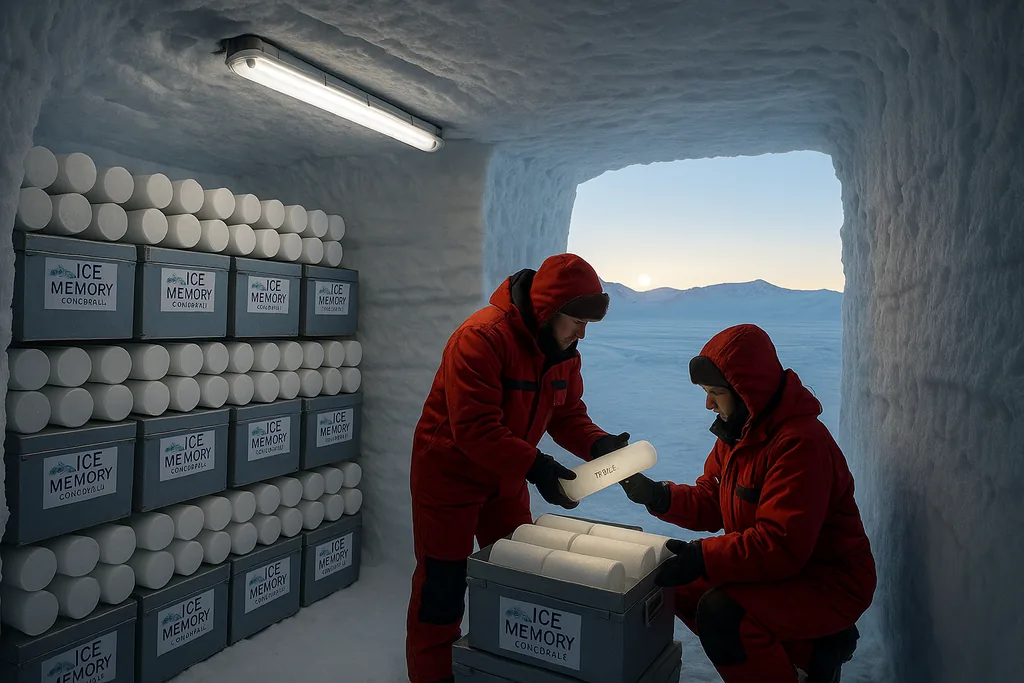
This week something that feels a little like time‑travel arrived on the high Antarctic plateau: freshly drilled columns of glacial ice bound for a purpose‑built vault whose aim is simple and urgent — to keep the planet's climate memory safe as the world warms. The Ice Memory Sanctuary, carved into the frozen ground at Concordia Station, has taken in its first shipment of ice cores from the European Alps. Scientists say the move is a hedge against irreversible loss: glaciers are melting now, and with them the layered archive of past climate.
A frozen archive at Concordia Station
Concordia Station sits on Antarctica’s high polar plateau, where an annual mean temperature near -50 °C and near‑zero human footprint combine to create one of the most stable cold environments on Earth. The sanctuary is not a gigantic cavern: the storage space is roughly five metres high, five metres wide and 35 metres long, dug into the ground about five metres beneath the surface. But its remoteness and the extreme ambient cold mean that once an ice core arrives and is placed on cold racks, it can remain frozen for centuries with a minimal active energy footprint. That stability — and the protections afforded by the Antarctic Treaty System — are what make Concordia attractive as a global backup repository.
Ice cores as climate archives
Glaciers are not only water stores and landscape features; they are layered recordkeepers. Each year’s snowfall compresses and traps air, dust, volcanic ash and chemical signatures that reflect atmospheric composition and temperature in the past. By analysing isotopes of oxygen and hydrogen, trapped greenhouse gases, particulates and pollutant markers along a long core, scientists can reconstruct temperature, precipitation and atmospheric chemistry across centuries or even hundreds of thousands of years.
Those records are essential for calibrating climate models, testing hypotheses about past rapid climate events, and understanding regional water resources. According to the World Meteorological Organization’s recent report, the planet is losing roughly 273 billion tonnes of glacial ice every year — a pace that will erase many mountain records within decades. In the past half‑century, some 9,000 billion tonnes of glacial ice have already disappeared. The Ice Memory Sanctuary is explicitly designed to extend those archives beyond the lifetime of the source glaciers.
The sanctuary's design and logistics
The technical challenge is deceptively simple: keep ice cold and uncontaminated. Cores are usually drilled on site in mountain expeditions, split so one half can be analysed immediately at a local laboratory and one half sent as a ‘twin’ to a long‑term archive. For the Ice Memory project the twin is shipped along a strict cold chain to Concordia. The Antarctic vault itself is a partially buried, insulated chamber where low ambient temperatures do much of the work. That reduces dependence on electric refrigeration systems that could fail in a crisis.
Beyond temperature control, maintaining the scientific value of a core requires rigorous handling protocols to avoid contamination, careful labelling of provenance and depth, and documentation so that future researchers can place an ice segment in its correct stratigraphic context. The sanctuary team anticipates storing cores from a wide geographic sweep: the Andes, the Caucasus, Svalbard, the Pamir Mountains and elsewhere. Some expeditions — notably recent work on the Pamir Kon‑Chukurbashi ice cap — already split cores so that one sample remains with an institute such as Hokkaido University’s Institute of Low Temperature Science while its twin heads to Concordia.
International governance and geopolitics
The choice of Antarctica as a repository is as much political as practical. The Antarctic Treaty sets aside the continent for peaceful scientific cooperation and places restrictions on resource exploitation, giving the sanctuary a layer of international legal protection. Still, the political and ethical questions are nontrivial. The ice cores themselves come from sovereign territories or regions with local populations who depend on glaciers for water, culture and livelihoods. Decisions about which cores to export, who gets to access them, and how long the duplicates are held raise questions of scientific sovereignty and benefit‑sharing.
Project organisers stress that the sanctuary is intended as a complement to existing national archives rather than a replacement. The idea is simple: keep a duplicate that can be used when the original is lost or degraded. But practical arrangements — agreements with source countries, permits for drilling and transport, and long‑term funding commitments — will determine whether the sanctuary truly functions as a global commons for climate memory.
Scientific uses and future access
Stored cores are not time capsules to be sealed and forgotten. They are research capital. Future analytical techniques — some not yet invented — might extract information now inaccessible: more precise isotopic fractionation records, micro‑particle fingerprints, ancient microbial DNA or improved greenhouse‑gas measurements. Having a secure duplicate means future researchers can revisit the exact same segment of ice with new tools and questions.
Researchers also point out that ice cores can calibrate independent records — tree rings, lake sediments, coral layers — and so preserving cores helps knit a more complete picture of regional climate histories. The World Meteorological Organization characterises initiatives like Ice Memory as strengthening global observing systems by extending records beyond the age of instrumental observations; that extension matters because models and policy rely on long, well‑dated baselines.
Urgency and unresolved questions
There is a tight race between logistics and melting. Drilling expeditions are complex and expensive, requiring helicopters or overland traverses, specialist teams and secure transport. For many small or hard‑to‑reach glaciers, the decision to take a core requires prioritisation: which sites most usefully extend records, which are most at risk, and how to balance scientific value with respect for local stakeholders. The sanctuary helps with one part of the problem — long‑term storage — but it does not relieve the need to drill while the ice still preserves its seasonal layering.
Other unresolved practicalities include stewardship over centuries: who ensures maintenance, who pays if a future power is unwilling to continue Antarctic scientific cooperation, and how to guarantee that the samples will remain accessible to a broad international scientific community. Those questions are more sociopolitical than technical, and they will need answers if the sanctuary’s promise is to be realised.
Sources
- World Meteorological Organization (State of Global Climate 2024)
- Ice Memory Foundation and Prince Albert II Foundation press materials
- Concordia Station (French‑Italian Antarctic research facility) and Institute of Low Temperature Science, Hokkaido University




Comments
No comments yet. Be the first!