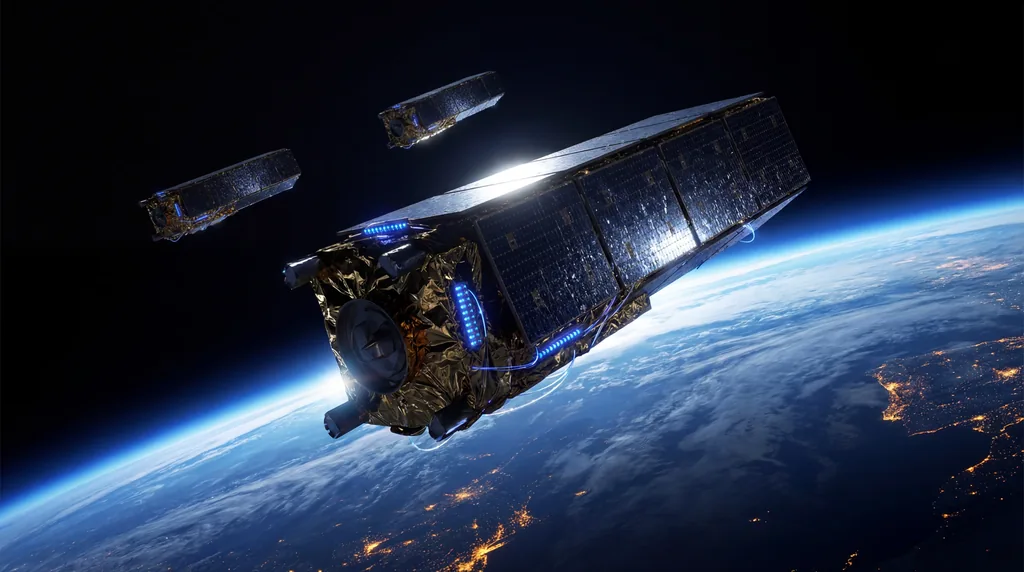

China has successfully tested a network of satellites capable of running complex AI models directly in orbit, marking a significant leap for the Three-Body Computing Constellation. Developed by Zhejiang Lab in collaboration with international partners, this experimental swarm demonstrates the potential of orbital edge computing to process vast amounts of data in space, bypassing the bottleneck of traditional ground-station relays. On February 16, 2026, researchers confirmed that the network has successfully deployed 10 artificial intelligence models, validating a new architecture for decentralized space-based processing.
The Three-Body Computing Constellation represents a strategic shift from simple data collection to active on-orbit intelligence. Traditionally, satellites act as "mirrors," capturing raw data and beaming it to Earth for analysis, which creates significant latency and taxes communication bandwidth. By integrating high-performance computing hardware into the satellites themselves, Zhejiang Lab aims to create a "computer in the sky" that can interpret data in real time, delivering actionable insights directly to users on the ground or in deep space.
What AI models are running on China's orbital satellites?
China's Three-Body Computing Constellation currently operates 10 artificial intelligence models in orbit, including two massive 8-billion-parameter systems for remote sensing and astronomical analysis. These models allow for autonomous feature identification and real-time classification of cosmic events, drastically reducing the volume of data that must be transmitted back to Earth-based ground stations for processing.
The technical sophistication of these models is unprecedented for orbital hardware. Specifically, the 8-billion-parameter remote sensing model has already demonstrated its efficacy during a November 2025 mission. It conducted an infrastructure survey over 189 square kilometers in northwest China, successfully identifying bridges and stadiums despite heavy snow cover. Simultaneously, an astronomical time-domain model is being used to analyze cosmic phenomena. Key highlights of the current AI deployment include:
- 99 percent accuracy in classifying gamma-ray bursts in real time.
- Autonomous detection of geospatial features under adverse weather conditions.
- Real-time data compression by filtering out irrelevant imagery before transmission.
- On-orbit distributed computing that splits complex tasks across multiple satellite nodes.
How does inter-satellite networking work in the Three-Body Computing Constellation?
Inter-satellite networking within the constellation functions through a distributed crosslink system that allows multiple spacecraft to share data and processing tasks simultaneously. By utilizing high-speed communication links, the swarm creates a functional orbital computing network that routes information between units to optimize computational workloads and bypass traditional ground-relay latencies through shared on-orbit resources.
Testing conducted over the last nine months has verified that six spacecraft within the fleet can maintain stable inter-satellite links to function as a singular processing unit. This "swarm intelligence" allows the satellites to hand off data packets seamlessly, ensuring that if one satellite is overwhelmed or out of range, another can take over the computational load. Mission controllers at Zhejiang Lab have utilized these crosslinks to demonstrate distributed computing, where a single large AI task is partitioned and solved by several satellites working in tandem. This capability is essential for managing the massive datasets generated by modern hyperspectral and X-ray sensors.
What computing power will the full Three-Body Computing Constellation provide?
Once fully deployed with over 1,000 satellites, the Three-Body Computing Constellation is projected to deliver an aggregate performance of 100 quintillion operations per second. This massive scaling from the initial 12-satellite pilot program aims to establish a decentralized orbital supercomputer capable of near-instantaneous data processing for global end-users and complex deep-space exploration missions.
The roadmap for the constellation involves a rapid expansion following the success of the first 12 satellites launched in May 2025. According to Li Chao, a lead researcher at Zhejiang Lab, the ultimate goal is to provide a ubiquitous computing fabric in Low Earth Orbit (LEO). With 100 quintillion operations per second—equivalent to the world’s most powerful terrestrial supercomputers—the network will support smart city management, environmental monitoring, and autonomous navigation for other spacecraft. This level of performance ensures that space-based data is no longer a "store-and-forward" commodity but a real-time utility for global infrastructure.
Implications for Space Science and Communications
The transition to orbital edge computing effectively breaks the "downlink bottleneck" that has limited satellite utility for decades. By processing data at the source, the Three-Body Computing Constellation minimizes the need for high-bandwidth radio frequency or laser links to the ground. This is particularly vital for astrophysics; for example, two satellites equipped with cosmic X-ray polarization detectors can now identify and report gamma-ray bursts instantly, allowing ground-based telescopes to pivot and observe the events before they fade. This real-time capability could lead to breakthroughs in our understanding of high-energy transient events in the universe.
Furthermore, the decentralized nature of this AI swarm provides a level of resilience that traditional monolithic satellites lack. If a single unit fails or is damaged by space debris, the networking protocols allow the remaining fleet to reroute data and redistribute the AI processing workload. This architecture is expected to serve as the blueprint for future Internet of Things (IoT) frameworks in space, enabling millions of devices to connect through a high-speed, intelligent orbital backbone.
Future Directions: Scaling the Orbital Swarm
Looking ahead, Zhejiang Lab plans to accelerate the launch schedule to reach the 1,000-satellite milestone within the next few years. Future iterations of the hardware will likely incorporate even larger AI models and more robust inter-satellite laser communication systems to increase data throughput. The success of the current 8-billion-parameter models suggests that Large Language Models (LLMs) and specialized generative AI could eventually be hosted in orbit to assist with autonomous mission planning for lunar or Martian expeditions. As the Three-Body Computing Constellation grows, it will redefine the relationship between terrestrial data centers and orbital assets, ushering in an era where the most critical computations happen miles above the Earth's surface.




Comments
No comments yet. Be the first!