Robots and spectacle: a precise, engineered surprise
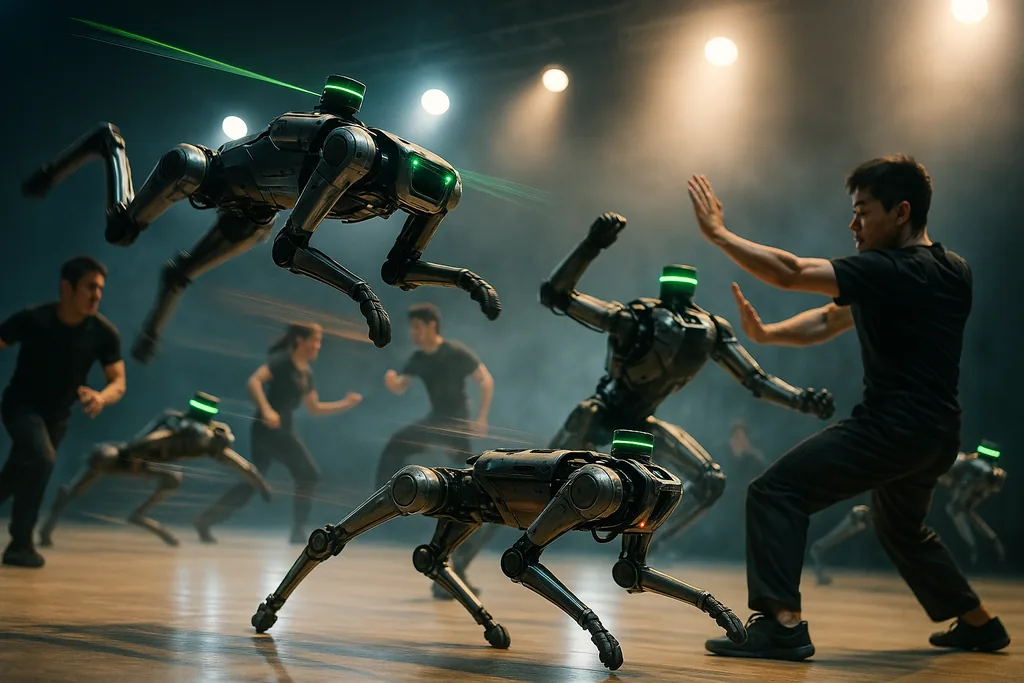
The 2026 Spring Festival Gala on 17 February delivered a moment that many viewers remembered within seconds: quadrupedal robots vaulting over tables, executing consecutive single‑leg backflips and trading mock blows with human martial‑arts performers while twirling nunchaku. The production framed those moments as entertainment, but behind the choreography lie the secrets behind technology feats that engineers at Unitree Robotics and the show’s production team had spent months proving in simulation and in the lab. What played out on a national stage was not only a performance but an engineered stress test for mobility, perception and multi‑agent coordination.
Secrets behind technology feats: motion, launchers and control
The first and most obvious technical leap in the gala performance was raw dynamic ability: robots launched themselves two to three metres into the air, completed aerial flips and landed cleanly. Those stunts depended on several interlocking elements. On the hardware side, robots used high‑power actuators and reinforced legs plus customised mechanical launchers for the highest jumps; on the software side, teams combined carefully tuned open‑ and closed‑loop controllers with pre‑trained general motion models to plan and recover from aggressive maneuvers.
That layered approach explains how the robots could perform continuous single‑leg flips, two‑step wall‑assisted backflips and complex parkour sequences. Every jump had to be planned for centre‑of‑mass trajectory, joint torque limits and impact attenuation. The result is a motion stack that blends model‑based dynamics with machine‑learned components, giving the robots both planned stability and rapid response to unexpected disturbances.
Secrets behind technology feats: cluster control and AI fusion localization
Beyond flashy solo moves, the gala highlight was dozens of units moving in tight formations with sub‑second synchrony. That scaling required a redesigned cluster control system capable of high concurrency: dozens of agents accepting central planning directives while maintaining local autonomy to react to small perturbations. The control architecture routes global choreography commands to each robot while a local controller enforces safety and balance constraints in real time.
Sensory fusion underpins that local autonomy. The robots fused proprioceptive measurements — joint encoders and inertial sensors — with 3D LiDAR scans at high frequency, processing environmental updates hundreds of times per second. By deeply fusing these streams, the system maintains accurate localization and obstacle awareness even directly after dynamic leaps and spins, when inertial sensors alone would drift. Engineers describe this as an AI fusion localization algorithm: machine learning assists in interpreting noisy sensor inputs, while deterministic filters enforce physically plausible state estimates.
Low latency was critical. Performers and music were synchronised to within a tenth of a second, which meant the cluster control system had to handle wireless command distribution, local state estimation and fail‑safe handoffs with minimal delay. The combined stack — global choreography, high‑frequency sensor fusion, and local robust control — made rapid, visually complex formation changes possible without collisions or timing errors.
How the martial‑arts robots work and how they were built
At a functional level, the martial‑arts robots operate like advanced athletic machines: perception sensors build a live model of the world; planning modules compute trajectories and sequence moves; and low‑level controllers translate those plans into motor torques that produce the desired motion. Perception and planning run concurrently, so a robot can commit to a flip while still adjusting foot placement based on last‑second range data. Compliance control and force sensing allow the machines to withstand external contact — in staged duels they accepted pushes and grappled-like interactions while maintaining grip or posture.
Construction followed an iterative development pipeline common to advanced robotics. Early prototypes focused on structural strength and joint speed. Simulators — ranging from physics engines to custom biomechanics models — were used to exhaustively explore parameter space. Developers then transferred pre‑trained control models into hardware and fine‑tuned them with domain‑adaptation tests: real world trials that correct for simulation bias. That mix of simulation, machine learning, and hands‑on tuning is how teams achieved tight timing and the apparent fluidity of the choreography.
Because the gala required theatrical reliability, the final validation phase emphasised redundancy and safety: fallback behaviours that lower a robot to a safe posture if localization degrades, conservative torque limits in crowded formations, and supervised rehearsals in a controlled environment before live broadcast. The engineering tradeoffs were clear — practising spectacular moves while keeping a moth‑like margin for error.
Technologies powering the gala and what they reveal about humanoid progress
The performance exposed a handful of technologies now maturing in the broader field of legged and humanoid robotics. Key items included high‑rate sensor fusion, pre‑trained and fine‑tuned control models (a sign that machine learning is part of the motion pipeline), cluster orchestration for multi‑robot systems, and compliant manipulation to handle interaction with humans and objects. Customized launch systems allowed the robots to temporarily expand the envelope of what their legs could do, but the sustained advances are in perception and control.
For humanoid robotics more generally, these demonstrations matter because they shift the conversation from incremental walking improvements to purposeful dynamic actions: vaulting, rapid re‑orientation, and coordinated team behaviours. That matters for applied domains — a warehouse robot that can handle stairs or a maintenance robot that can place parts at height benefits from the same sensing and control improvements that produced a clean aerial flip on stage.
Are these machines AI‑driven and capable of learning new moves? The gala suggests a mixed answer: machine learning appears in pre‑training and sensor interpretation, while deterministic control guarantees physical safety. The “learning” occurs primarily during model training and simulation‑to‑real adaptation rather than as unsupervised online learning during a performance. That design is intentional: on a live stage, engineers prioritise predictable, validated responses over open‑ended adaptation.
From spectacle to industry: real‑world use cases
The organisers and Unitree’s engineers framed the gala work as both art and proof of concept. Cluster automation control can be repurposed for coordinated inspection, warehouse sorting and multi‑robot assembly lines. Parkour‑grade obstacle negotiation translates into better gait planners for robots that must traverse cluttered factory floors or domestic environments. Compliant control under external force — used in staged weapon‑seizing sequences — maps directly onto tasks like collaborative assembly where a robot must accept human contact while preserving a manipulation task.
In short, the show is an advertisement for a specific technical thesis: pushing robots to perform spectacular dynamics in a controlled setting forces development of perception, control and safety subsystems that make robots safer and more useful in everyday, industrial contexts.
The Spring Festival Gala offered more than viral clips; it gave a concentrated view of engineering tradeoffs and technological priorities in contemporary robotics. The secrets behind technology feats on display are not single magic components but interconnected stacks of simulation, machine learning, sensor fusion, deterministic control and high‑concurrency coordination — all rehearsed to the precision of a stage production. For researchers and industrial customers alike, the lesson is clear: theatrical reliability is a tough benchmark, and one that accelerates useful capabilities when met.
Sources
- Unitree Robotics — company technical team and performance demonstrations
- China Media Group (CMG) — Spring Festival Gala footage and production materials
- Spring Festival Gala production team (television special event technical briefings)




Comments
No comments yet. Be the first!