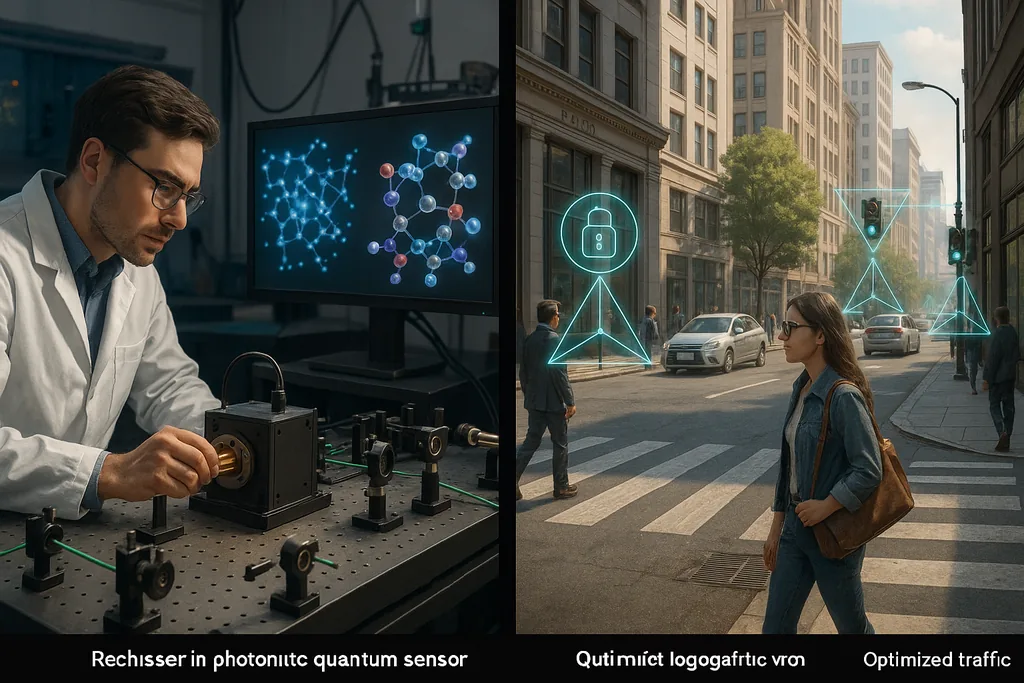
Quantum is moving out of the lab — and into your life
This week’s headlines — from IBM announcing new quantum systems to industry consortia such as Quantum Industry Canada joining a global Year of Quantum Security — make one thing clear: the conversation about "five ways quantum technology" could shape everyday life is no longer purely hypothetical. Engineers and entrepreneurs are already building prototypes and pilot networks, governments are funding readiness programs, and companies are rolling out products aimed at the coming era when quantum effects are used for computing, sensing and communications.
What follows is a concise tour of the five areas where quantum technology is most likely to affect consumers and organisations in the next decade, grounded in recent developments and realistic timelines. I explain the mechanics in plain language, show where practical applications already exist, and highlight the policy and industry moves that will determine who benefits and when.
Five ways quantum technology: discovery for medicine and materials
One of the clearest near-term impacts of quantum technology lies in simulation — using quantum hardware to model molecules, chemical reactions and materials at the atomic level. Classical supercomputers struggle with some of those problems because the quantum mechanics of many-electron systems explode combinatorially; quantum processors, in principle, can represent those quantum states more naturally.
Today, hybrid approaches that combine quantum and classical computation are already helping chemists narrow candidate molecules for drug discovery and materials design. That means faster exploration of thousands or millions of possibilities, which could shorten the time from lab idea to clinical trial or a new battery material. Within ten years, practical quantum-enhanced workflows could be part of pharmaceutical R&D pipelines, offering earlier detection of promising drug candidates and more targeted simulations for complex proteins.
But there are limits and caveats: fully general-purpose, error-corrected quantum computers remain an engineering challenge. Much of the progress expected in drug discovery will come from specialised quantum simulators, near-term hybrid algorithms, and software that translates lab problems into quantum-friendly forms. Companies and national programmes are funding this transition now because the potential payoff — cheaper drug development and more efficient materials discovery — is enormous.
Five ways quantum technology: sensors for navigation, medicine and the environment
Quantum sensors exploit fragile quantum states to measure tiny changes in magnetic fields, time, gravity or other physical quantities with sensitivity beyond classical limits. Unlike quantum computing, sensing applications can deliver value in the short term: compact quantum sensors are already being prototyped for navigation, medical imaging and environmental monitoring.
For navigation, quantum accelerometers and gravimeters could guide ships and aircraft where GPS is unavailable or unreliable. In healthcare, quantum-enhanced imaging and spectroscopy promise earlier detection of physiological changes and less invasive diagnostics. Environmental uses include high-precision detection of trace pollutants, underground water mapping, and seismic early warning systems. Because these sensors measure physical signals directly, their integration into consumer or industrial devices can be quicker than building large-scale quantum computers.
Across these areas, firms working with defence agencies and transport providers are running trials now. That real-world testing is essential: sensor hardware and algorithms must be robust to noise and operate reliably outside controlled labs before being widely adopted.
Optimisation and AI: five ways quantum technology could improve complex systems
Many everyday services depend on solving very hard optimisation problems: routing deliveries, scheduling flights, balancing electrical grids, and training large AI models. Quantum approaches aim to explore multiple candidate solutions in parallel, potentially finding better answers faster than classical methods for certain problem classes.
In logistics and finance, quantum-inspired algorithms and early quantum processors are already being explored to optimize portfolios or dynamic routing when conditions change rapidly. For AI, particular quantum routines could accelerate specific sub-tasks — for example kernel evaluations or sampling — but the headline of a fully quantum-trained, general-purpose AI assistant is still speculative. More plausibly, over the next decade hybrid classical–quantum workflows will assist data scientists and engineers by accelerating bottleneck calculations and improving parameter searches used in model training.
That means consumers might notice improvements indirectly: smarter traffic routing in city apps, energy utilities that integrate renewables more efficiently, and AI systems that personalize services with lower latency and better resource use. The pace of impact depends as much on software and integration as on qubit counts, and companies are investing in software toolchains to translate real optimisation problems to quantum-compatible formats today.
Ultra-secure communication: five ways quantum technology will change online security
Quantum computers threaten some widely used public-key systems (like RSA) because certain quantum algorithms can factor the large numbers that underpin those systems. Governments and firms therefore push for post‑quantum cryptography standards and migration plans to protect data that must stay confidential for decades. That’s why initiatives such as the Year of Quantum Security are bringing together industry and policy actors: to coordinate upgrades, educate practitioners, and reduce the risk of a disruptive transition.
On the defensive side, quantum key distribution (QKD) and entanglement-based networking promise methods of sharing cryptographic keys with security rooted in the laws of physics. Companies deploying metro-scale entanglement networks in cities have demonstrated impressive fidelity in real fiber. In practical consumer terms, quantum-secure communication could strengthen banking, protect health records, and harden critical infrastructure. But wide availability will depend on standards, cost reductions, and hybrid architectures that allow quantum-safe methods to be deployed without overhauling existing internet infrastructure.
From lab to streets: industrialisation, policy and timelines
How soon will consumers see these five ways quantum technology influence daily life? The short answer is: staggered and unevenly. Sensors and specialised quantum-enhanced devices will appear earlier — in a few years — because they require less qubit scale and can be engineered for specific use cases. Quantum-safe cryptography and hybrid security deployments are already a policy priority, and many organisations are preparing migrations now to avoid a future "harvest now, decrypt later" threat.
Large-scale, general-purpose quantum computers that outperform classical machines across many tasks remain a longer-term ambition. Meanwhile, hybrid approaches, cloud-accessible quantum services, and industry consortiums are accelerating practical uptake. Recent industry moves — for example, entanglement-based metropolitan networks passing real-world trials and industry groupings coordinating a Year of Quantum Security — show how companies and governments are laying the infrastructure and governance to bring quantum benefits into everyday products.
For consumers, that means incremental changes: better sensors in phones and cars, stronger back-end security for online services, improved logistics and AI-driven features, and eventually faster discovery pipelines for medicines and materials. The exact timeline depends on engineering progress, standards bodies like NIST, national funding priorities, and commercial incentives that scale manufacturing and lower costs.
Practical consumer applications today
What to watch next
Watch three tracks: hardware scale-up (qubits, error correction), near-term commercial pilots (sensing, network demos, optimisation), and policy/standards work (post-quantum cryptography and national readiness). Investments by national labs and private firms, public–private partnerships, and industry alliances shaping procurement will determine how equitably and quickly these technologies diffuse.
In short, the "five ways quantum technology" narrative is not an abstract scientific wish list anymore. It is a practical roadmap — sensors, discovery, optimisation, secure communications and AI acceleration — that companies, labs and governments are already following. The next decade will tell which threads weave into everyday life first, and which require more time and coordination.
Sources
- Nature (research papers on quantum simulation and materials)
- Optica / Journal of the Optical Society (optical networking research)
- Lawrence Livermore National Laboratory (LLNL) — simulations and large-scale modelling
- National Institute of Standards and Technology (NIST) — standards and post‑quantum cryptography work
- Quantum Industry Canada (industry consortium engagement)




Comments
No comments yet. Be the first!