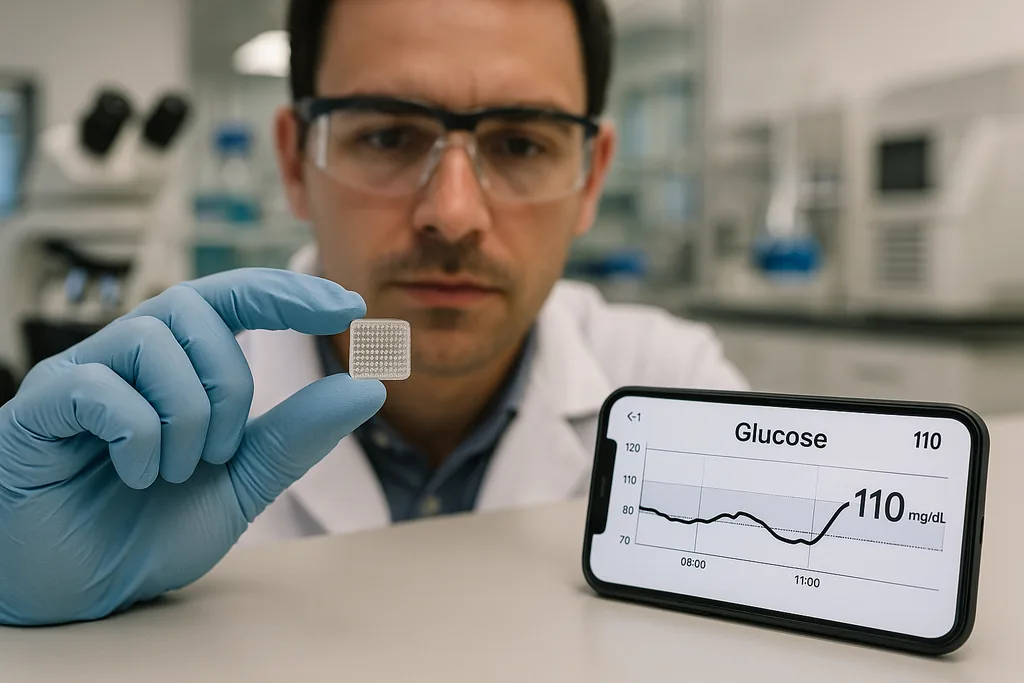
Small needles, big promise: a clearer glucose signal
On 11 February 2026 Washington State University unveiled a prototype wearable that its developers say may mark a step change for continuous glucose monitoring: a 3D‑printed patch containing arrays of microneedles, a tiny pump and a signal‑amplifying chemistry that together read glucose in interstitial fluid and stream results to a smartphone. The team describes how breakthrough biosensor technology enhances precision by marrying minimally invasive sampling with catalytic signal amplification — an architecture intended to detect much smaller changes in glucose concentration than current commercial sensors.
The device couples two ideas that have appeared separately in the literature: brief, sub‑millimetre microneedles to access interstitial fluid with minimal pain and skin trauma, and powerful electrochemical amplification layers (nanozymes and single‑atom catalysts) that multiply the electrochemical response to each glucose molecule. The researchers have filed a provisional patent and plan animal studies next; for now the system is a research prototype, not a hospital product.
Breakthrough biosensor technology enhances sensitivity and user comfort
What makes the WSU approach more precise than current methods is a combination of sampling geometry and chemistry. Commercial continuous glucose monitors (CGMs) typically place a filamentous sensor under the skin and infer blood‑glucose trends from interstitial fluid; accuracy depends on sensor chemistry, signal‑noise and lag between blood and interstitial readings. WSU’s microneedles penetrate only a fraction of a millimetre, reducing inflammatory responses and the biofouling that blunts many electrochemical sensors. That reduces baseline noise.
On top of that the team reports a new amplification strategy: a single‑atom catalyst / nanozyme layer that catalyses the glucose‑oxidation reaction far more efficiently than standard enzyme coatings. The chemical amplifier converts each glucose reaction into a much larger, cleaner electrical pulse. Put together, the patch increases signal‑to‑noise and sharpens the sensor’s ability to resolve small concentration changes — the basic path to improved precision.
Importantly, the developers aimed for a design that is low cost to make: the microneedle arrays and hollow channels are produced with additive manufacturing, and the sensing chemistry can be applied in standard thin‑film steps. That lowers a second barrier to precision devices: the trade‑off between expensive lab hardware and consumer affordability.
How the sensor works in practice
The device’s workflow is simple on paper. A button activates a tiny integrated pump that draws interstitial fluid through hollow microneedles into a microchannel above the sensing electrode. The sensing surface carries the catalytic amplification layer: glucose in the interstitial fluid reacts at the surface and the nanozyme amplifies the resulting electrochemical signal. Electronics on the patch convert that current into calibrated glucose readings and stream them wirelessly to a phone or a cloud service.
That architecture addresses several technical points people ask about: the microneedles are shorter than 1 mm to avoid blood draws and reduce irritation; nanozymes are robust to temperature and degrade less rapidly than native enzymes; and the hollow‑needle pump avoids prolonged tissue contact that can provoke local inflammation. In effect, the patch turns very low concentrations of glucose in interstitial fluid into a measurable, repeatable electrical trace.
Breakthrough biosensor technology enhances clinical prospects — where it fits among CGMs
How does this compare to existing CGMs? Today’s leading commercial systems already deliver clinically useful glucose trends and alarms, and many integrate with insulin pumps. They typically measure interstitial fluid with proprietary electrochemical enzyme layers and offer proven safety and regulatory clearance. The new patch does not claim to replace those systems overnight; rather, it targets two weaknesses that clinicians and users still see: accuracy at very low glucose excursions, and user comfort/cost.
Compared with current systems, the microneedle patch promises less pain, lower local skin reactions and potentially improved detection of small, fast glucose swings because of the stronger, cleaner electrochemical signal. Pharmacy and device reviews have also emphasised a parallel line of innovation: CGMs that read alternative biofluids (sweat, saliva, tears). Those alternatives can be less invasive but face larger calibration and interference challenges. Interstitial‑fluid microneedles keep the clinically useful sampling medium while reducing invasiveness — a pragmatic middle ground.
That said, the WSU patch must still pass animal studies and human trials to show it matches or exceeds the accuracy (mean absolute relative difference) and reliability of cleared CGMs. Until regulators review clinical data, claims of superior clinical performance remain provisional.
How the breakthrough biosensor technology enhances daily life for people with diabetes
For people with diabetes the potential benefits are concrete. A more precise sensor that is less intrusive could reduce the number of false alarms and missed hypoglycaemia events, enable tighter glucose control with less user burden, and — if manufactured affordably — broaden access. Real‑time wireless reporting and smartphone dashboards let users see trends and make insulin, food and exercise decisions quickly. Clinicians charged with adjusting therapy could get higher‑quality data for dose tuning.
Beyond glucose, the same microneedle/amplifier platform could be adapted to other biochemical markers in interstitial fluid. Sources reviewing biosensor strategies point to multiplexed sensing — glucose plus lactate, cortisol or ketones — as the next frontier for truly personalised metabolic monitoring. That would be valuable not only for diabetes but also for broader metabolic health management.
How the new device answers patients’ frequent questions
What makes the new biosensor technology more precise? Principally the catalytic amplification layer (nanozymes / single‑atom catalysts) and the low‑inflammation sampling geometry: together they raise the useful signal and reduce background variation. How does it measure glucose? By drawing interstitial fluid through tiny hollow microneedles to an electrochemical electrode where the amplified oxidation of glucose produces a measurable current. What benefits follow? Less pain, fewer skin problems, and the prospect of detecting smaller glucose changes in real time.
How does it compare to existing CGMs in accuracy and safety? Existing CGMs are proven and cleared; the patch must demonstrate at least equivalent accuracy and long‑term biocompatibility in clinical trials. The preliminary evidence and the device design point toward competitive safety and potentially better sensitivity, but independent trials are required. When might it be available? The team has filed a provisional patent and plans animal tests next; typical device development from animal studies through human trials and regulatory approval usually takes several years, so a conservative expectation is that a commercial product would still be years away.
Where the technology sits in a crowded field
WSU’s work arrives as several parallel advances push biosensing: a Nature review earlier this year synthesised how nanostructures (metal nanoparticles, 2D materials, metasurfaces) boost signal strength and instrument figures‑of‑merit, while other university teams are developing enzyme‑amplified test strips capable of attomolar detection of microRNAs. Industry players are also active: Trinity Biotech recently emphasised its HbA1c analyser and flagged an R&D program called CGM+ that aims to combine multiple metabolic metrics and AI in a single device. Together, those threads indicate heavy interest across academia and industry in both higher precision and broader multiplexing.
Market context: analysts project substantial growth in the continuous glucose monitoring market over the coming decade. That expansion both drives competition and creates space for differentiated products — notably those that improve accuracy, cost or comfort.
Next steps and the path to patients
Even as academic prototypes advance, other labs work on complementary problems: making sensors that read alternative biofluids, developing antifouling surface chemistries, and incorporating machine‑learning pipelines to filter noise and predict glucose trajectories from sensor traces. For users and clinicians, the coming decade will be shaped by whether these research gains translate into devices that win regulatory approval, are affordable, and integrate with existing diabetes care ecosystems.
Sources
- Analytical Methods / RSC (Research paper on 3D‑printed hollow microneedle electrochemical sensor)
- Microsystems & Nanoengineering (Nature review: sensitivity enhancement of SPR biosensors)
- Washington State University (press materials and institutional research on wearable microneedle biosensor)
- La Trobe University (Small — enzyme‑amplified test strip for attomolar microRNA detection)
- Trinity Biotech press materials (industry developments for HbA1c and CGM+ platforms)




Comments
No comments yet. Be the first!