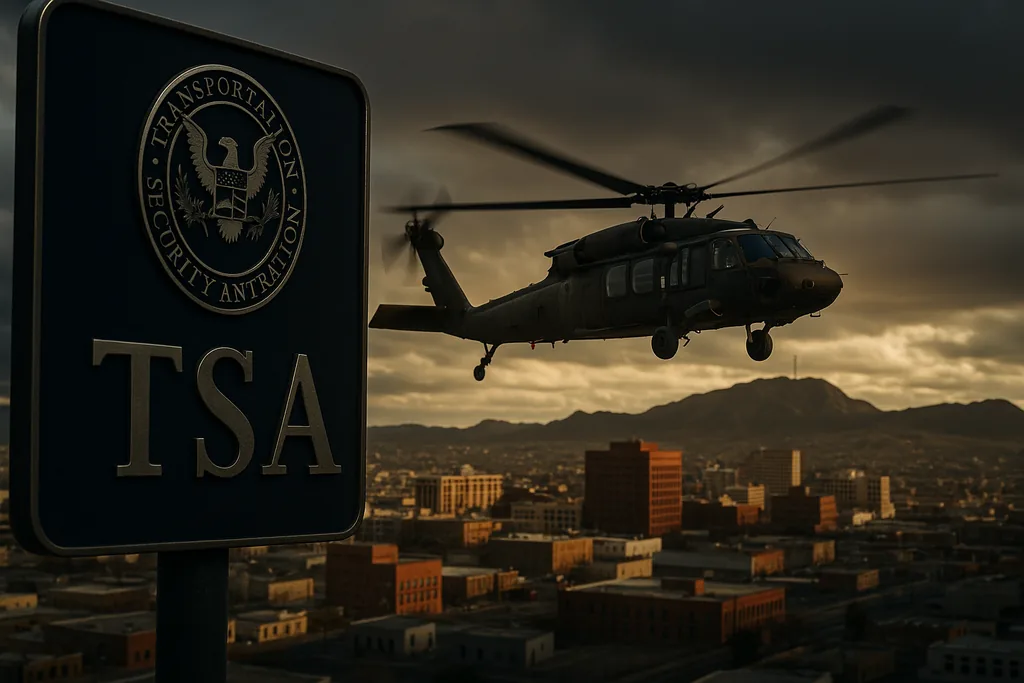
What is national defense airspace and why is it used in El Paso?
National defense airspace is a regulatory classification by the Federal Aviation Administration (FAA) for areas of extreme national security interest where flight operations are restricted, controlled, or prohibited to protect critical infrastructure, personnel, or U.S. territory. In El Paso, this designation has been used to implement a 10-day Temporary Flight Restriction (TFR) over El Paso International Airport and the surrounding 10-nautical-mile radius, effective from February 10 to February 20, 2026.
The sudden implementation of this restriction, which began at 11:30 PM local time on Tuesday night, has effectively paralyzed one of the region's most critical transit hubs. According to reporting from Eric Berger at Ars Technica, the FAA provided no detailed public explanation for the closure, citing only "special security reasons." This lack of transparency has sparked intense speculation, as El Paso International Airport serves more than 3 million passengers monthly and is situated in the 22nd most-populous city in the United States.
Local and state officials were reportedly caught off guard by the move. The New York Times noted that the Federal Aviation Administration (FAA) did not provide advance notice to municipal leaders before the airspace was locked down. This high-level federal intervention suggests a priority of national security that supersedes local commercial interests and regional travel logistics for the duration of the 10-day window.
Is it true that violators of the El Paso no-fly zone may be shot down?
Yes, violators of the El Paso no-fly zone may be subject to deadly force if an unauthorized aircraft is deemed an imminent security threat by the United States government. The FAA's official notice explicitly warns that pilots who fail to adhere to the restrictions may be intercepted, detained, and interviewed by law enforcement, and could face civil penalties or criminal charges.
The legal authority for such measures is rooted in 49 U.S.C. Section 40103, which grants the federal government the power to manage and secure the nation's navigable airspace. While the mention of "deadly force" is standard for specific "national defense airspace" classifications, its application over a major metropolitan airport like El Paso highlights the severity of the perceived threat or the sensitivity of the operations occurring within the zone.
For pilots in the West Texas and Southern New Mexico region, the Notice to Air Missions (NOTAM) serves as a final warning. Historically, TFRs of this magnitude are rare outside of presidential movements or major disasters. The inclusion of lethal force warnings indicates that the Federal Aviation Administration (FAA) and the Department of Defense are prepared to take extreme measures to ensure no unvetted aerial assets enter the 10-nautical-mile radius.
Is the El Paso airspace closure related to drones or hypersonic testing?
While the FAA has not confirmed a link to drones or hypersonic testing, the regional proximity to advanced military testing grounds strongly suggests a connection to sensitive aerospace maneuvers. The El Paso corridor is strategically located near White Sands Missile Range and Fort Bliss, both of which are central to the development of next-generation defense technologies and counter-UAS (Unmanned Aircraft Systems) operations.
The testing of hypersonic weapons, which travel at speeds exceeding Mach 5, requires vast "cleared corridors" to ensure that no civilian or commercial aircraft are at risk of a mid-air collision. Because these systems maneuver in ways that are difficult for traditional air traffic control to track, a total exclusion zone—such as the one recently established by the Federal Aviation Administration (FAA)—is often the only way to guarantee safety during high-stakes flight trials.
Additionally, the area is a known hub for integrated drone swarm testing. The Department of Defense has increasingly focused on the challenges of detecting and neutralizing small, coordinated groups of drones. Conducting these exercises over a controlled environment that mimics a metropolitan area, yet remains cleared of civilian traffic, provides researchers with invaluable data that cannot be replicated in remote desert locations alone.
Strategic Proximity: White Sands and Blue Origin
The geography of the El Paso closure is significant due to its proximity to Launch Site One, the private facility operated by Blue Origin in West Texas. While Blue Origin typically coordinates its suborbital launches with standard TFRs, a 10-day blanket closure of a major international airport suggests a far more complex or continuous operation than a single rocket launch.
White Sands Missile Range, located just north of El Paso in New Mexico, is the largest military installation in the United States. It frequently hosts tests involving electronic warfare, missile defense systems, and secretive aerospace prototypes. The decision to expand restricted airspace into the El Paso metropolitan area may indicate a need for an extended radar "blank spot" or a corridor for equipment that requires an unprecedented level of security and isolation from public observation.
Impact on Civil Aviation and the "What's Next" Scenario
The immediate impact on civil aviation is profound, with all commercial, cargo, and general aviation grounded at El Paso International. The FAA's protocol for communication with unauthorized aircraft during this period will involve high-frequency radio contact and physical interception by military jets if necessary. Travelers are currently advised to contact their airlines, though the 10-day duration suggests that many flights will be rerouted to neighboring hubs like Albuquerque or San Antonio.
As the February 20 deadline approaches, the aviation community will be watching for any extension of the Temporary Flight Restriction. If the closure is extended, it would signal a long-term shift in the regional security posture. For now, the Federal Aviation Administration (FAA) remains silent on the specific catalysts, leaving a void filled by the logistical challenges of a grounded city and the silent operations of the nation's most advanced defense assets.
- Location: El Paso International Airport and 10-nautical-mile radius.
- Duration: February 10, 11:30 PM to February 20, 11:30 PM (MST).
- Restriction Level: National Defense Airspace (Deadly Force Authorized).
- Primary Impact: Total halt of commercial and private aviation.
Future directions for this research and reporting will likely focus on FOIA (Freedom of Information Act) requests directed at the FAA and the Department of Defense. Once the 10-day window concludes, satellite imagery and flight tracking data from the perimeter may provide more concrete evidence of whether the closure was necessitated by a localized national security threat or the testing of advanced aerospace technology that defines the future of American defense.




Comments
No comments yet. Be the first!