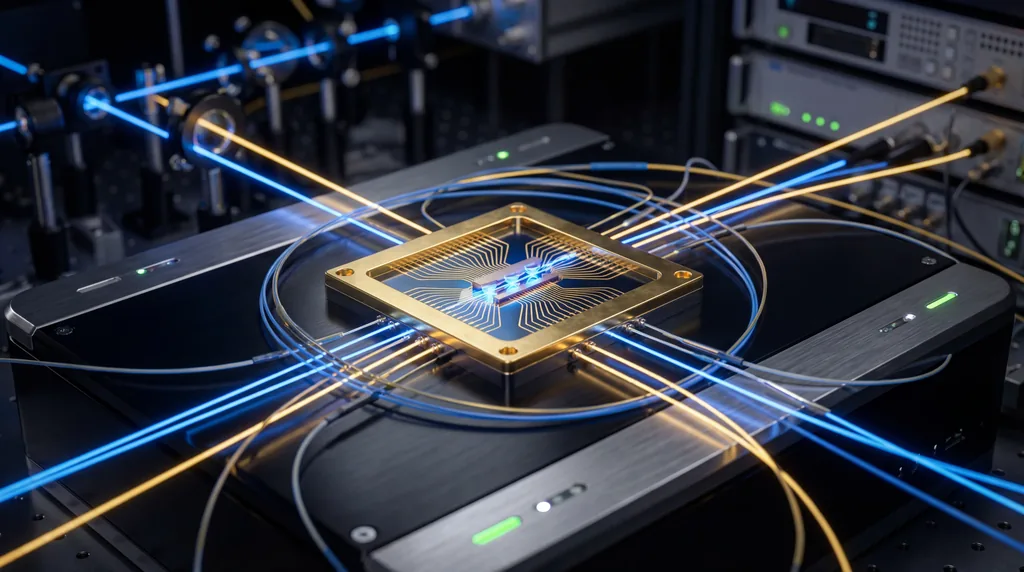

In early 2026, researchers at the University of Science and Technology of China (USTC) achieved a landmark breakthrough in quantum computing and communication by demonstrating a scalable building block for quantum repeaters. This advancement, published in the journal Nature, utilized long-lived trapped-ion quantum memories and efficient telecom interfaces to establish entanglement over 10 kilometers of optical fiber. By overcoming the rapid decoherence of remote quantum states, the team, led by Hao Li, Yi Yang, and Ye Wang, has provided the first practical evidence that metropolitan-scale quantum networks are physically and technologically viable.
The vision of a global Quantum Internet relies on the seamless integration of quantum communication, quantum metrology, and distributed quantum computing. Such a network promises a paradigm shift in how information is processed and secured, offering high-resolution sensing and exponential speed-ups in computational tasks. However, the physical foundation of this network requires the deterministic distribution of entanglement—a phenomenon where particles remain connected regardless of distance—across vast geographical areas. Until recently, the infrastructure needed to maintain these fragile connections over long distances remained the industry’s most significant "missing link."
How do quantum repeaters solve photon loss in fiber optics?
Quantum repeaters overcome photon loss in fiber optics by dividing long communication links into shorter segments and using entanglement swapping to connect them without directly amplifying the signal. By employing quantum memories to store information while waiting for successful link confirmation, these repeaters prevent the decoherence that typically occurs during long-distance transmission. This method effectively bypasses the no-cloning theorem, which prevents the amplification of quantum states in the same way classical signals are boosted.
In traditional fiber-optic telecommunications, signal loss is managed through amplifiers that boost the intensity of light. In the realm of quantum computing and communication, however, standard amplifiers cannot be used because any attempt to copy or amplify a quantum state destroys the original information. This exponential photon loss in glass fibers has historically limited fiber-based quantum communication to relatively short ranges. Quantum repeaters address this by generating entanglement within local segments and then "swapping" that entanglement to the next segment, creating a continuous link that can span hundreds or even thousands of kilometers without the need for signal cloning.
What recent breakthroughs occurred in quantum repeaters in 2026?
The primary 2026 breakthrough involved the development of long-lived trapped-ion memories and a high-visibility single-photon entanglement protocol to establish memory-memory entanglement over 10 km. This research, authored by Hao Li and colleagues, achieved entanglement lifetimes that exceed the time required for establishment, solving the critical bottleneck of rapid decoherence in remote quantum memories. This marks a transition from theoretical laboratory designs to functional hardware capable of supporting metropolitan-scale quantum computing networks.
The methodology employed by the USTC team involved several key technological innovations. First, they utilized trapped-ion technology, which offers significantly longer coherence times compared to other solid-state systems. Second, they developed an efficient telecom interface that converts the ions' internal quantum states into photons compatible with existing fiber-optic infrastructure. This allowed the researchers to maintain memory-memory entanglement over a 10 km fiber link within the average time it takes to establish that entanglement. This synchronization is a vital prerequisite for scaling the network, as it ensures that the quantum information does not disappear before the next link in the chain is ready.
How will quantum repeaters enable device-independent QKD?
Quantum repeaters enable device-independent quantum key distribution (DI-QKD) by extending high-fidelity entanglement distribution over distances that are impossible for direct fiber links. By validating a positive secret key rate over 101 kilometers in the asymptotic limit, the USTC team demonstrated that quantum repeaters can facilitate "unhackable" communication. This ensures that the security of the communication is guaranteed by the laws of physics, regardless of the hardware's internal imperfections.
The practical demonstration of DI-QKD at a metropolitan scale is perhaps the most significant immediate application of this research. The team successfully distilled 1,917 secret keys from approximately 405,000 Bell pairs over a 10 km distance. Prior to this, DI-QKD was severely limited by distance; this new research extends the achievable range by more than two orders of magnitude. For governmental, financial, and personal data security, this represents a shift toward a future where quantum cryptography protects data against even the most sophisticated classical or quantum hacking attempts.
The implications for the field of quantum computing are profound, as these repeaters serve as the fundamental "building blocks" for a scalable architecture. By proving that entanglement can be established and held long enough for purification and swapping, Hao Li and his colleagues have provided a blueprint for multi-node networks. The ability to achieve a positive key rate over 101 km suggests that we are nearing the point where quantum nodes can be placed at intervals similar to current classical internet hubs, allowing for a hybrid infrastructure that transitions the world from classical to quantum-secure communication.
Looking ahead, the focus of quantum computing research will shift toward the integration of these repeater modules into existing commercial fiber networks. The "What's Next" for the USTC team and the broader scientific community involves optimizing the entanglement purification process to further increase the secret key rate and extending the network to include multiple nodes in a mesh configuration. As these systems move from 10 km to 100 km and eventually to global scales, the dream of a secure, interconnected Quantum Internet moves from the realm of theoretical physics into the reality of global telecommunications.
- Primary Research: A building block of quantum repeaters for scalable quantum networks.
- Lead Authors: Hao Li, Yi Yang, Ye Wang (USTC).
- Key Milestone: 10 km fiber entanglement with 101 km asymptotic capability.
- Technology: Trapped-ion quantum memories and telecom-interface conversion.
- Security Application: Breakthrough in Device-Independent Quantum Key Distribution (DI-QKD).




Comments
No comments yet. Be the first!