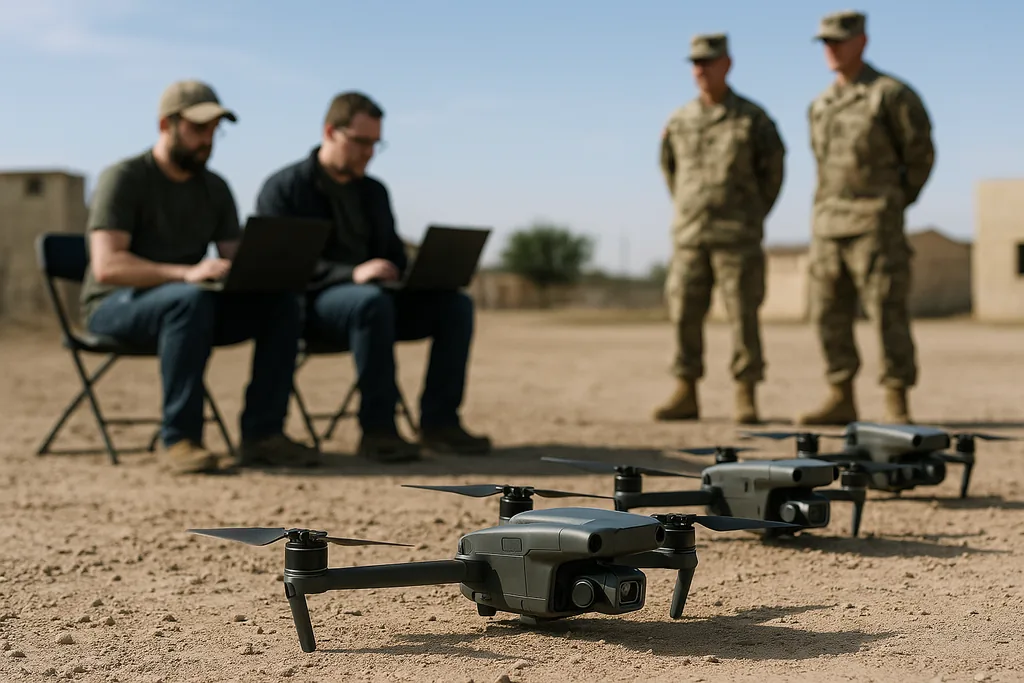
SpaceX will compete in a Pentagon contest on Feb. 16, 2026
On Feb. 16, 2026, news outlets reported that SpaceX and its recently acquired AI unit xAI have been selected to take part in a secretive Pentagon prize challenge to develop voice‑controlled, autonomous drone swarming technology — a story often indexed under the phrase "spacex compete pentagon contest." The competition, seeded with roughly $100 million and designed as a six‑month acceleration race, asks teams to show software that can translate spoken orders into digital instructions and coordinate multiple drones across domains. The early reporting tied the move to wider Pentagon efforts to speed adoption of AI for battlefield tasks and to SpaceX’s growing role as a defense contractor following its merger with xAI.
Bloomberg first detailed the list of select participants and the scope of the prize; Reuters and other outlets published summaries that same day. The Pentagon’s Defense Innovation Unit and the Defense Autonomous Warfare Group are named by officials and paperwork as the challenge sponsors, and the initiative is framed as one phase in a broader push to field more autonomous capabilities quickly.
spacex compete pentagon contest: what the challenge actually asks teams to build
The contest sets out a staged test plan that begins with software development and then moves to live trials on hardware if teams clear initial gates. Entrants must show they can translate a battlefield commander’s spoken instructions into machine‑actionable commands that an orchestration layer — sometimes described internally as the "orchestrator" or "Mission Control" — can use to direct fleets of unmanned systems. The scope includes cross‑domain coordination, for example directing small air and surface drones to reposition and share target awareness, with later phases asking for target‑related sensing and potentially end‑to‑end mission execution.
spacex compete pentagon contest: who else is building with voice tech and orchestration
The contest appears to have drawn a mix of traditional defense contractors, specialist autonomy firms and a handful of high‑profile AI labs. Reporting names Applied Intuition, Sierra Nevada Corporation and Noda AI as collaborators on at least one bid that incorporates an open‑source OpenAI model for voice translation, while other entries reportedly include major cloud and AI companies that already hold Pentagon contracts. Some entrants partnered with external AI providers to supply the voice‑to‑text and orchestration pieces rather than building every layer in‑house.
That mix reflects a deliberate Pentagon approach: pair domain expertise in autonomy and platforms with large language model capabilities for human‑machine interfaces, but confine generative models to translation and interface tasks rather than giving them authority over targeting or kill decisions. The document reviewed by reporters places the generative AI or language model inside a command translation role in the stack, between a human operator and the swarm controller.
Operational and ethical stakes
The technical ask is straightforward to describe but fiendishly hard to execute safely: making voice commands unambiguous, ensuring the model’s outputs are robust under stress and noise, and guaranteeing the orchestration layer won’t misinterpret or "hallucinate" orders under adversarial conditions. Large language models are known to produce confident but incorrect answers in ambiguous situations, a class of failure that raises special risks when those outputs are translated into machine movement or engagement instructions.
Beyond pure reliability, the project rekindles deep ethical concerns about autonomy in weapons systems. Officials briefed on the effort told reporters that the contest is intended to accelerate capabilities but also to constrain where generative AI is used — limited to translation rather than autonomy of lethal decisions. Still, the notion of voice‑driven orchestration for swarms that can make some real‑time choices alarms ethicists, some defense insiders and workers at AI labs who have historically resisted military applications of their tools. The tension — accelerate and control — is explicit in recent Pentagon policy moves to "unleash" AI while also attempting to bake in guardrails.
Why SpaceX is participating
SpaceX is already a major defense contractor and, according to reporting, the company folded xAI into its corporate structure shortly before announcing plans for an initial public offering. Entering the Pentagon contest gives SpaceX a route to broaden its government business into AI‑enabled robotic systems and to showcase xAI’s applied capabilities under the umbrella of an established prime. For the Pentagon, a large, well‑resourced participant like SpaceX brings engineering scale and experience integrating complex systems.
The move carries political and reputational tradeoffs. Elon Musk has previously supported calls for limits on offensive autonomous weapons, even as many of his companies have deep ties to defense customers. Participation signals that commercial AI firms and space companies are increasingly willing to engage directly in defense AI projects — a shift that has been accelerating across the industry.
How the Pentagon will judge submissions
Documents and officials described to reporters lay out an evaluation sequence that rewards safe, auditable translation from voice command to actionable plan, demonstrated orchestration of multiple assets, and progressively more advanced mission capabilities in later phases. Initial scoring concentrates on software correctness, interfaces, and resilience to ambiguous or noisy inputs; later gates will test live coordination and situational awareness sharing among platforms. The prize structure — an initial $100 million pool and a six‑month timetable — is intended to accelerate development while allowing the department to terminate or extend participation based on safety and performance.
What this means for deployment and policy
If the contest succeeds in producing robust orchestration software, the likely next steps are procurement pilots and integration with existing unmanned platforms. That could accelerate the Pentagon’s ability to employ dense swarms for reconnaissance, electronic warfare, logistics and, potentially, offensive missions — the latter being expressly part of the design according to the announcement language that frames the human‑machine interaction as affecting "lethality and effectiveness." Expect congressional and public scrutiny as prototypes move from software tests to live operations.
On the policy front, the contest highlights a persistent dilemma: the desire to harness commercial AI advances for national security while avoiding premature delegation of critical decisions to opaque models. That tension will shape future procurement rules, auditing requirements, and likely restrictions on which model classes and datasets are allowable for particular roles. The technical race is therefore also a regulatory and ethical one.
Sources
- U.S. Department of Defense (prize challenge announcement and related materials)
- Defense Innovation Unit (contest documents and solicitations)
- Defense Autonomous Warfare Group / Special Operations Command materials




Comments
No comments yet. Be the first!