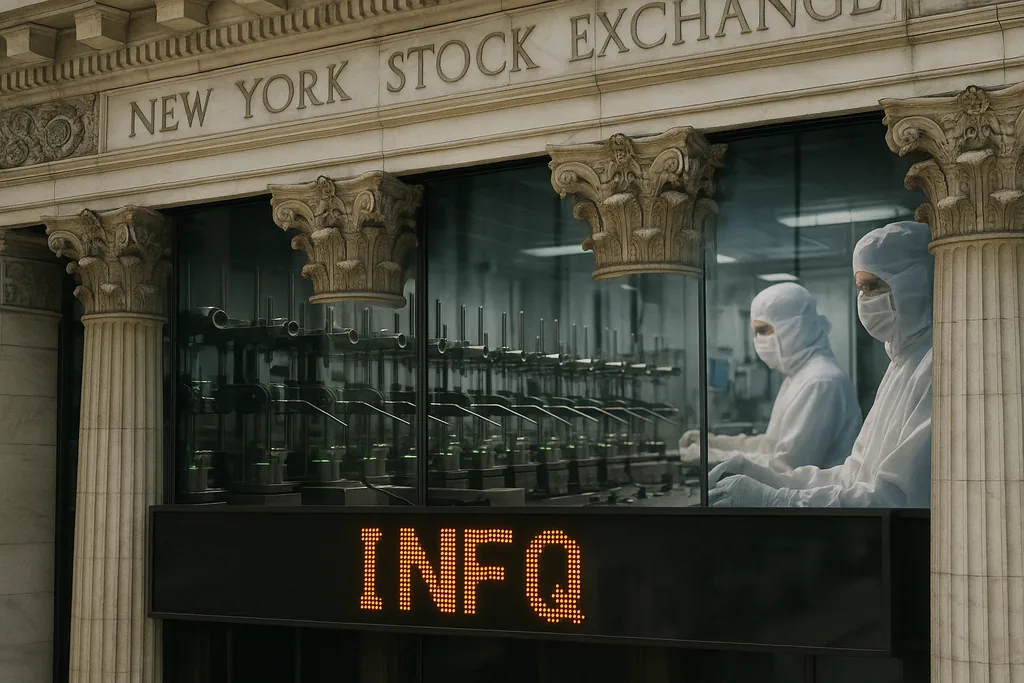
Today Infleqtion begins trading on the New York Stock Exchange under the ticker INFQ, marking the first public listing for a company built around neutral‑atom quantum technology. The move — the culmination of a SPAC combination that first surfaced in filings late last year and that gained momentum through scientific announcements and investor attention — shifts the conversation from private R&D milestones to market scrutiny, contracts and the cash Infleqtion will need to scale.
infleqtion begins trading nyse: what the listing means
The listing is in practical terms a transition from development-stage startup to a public company that must balance science, sales and quarterly reporting. Infleqtion framed the public debut as the next step to accelerate commercial deployments in aerospace, defense and critical infrastructure, areas where the company already sells precision sensing systems such as atomic clocks, RF instruments and inertial sensors. Those existing product lines set Infleqtion apart from many quantum names that pitch only long‑horizon computing gains.
For markets, the listing changes the signal set investors can use. Instead of only research papers and grant awards, analysts and investors will track contract announcements, revenue cadence, order books for sensors, and the cash Infleqtion carries into hardware scale‑up. At the same time, public trading exposes the company to retail flows, short‑term technical dynamics and the volatility that often follows SPAC transactions.
Finally, the NYSE debut also validates a business‑process milestone: the completion of the merger with the Churchill Capital SPAC vehicle and the mechanics that bring PIPE financing and trust cash onto the balance sheet. That procedural closure reduces some execution risk but replaces it with the new obligations of being a listed company.
infleqtion begins trading nyse — the neutral‑atom approach explained
Infleqtion is best described as a neutral‑atom quantum hardware and sensing company that pairs quantum computers with precision sensors and supporting software. In plain terms, the firm traps and manipulates arrays of neutral atoms — typically using tightly focused laser beams called optical tweezers — to encode and process quantum information, and it uses atom‑based techniques to build sensors that measure time, rotation and radio signals with extreme precision.
From SPAC to public company: the structure and the cash
Infleqtion’s NYSE debut follows a SPAC merger path that began with a deal announcement and subsequent regulatory paperwork. The SPAC structure brought two practical benefits: speed to public markets and a committed set of PIPE backers that were intended to deliver meaningful growth capital at closing. Those details matter because the size of the cash infusion available at close directly affects how quickly Infleqtion can expand labs, hire engineers, and build factory‑grade systems.
Market dynamics leading into the listing also included notable publicity events tied to the company’s scientific leadership. Public announcements and awards that highlight core scientists and technical credibility tend to shift sentiment, drawing retail attention and trading volume in SPAC timelines. But once the ticker opens, the market prices execution risk, not only technical potential.
How Infleqtion compares with other public quantum names
Infleqtion’s public listing adds a new axis to comparisons among quantum‑era companies. IonQ and other gate‑model creators focus primarily on building general‑purpose quantum processors based on trapped ions; other public firms target annealing or hybrid models, or combine software stacks with emerging hardware. Infleqtion’s pitch is distinct because it mixes a neutral‑atom gate‑model roadmap with an active, contractable sensing business today.
That blend matters for investors who want exposure to quantum technology but prefer some near‑term revenue visibility. If sensing contracts — especially with defense and aerospace customers — scale as management expects, Infleqtion could show commercial milestones while still investing in long‑cycle computing research. On the flip side, if sensing revenues remain niche and quantum compute scale‑up takes longer, INFQ may trade like other high‑risk frontier tech stocks: sensitive to execution news and broader sentiment swings in small‑cap markets.
Comparisons should also account for platform differences. Neutral atoms, trapped ions and superconducting qubits each bring tradeoffs in coherence time, gate overhead, and engineering complexity. Investors assessing public quantum equities therefore need to read both scientific progress and customer adoption in parallel.
What investors and customers should watch next
In the weeks and quarters ahead, four categories of updates will matter most. First, contract wins and revenue recognition for sensing products will test the claim that Infleqtion has a near‑term commercial channel. Second, capital and burn metrics — how much cash remains after the SPAC close and how quickly the company is spending it — will set expectations for delivery timelines.
Third, technical milestones from the neutral‑atom roadmap (error‑rate improvements, qubit counts and demonstration of error mitigation strategies) will influence long‑term upside. Fourth, any guidance on manufacturing plans or partnerships that help move systems from lab to production will shape investor confidence: scaling optical‑tweezer arrays and control electronics at industrial volumes is nontrivial and capital‑intensive.
For researchers and customers, the listing may also make it easier to evaluate Infleqtion’s public disclosures, procurement options and collaborations — a shift that often accompanies a company’s transition to being a public supplier in government and enterprise ecosystems.
As INFQ opens to public markets, the company turns a page: the narrative will now be written in contracts, balance sheets and quarterly metrics as much as in scientific papers and prize announcements.
Sources
- Infleqtion investor presentation and transaction materials (deal deck / investor presentation)
- Form S‑4 / SEC filing related to the Infleqtion and Churchill Capital Corp X business combination
- John Stewart Bell Prize announcement (award to Infleqtion chief scientist)
- NASA (customer and collaborator references cited in company materials)




Comments
No comments yet. Be the first!