'going critical': shipping takes a step closer to nuclear reality
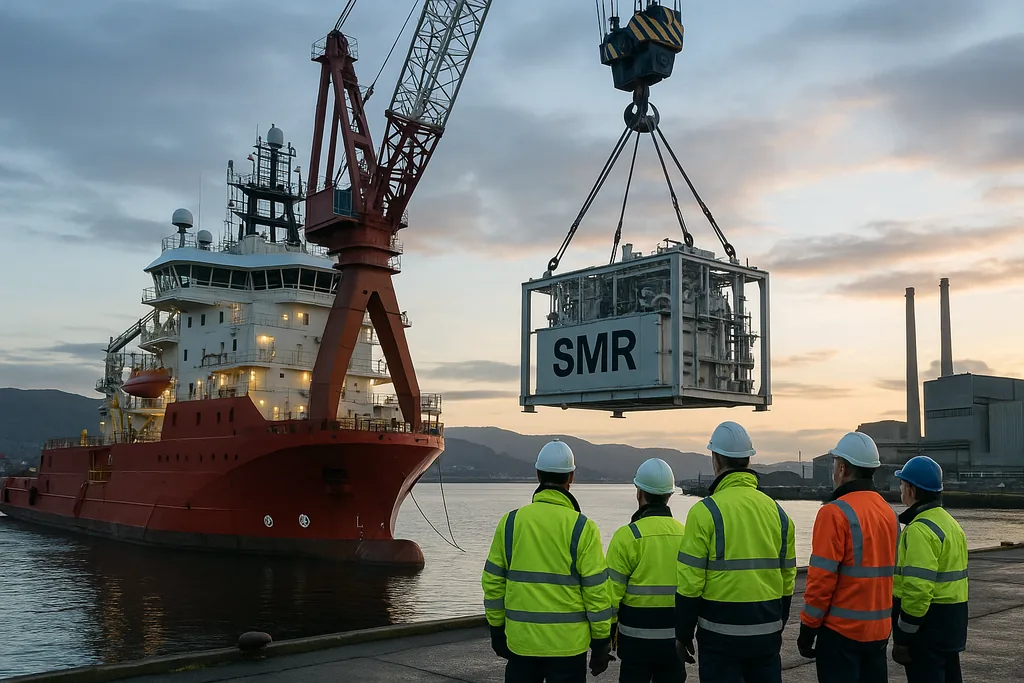
"Going critical": shipping takes a step closer to nuclear reality this week as Norway's NuProShip II feasibility work and a string of small‑reactor demonstrations elsewhere have turned a long‑running idea into a near‑term engineering programme. The phrase "going critical" has a double meaning here — in reactor physics it denotes the moment a core achieves a self‑sustaining fission chain reaction, and in industry shorthand it now captures the shift from laboratory designs and concept papers to projects that plan prototypes, funding and crew training. The latest project reports, government grants and private letters of intent suggest the maritime sector is no longer only talking about nuclear as a decarbonisation fantasy; teams are testing concrete reactor choices, conversion cycles and energy buffering systems so designs can be licensed, built and sailed in coming decades.
'going critical': shipping takes aim at DP vessels and offshore work
The NuProShip II study moved away from military‑style pressurised‑water reactors toward Generation IV small modular reactors (SMRs), and tested combinations such as helium gas‑cooled cores using TRISO particle fuel paired with supercritical CO2 (sCO2) power cycles. The result, engineers say, is a compact, high‑temperature heat source that can feed a small, factory‑built power conversion train. Because a reactor runs steadily rather than throttling rapidly, the concept layers a thermal battery — a heat buffer — to absorb base heat and deliver surges to thrusters on demand, a design that allows the ship to meet DP2/DP3 redundancy and instant response requirements while keeping the reactor's control systems stable and simple.
Engineering choices: helium cores, TRISO fuel, sCO2 and thermal batteries
Technical choices in NuProShip II and similar studies are deliberate, and they respond to lessons from both naval reactors and the new civilian SMR sector. Helium‑cooled, high‑temperature gas reactors allow lower‑pressure operation and higher thermal efficiency compared with pressurised water. TRISO fuel — ceramic coated particles that retain fission products — is favoured for its robust behaviour under accident scenarios and its passive containment properties. Supercritical CO2 cycles convert heat to work in a much smaller package than steam turbines, reducing below‑deck volume for equipment and crew spaces on a merchant hull.
How close is the industry? Pilots, prototypes and national SMR programmes
Today the industry is squarely in a demonstration and early design‑validation phase rather than mass deployment. NuProShip II has produced concept designs and technology roadmaps and will hand off industrialisation tasks to SFI SAINT (Sustainable Applied and Industrialised Nuclear Technology), an eight‑year centre backed by NOK 96 million in public funding and NOK 200 million in industry commitments to run from 2026 through 2034. That funding is intended to take technical concepts toward prototype hardware, supply‑chain shaping and crew training. If timelines hold, proponents envisage keel‑laying for a first nuclear‑propelled offshore construction vessel in the 2030s.
Outside shipping there are active land‑based and military adjacent pilots that matter to maritime timelines. Advanced SMR projects in the US — TerraPower's Natrium, Kairos Power's Hermes and other microreactor efforts such as Project Pele — are moving through demonstration or licensing stages. These projects underline two realities: regulators and national labs are being asked to adapt to new fuels (including high‑assay low enriched uranium, HALEU), and supply‑chain and enrichment capacity must scale if civilian SMRs and maritime variants are to spread internationally.
Regulatory, port and insurance challenges that remain large
Technology is only one axis of the problem. The existing international framework for nuclear merchant ships dates back to a 1981 code that pre‑dates passive‑safety SMRs, TRISO fuels and modern containment thinking. That code is not fit for the Gen‑IV gas‑cooled and factory‑built concepts now being proposed. To operate commercially, nuclear merchant ships must clear an intertwined set of obstacles: international treaty-level acceptance for port calls, harmonised classification society rules (DNV and others are already participating in design assurance), port contingency planning, liability and insurance regimes that go beyond ordinary P&I coverage, and acceptance by local communities and authorities where ships would be inspected or serviced.
Practical questions include: which authority licenses a shipboard reactor — a national nuclear regulator, the flag state, or a hybrid regime tied to IMO standards; how emergency planning zones are defined for vessels that can transit many jurisdictions; and how spent fuel and radioactive waste are handled after a vessel is retired. All of these require new international negotiation. Without agreed standards and port‑by‑port acceptance, a nuclear merchant vessel could find itself limited in where it may call — an untenable commercial risk for shipowners.
Safety framing: what 'going critical' means and how reactors are made safe at sea
In reactor physics, "going critical" means the core has reached a neutron multiplication factor of one — each fission produces, on average, one neutron that causes another fission — and the chain reaction is self‑sustaining. For ship designers and regulators the engineering objective is not to avoid criticality — that is how a reactor produces heat — but to design passive and engineered systems that make the core behaviour predictable, controllable and safe under all credible scenarios.
Modern SMR concepts emphasise passive safety: physics and materials that naturally shut down or dissipate heat if coolant is lost, coupled with fuel forms such as TRISO designed to retain radioactivity even under severe conditions. Shipboard designs add naval heritage (compact shielding, compartmentalisation, robust containment) and maritime redundancy practices. Nevertheless, safety trade‑offs must be examined alongside security and proliferation risks, especially where fuel types or reprocessing could change waste streams.
Why it matters: emissions, endurance and commercial opportunity
Shipping accounts for a significant share of global CO2 and other pollutants. For offshore operations, where bunkering logistics and endurance matter, nuclear propulsion promises zero operational emissions and effectively unlimited range between refuellings — a compelling value proposition for operators who now run fleets of diesel generators and carry heavy fuel inventories. For the wider merchant fleet, the picture is nuanced: nuclear could offset fossil fuels in niche classes (offshore service vessels, icebreakers, ferries, possibly some container or ro-ro ships) while other fuels — ammonia, hydrogen, methanol — may dominate shorter‑range or lower‑power segments.
Commercially, the market for factory‑built power plants and marine nuclear systems could create new industrial chains and skilled maritime nuclear crews, but only if designers, insurers and port states can agree on safe, replicable standards and investors can see a path to bankable projects rather than one‑off prototypes.
What's next and a realistic timeline
Expect activity to accelerate through the late 2020s and into the 2030s. NuProShip II will transition into industrialisation at SFI SAINT in 2026, national SMR demonstrations will press on with licensing and fuel supply work, and if first prototypes are built they will be classed and inspected under updated rules that industry and regulators will need to negotiate in parallel. Conservatively, the first oceangoing nuclear merchant or offshore construction vessel would be a 2030s ship — not because the physics is novel, but because port access, legal frameworks, fuel logistics and public consent must be solved first.
Sources
- The Information Technology and Innovation Foundation (ITIF report on Small Modular Reactors)
- Norwegian University of Science and Technology (NTNU) / NuProShip II project materials and SFI SAINT funding announcements
- International Atomic Energy Agency (IAEA) regulatory and SMR guidance
- Idaho National Laboratory (INL) and U.S. Department of Energy technical and demonstration programmes




Comments
No comments yet. Be the first!