Earth, a 340‑metre rock and a tight window
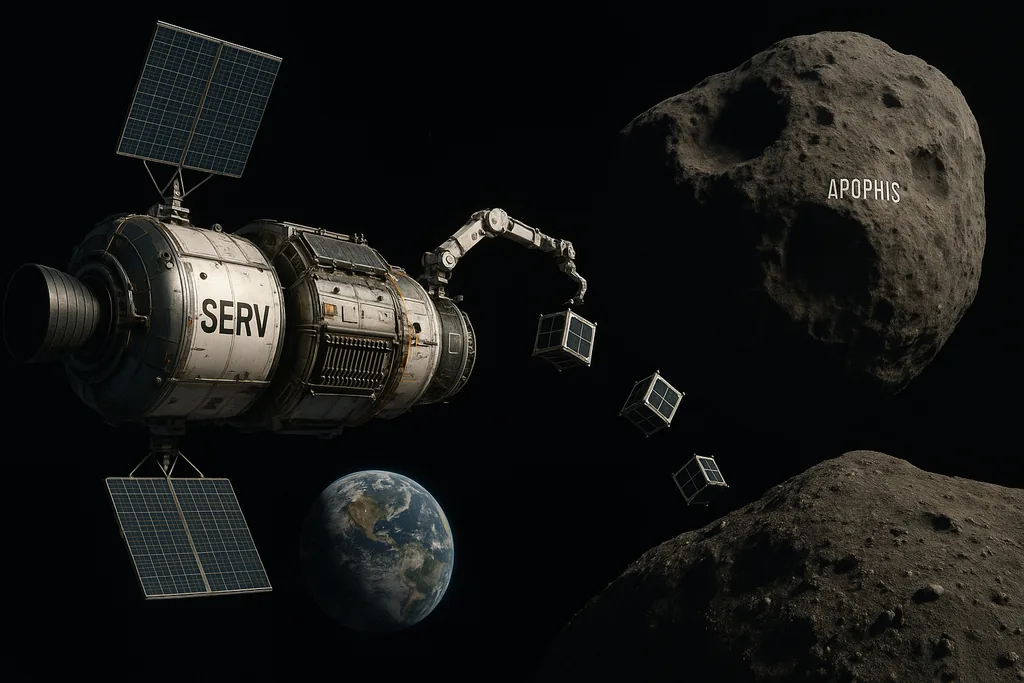
On 13 April 2029 the near‑Earth asteroid Apophis will sweep past our planet at roughly 32,000 kilometres — well inside the ring of geostationary satellites. That single datapoint is now the axis for an unlikely experiment: a small US company, ExLabs, plans to park a mothership nearby and release CubeSat‑scale landers to touch the asteroid’s surface during the flyby.
The detail matters because the timing compresses everything. ExLabs lists an April 2028 launch, a year of approach and rehearsals, and a goal of releasing tiny landers when Earth’s gravity and solar heating twist Apophis’s spin and surface behaviour. For students and smaller research teams, it promises rare, hands‑on access; for planners and regulators, it raises immediate questions about risk, oversight and the limits of commercial operations in crowded cislunar space.
A commercial deep‑space rideshare with academic passengers
ExLabs calls the mission ApophisExL and the carrier vehicle SERV, pitching it as the first commercial deep‑space rideshare. The SERV bus would host instruments, communications relays and a set of CubeLanders built on off‑the‑shelf CubeSat technology. The company has announced a formal partnership with the Planetary Exploration Research Center at Chiba Institute of Technology to fly student‑designed payloads, and says it will coordinate operations with NASA’s Jet Propulsion Laboratory.
That combination — private cash and hardware, university payloads, and agency operational advice — is increasingly familiar. What is less familiar is doing it for a target that will zip past Earth inside GEO altitudes, where national missions, commercial satellites and regulators are all watching the same sky.
Students, vendors and a hybrid mission architecture
ExLabs’s public materials emphasise accessibility: a hosted‑payload model intended to lower the barrier for universities and small national programmes to fly beyond Earth orbit. The student landers are presented as genuine flight hardware rather than educational mockups, and Chiba’s involvement gives the effort academic legitimacy.
Operationally, the SERV bus would characterise Apophis, practise proximity operations and then release cube‑scale landers in time to sample the rock’s response to tidal forces. That choreography is appealing on paper because it multiplies scientific return at a lower per‑team cost. In practice it also concentrates complexity on a single platform and a single launch window — a risky bet if anything slips.
Engineering tightrope: milligravity, loose regolith and autonomy
Landing on a sub‑kilometre asteroid is an engineering tightrope. Gravity is vanishingly small, the surface may behave unpredictably, and a lander can easily bounce away. ExLabs argues that CubeSat heritage and advances in small‑sat autonomy make the plan feasible, and it points to precedent from Hayabusa, Hayabusa2 and OSIRIS‑REx for specific techniques.
But there is a contradiction baked into the proposal: lowering the entry cost for universities implies smaller margins and less redundancy, while deep‑space operations reward conservative design and heavy testing. The result is a trade‑off between educational access and the extra engineering weight that makes planetary missions reliably successful.
Regulatory fault lines and the debris problem
Apophis will pass through an orbital regime thick with commercial and government assets. Any operation that places vehicles near an object transiting geostationary altitudes must coordinate to avoid accidental conjunctions or debris creation. ExLabs says it will work within existing licensing frameworks, but the company — and its academic partners — will need clear agreements with national authorities, satellite operators and export‑control agencies before launch.
Planetary protection is another unresolved knot. Forward contamination of a scientifically interesting body, and the risk that poorly tested contact operations might change Apophis’s spin or orbit in ways that complicate long‑term tracking, are real concerns. Those are precisely the questions that make agency partnerships attractive: national labs bring technical oversight and regulatory compliance that private teams may struggle to provide alone.
Multiple motives: science, defence data and prospecting hopes
The mission narrative folds several rationales together. Scientific teams want time‑series measurements of surface mechanics and spectral shifts as Apophis experiences Earth's tug. Planetary‑defence planners value improved in‑situ tracking and constraints on subtle forces that alter trajectories. Commercial proponents flag prospecting and resource‑identification as a downstream possibility, although those claims are speculative and would require follow‑on work and economic proof.
ExLabs insists the student payloads also serve workforce development: engineers who build flight hardware that leaves Earth orbit. That angle is persuasive — practical experience in deep‑space missions is scarce — but it sits uneasily with the high‑risk environment the mission proposes to use as a training ground.
A narrow countdown and a binary payoff
The calendar is unforgiving. If ExLabs maintains an April 2028 launch and the SERV bus reaches Apophis in time, the company will have months to validate systems, practise proximity‑operations and rehearse the release sequence. Success would be a striking demonstration that private teams can execute complex deep‑space tasks and could open the door to more commercial science and prospecting. Failure — even partial — would expose the real costs, the testing shortfalls and the operational hazards of shrinking high‑risk planetary missions into lower‑budget commercial offerings.
Either outcome will sharpen debates over how far the private sector should be allowed to go in crowded, high‑stakes arenas of space where scientific, commercial and defence interests overlap.
Sources
- NASA / Jet Propulsion Laboratory
- ExLabs (corporate mission materials)
- Chiba Institute of Technology, Planetary Exploration Research Center
- NASA OSIRIS‑APEX mission documentation




Comments
No comments yet. Be the first!