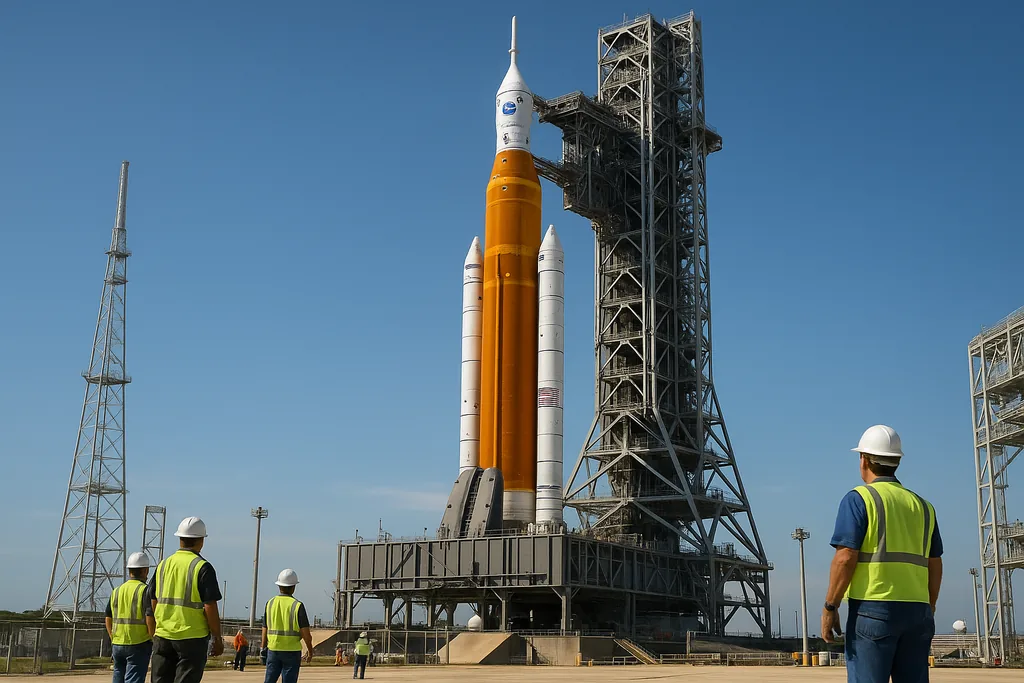
This week nasa sets date first for the Artemis II mission: NASA named 6 March 2026 as the earliest possible launch date for the agency's first crewed flight around the Moon in more than half a century. The announcement follows a successful "wet dress rehearsal" at Kennedy Space Center and a flurry of pad fixes and inspections, but agency leaders cautioned the timetable remains conditional on follow-up checks and any newly discovered issues.
nasa sets date first crewed Moon flyby: timeline and crew
Artemis II is scheduled as a roughly 10-day flight that will take four astronauts on a deep-space loop around the Moon and back. If it launches on the earliest target, the mission will spend the first day in Earth orbit, then take about four days to travel outward to the Moon, loop around the far side and begin a four-day return to Earth that ends with a Pacific Ocean splashdown. The crew announced for the mission comprises commander Reid Wiseman, pilot Victor Glover and mission specialist Christina Koch — all from NASA — together with Jeremy Hansen of the Canadian Space Agency, who will be the first Canadian to fly beyond low Earth orbit.
nasa sets date first mission: technical rehearsals and pad readiness
The decision to name an earliest launch date comes after two wet dress rehearsals — full-fueling, pad-countdown practice runs — at Launch Complex 39B. A first rehearsal in early February was cut short when technicians detected a liquid hydrogen leak in an umbilical connection; engineers subsequently replaced seals and inspected filters. A later rehearsal concluded to the point known as "T‑29 seconds," the moment before terminal count operations, and that success gave program managers confidence to propose 6 March as the earliest possible liftoff.
Even so, NASA officials stress that the date is contingent on completing pad repairs, a formal flight readiness review and a detailed dress-rehearsal analysis. News organisations have reported subsequent fault findings that could push a launch into later windows; mission planners note that the Moon's geometry constrains opportunities, so slipping a few weeks can move the target into the next available multi-day window. Those windows typically appear in short bursts spaced roughly a month apart, when orbital mechanics line up for an outbound trajectory to the Moon.
Mission profile and how a crewed Moon flyby differs from a landing
A crewed Moon flyby is a deep-space transit that carries people out past the Moon and around its far side without descending to the surface. Artemis II will not attempt a landing; the Orion capsule will remain in space and test systems in the harsher radiation and thermal environment beyond low Earth orbit. That contrasts with a landing mission, which requires an additional descent and ascent vehicle, surface systems and surface operations such as spacewalks, rovers and habitat support.
For Artemis II, the operational goals are practical and incremental: validate Orion's life-support and propulsion in a long-duration mission, exercise crew procedures for navigation and manual control, and collect medical and engineering data on human performance and vehicle behavior in deep space. Those tests are designed to reduce risk for a later mission that will place astronauts on the lunar surface, where descent vehicles, surface suits and long-term logistics introduce an entirely different set of technical and programmatic challenges.
Space weather, radiation and communications for a far-side flyby
Going beyond low Earth orbit exposes the crew and hardware to much higher radiation levels, and that is one of the mission's principal technical risks. Solar energetic particle events and coronal mass ejections can deliver bursts of high-energy protons that increase astronaut radiation exposure and can damage electronics. Galactic cosmic rays — high-energy particles from outside the solar system — also contribute a steady background dose that mission planners account for when sizing shielding and medical monitoring protocols.
Because the spacecraft will pass behind the Moon, the crew will experience predictable communications blackouts during segments when lunar mass blocks direct radio links to Earth. For a flyby, those blackouts are operationally manageable, but they complicate any response to an off-nominal situation. Space-weather forecasting, onboard radiation monitoring, hardened electronics, and pre-planned operational procedures to shelter the crew or reorient the spacecraft are all part of the mitigation strategy. NASA, working with international partners, continuously monitors the Sun to provide early warnings and contingency plans for missions like Artemis II.
Why Artemis II matters for the return to the lunar surface
Artemis II is a test flight but also a critical stepping-stone toward a crewed lunar landing under Artemis III. A successful flyby will provide engineering confidence in Orion, the SLS rocket, and mission operations in deep space — demonstrating that systems perform reliably and that crews can live and work during a multi-day transit beyond Earth's protective magnetosphere. Data from astronaut health monitoring and spacecraft sensors will feed design refinements for surface missions, including improved spacesuits, radiation countermeasures and landing architectures.
NASA currently aims for a lunar landing under Artemis III in the latter part of this decade, with partners providing a landing system. Commercial lander development continues in parallel; NASA's plans name commercial providers as the likely descent vehicle, but schedule pressure and technical hurdles mean timelines are still aspirational. International competition — notably from a growing Chinese lunar programme — adds strategic urgency, but the technical path remains sequential: validate crewed transit, demonstrate surface systems, then proceed to sustained lunar operations.
For the public curious about the schedule: NASA's earliest possible launch date is 6 March 2026, but that date was announced with caveats and may shift if further issues are found or if the agency's formal reviews require more work. The mission is planned to last about 10 days, with roughly four days outbound, several hours around the Moon and four days for the return to Earth. The flight will test systems rather than attempt a landing, and the crew of Wiseman, Glover, Koch and Hansen will be the four people making the journey if the launch proceeds as planned.
Technically, the mission will travel farther from Earth than any humans have in over 50 years and will provide the critical deep-space operational experience needed before crews again set foot on the lunar surface. Space weather remains a live technical constraint: while it is unlikely to cancel a mission on short notice, a significant solar storm could force procedural changes or, in extreme cases, a postponement. Likewise, communications interruptions on the far side are an accepted part of the profile and are accounted for in crew procedures and mission planning.
As NASA moves from rehearsal to final readiness reviews, the agency will balance schedule ambition with caution. A launch in early March would be a high-profile step back into deep space for astronauts and for the Artemis programme; a delay into April or later would be a reminder of the complexity and risk involved in returning people to the Moon. Either way, Artemis II is designed to answer core questions about life support, navigation, radiation exposure and vehicle performance that must be settled before landing humans on the lunar surface again.
Sources
- NASA (Artemis programme and mission briefings)
- Canadian Space Agency (crew participation and mission statements)
- Kennedy Space Center / Marshall Space Flight Center (wet dress rehearsal and pad operations)
- Space Launch System (SLS) / Orion programme technical briefings




Comments
No comments yet. Be the first!