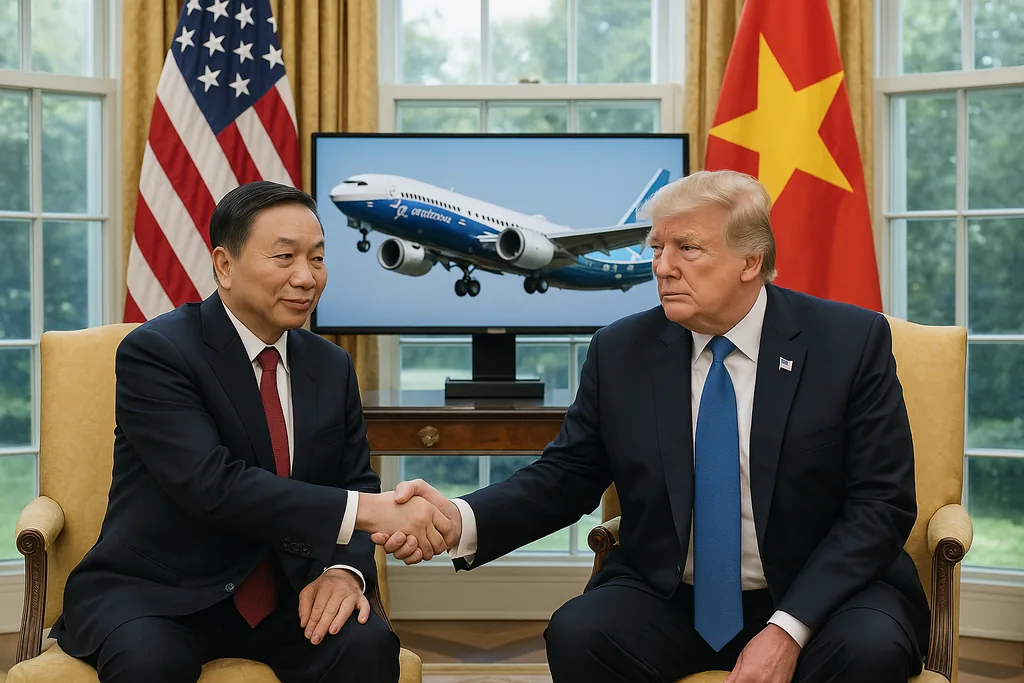
Washington meeting and the announcement
Today, President Donald Trump told Vietnam's top official To Lam in a White House meeting that the United States will ease certain restrictions on advanced technologies for Vietnam, Bloomberg reported and Vietnamese officials confirmed. The pledge came against the backdrop of Hanoi announcing roughly $39 billion in aircraft purchases from Boeing and posting a record $121.6 billion trade surplus with the United States in 2025. Vietnamese authorities did not publish a catalogue of the specific controls removed; instead they described Mr. Trump's comments as a political commitment to deepen economic, science and technology cooperation.
donald trump allow vietnam: what was said and who is To Lam
The visitor, To Lam, is the Communist Party chief of Vietnam and among the nation's most senior political figures; his trip to Washington was the highest-level in-person exchange between the two countries in recent months. During the meeting Mr. Trump publicly welcomed higher-level exchanges and accepted Lam's invitation to visit Vietnam, signalling a warming of bilateral ties that mixes trade, diplomacy and technology cooperation. For Washington, the engagement is simultaneously transactional — linked to big-ticket purchases and efforts to reduce a wide trade imbalance — and strategic, as both governments seek new commercial partners and supply-chain relationships in an era of tightened geopolitics.
donald trump allow vietnam: which technologies might be affected
Neither the Vietnamese statement nor US officials have published a list of the restrictions that have been lifted, so it is not possible at this stage to name exact items that Vietnam will now access. That said, observers and export-control specialists point to the categories typically controlled under US policy: high-performance semiconductors and chip-making equipment, certain telecommunications and networking gear, dual‑use sensors and avionics, and advanced manufacturing machinery. Defence‑grade systems and explicitly military technologies generally remain the most tightly restricted; any relaxation there would usually require a separate, formal process and often clearances by multiple agencies.
In practice, when presidents or senior officials signal a change it can mean several different legal and administrative steps: removal from an entity- or country‑specific list, the easing of licence requirements for particular end‑uses, or administrative guidance that streamlines commercial approvals. The details determine whether the change is narrow and transactional or broad and structural — and in this case those details have not yet been disclosed.
Geopolitical and economic motives behind the move
There are clear drivers for Washington behind the decision to say it will ease technology limits. The immediate economic backdrop is Hanoi's surge in purchases of US-made aircraft and aero-engines, plus pledges by Vietnamese carriers to buy other American goods as part of a push to reduce a large bilateral trade gap. For an administration that has repeatedly tied trade leverage to broader foreign policy aims, facilitating technology transfers can be a bargaining chip to secure industrial purchases or commitments to source in the United States.
Strategically, the United States has an interest in deepening engagement with Southeast Asian states to diversify supply chains away from single-country concentrations and to create stronger commercial and security ties in Asia. For Vietnam, access to advanced tools and machinery would accelerate industrial upgrading, help build local capabilities in electronics and aviation maintenance, and reduce the political pressure created by large trade imbalances.
Why did Donald Trump allow Vietnam access to restricted technology?
The most immediate answer is transactional: easing technology controls can be used as leverage to secure large procurement contracts and to encourage industrial ties that reduce trade frictions. Politically, an explicit offer from the US president signals to Vietnamese elites that Washington treats Hanoi as a partner worth investing in, and it rewards Vietnam's public support for initiatives the administration values. Policymakers also see economic benefits in reshoring or diversifying production of sensitive components; exporting controlled equipment to reliable partners under clear safeguards can strengthen allied supply chains and reduce dependence on adversary-dominated suppliers.
How export controls and safeguards work
Any real change will be mediated through US export-control systems. Agencies such as the Commerce Department's Bureau that administers dual‑use licensing evaluate applications on technical specifications, stated end‑use, end‑user assurances and the broader national‑security context. Lifting a restriction can take the form of a policy change, a removal from an entity list, or an increased willingness to grant licences, sometimes with strict end‑use monitoring, re‑export prohibitions and conditions attached. Congressional oversight and interagency review frequently accompany changes that touch on sensitive technologies.
Security risks, oversight and likely limits
Opening technology access to Vietnam raises immediate national‑security questions: could sensitive equipment be diverted to military uses inside Vietnam or re‑exported to third countries, including those of concern to the United States? Those concerns explain why explicit military systems and certain high‑end semiconductors typically remain controlled. In practice, US authorities can adopt layered safeguards — licence approvals conditional on end‑use checks, spot audits, technical limitations built into exported systems, and carve-outs that prevent re‑export to designated third countries.
Analysts caution that such safeguards are not foolproof. Vietnam's geographic proximity and economic ties to other powers mean Washington will likely insist on enhanced compliance measures, intelligence sharing and legal guarantees. Any broad relaxation without detailed vetting would attract scrutiny from allies and from domestic US oversight bodies that evaluate whether national‑security interests are sufficiently protected.
Potential impacts on US‑Vietnam cooperation
If implemented as a targeted, controlled easing, the shift could speed industrial partnerships — in civil aviation maintenance, advanced manufacturing, and certain information‑technology sectors — while giving US firms access to Vietnamese markets. Conversely, a broad or poorly supervised relaxation risks eroding trust among US allies and could create friction inside the US government and Congress, where oversight bodies watch transfers of strategically important technology. Expect negotiations to follow, with concrete licensing rules and maybe sectoral agreements announced in the weeks to come rather than an immediate, blanket lifting of controls.
For now, the headline — that Donald Trump will allow Vietnam to access restricted technology — sets a political tone rather than a new legal reality. The real test will be the paperwork, regulatory changes and interagency decisions that translate a White House assurance into definite, lawful transfers with enforceable safeguards. Both governments have signalled an appetite for deeper ties; converting that appetite into specific, secure, mutually beneficial technology cooperation will require detailed, technical negotiations and continued oversight.
Sources
- Bloomberg reporting on the US‑Vietnam meeting and technology comments
- Reuters trade data and reporting on Vietnam's 2025 trade surplus
- US Department of Commerce — export control policy and licensing frameworks
- Vietnamese government statements and trade announcements (aircraft purchase disclosures)




Comments
No comments yet. Be the first!