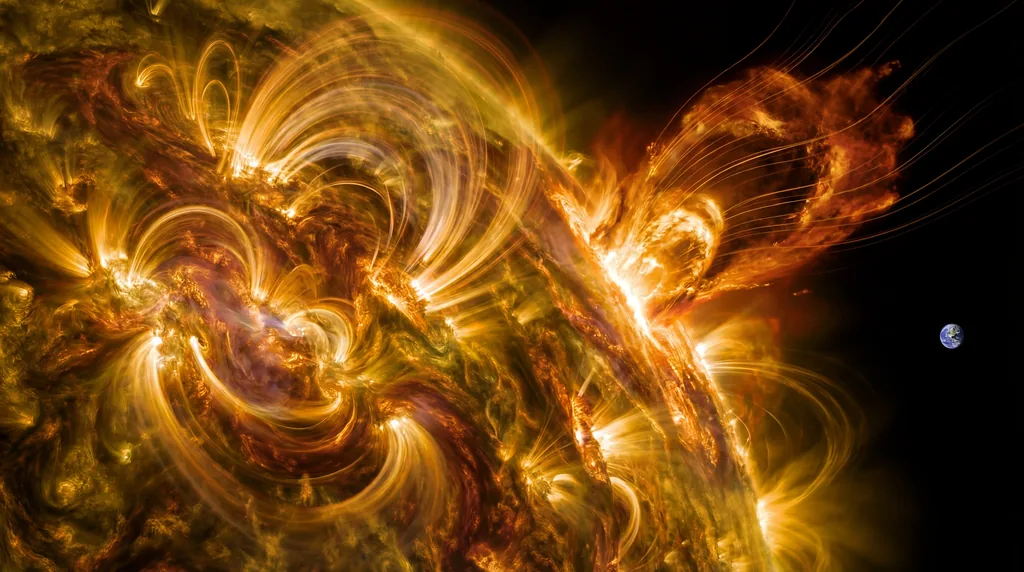

Researchers have successfully mapped the electron density of the Solar Corona using low-frequency radio observations, bridging a long-standing gap in our understanding of the Sun’s outer atmosphere. By utilizing the Long Wavelength Array at the Owens Valley Radio Observatory (OVRO-LWA), a team led by researchers Bin Chen, Shaheda Begum Shaik, and Gregg Hallinan has provided a more robust method for measuring plasma density between 1.7 and 3.5 solar radii. This discovery, detailed in their study "Estimating Electron Densities in the Middle Solar Corona using White-light and Radio Observations," validates theoretical models and offers a new, low-latency tool for predicting space weather events that can impact Earth’s technological infrastructure.
What is the OVRO-LWA and its role in solar radio observations?
The OVRO-LWA is a low-frequency radio interferometer in California consisting of 352 antennas that operate between 13–87 MHz to capture high-resolution images of the Solar Corona. It serves as a solar-dedicated all-sky imager, providing the high dynamic range necessary to monitor the middle corona for radio bursts, transients, and evolving plasma densities in near-real-time.
Solar radio observations have traditionally been difficult to capture with the precision needed for density modeling, but the OVRO-LWA’s 2.4-kilometer span allows it to function as a powerful "radio lens." Unlike traditional telescopes, this array produces science-ready images with incredibly low latency. This capability is vital for researchers who need to observe the Solar Corona during rapidly changing conditions, such as the onset of a solar flare or the launch of a plasma cloud toward Earth. By focusing on the 15–87 MHz range, the array targets the exact altitudes where the solar wind begins its primary acceleration.
The Owens Valley Radio Observatory has designed this system to overcome the limitations of single-dish radio telescopes. By combining signals from hundreds of antennas, the array can distinguish between different types of radio emissions, such as gyrosynchrotron radiation and plasma bursts. This level of detail allows scientists to construct a three-dimensional understanding of the middle corona, a region often referred to as the "no man's land" of solar physics because it sits between the areas best served by extreme ultraviolet imagers and outer-space coronagraphs.
How can radio observations improve electron density estimates in the Solar Corona?
Radio observations improve density estimates by detecting emissions from nonthermal electrons that are highly sensitive to local plasma conditions in the middle Solar Corona. These low-frequency measurements provide an independent validation of white-light data, allowing scientists to bypass the simplifying assumptions and complex mathematical inversions typically required by optical coronagraphs to estimate electron volumes.
Historically, the scientific community has relied on white-light coronagraphy, which measures the sunlight scattered by electrons in the Sun's atmosphere. However, converting these light measurements into accurate electron density maps requires assuming a specific geometry for the solar atmosphere, which can introduce significant errors. The research by Shaheda Begum Shaik and colleagues demonstrates that radio interferometry provides a "ground truth" that matches these optical results while offering a more direct probe into the density structures of the middle corona (1.7–3.5 $R_\odot$).
The team’s methodology involved comparing OVRO-LWA data with existing theoretical predictions and traditional coronagraph results. Their findings culminated in a new, highly accurate density model for the middle corona, expressed by the formula:
- ρ(r') = 1.27r'⁻² + 29.02r'⁻⁴ + 71.18r'⁻⁶
- Where r' represents the heliocentric distance in solar radii.
How do coronal mass ejections affect electron densities in the Solar Corona?
Coronal mass ejections (CMEs) dramatically increase electron densities in the Solar Corona by injecting massive quantities of nonthermal particles and plasma into the heliosphere. These events create intense radio bursts and gyrosynchrotron emissions that low-frequency arrays like the OVRO-LWA can track to monitor the propagation and speed of the CME as it travels outward.
Coronal Mass Ejections are among the most energetic events in our solar system, capable of disrupting satellites and power grids on Earth. When a CME erupts, it pushes through the middle corona, creating a wake of increased electron density. The OVRO-LWA’s ability to detect these density spikes in the 1.7–3.5 $R_\odot$ range is critical for space weather forecasting. Because radio waves travel at the speed of light, they provide the earliest possible warning of a CME’s characteristics, long before the actual plasma cloud reaches Earth-based sensors.
The impact of these density changes is currently visible in active space weather patterns. For instance, recent data indicates a Kp-index of 5, signifying a Moderate (G1) geomagnetic storm. This activity, driven by fluctuations in the solar wind and coronal density, has made the aurora visible in several northern regions:
- Fairbanks, Alaska (USA)
- Reykjavik, Iceland
- Tromsø, Norway
- Stockholm, Sweden
- Helsinki, Finland
Implications for Space Weather and Future Research
The development of a reliable density model using the Owens Valley Radio Observatory data marks a significant milestone in heliophysics. Accurate maps of the Solar Corona are not just academic; they are essential for the safety of our digital world. When we can precisely measure the electron density in the path of a solar storm, we can calculate the "drag" or acceleration the storm will experience, leading to much more accurate arrival time predictions for CMEs.
Furthermore, the high-impact nature of this research is reflected in the growing reliance on solar-dedicated radio arrays. The study by Bin Chen and his team proves that radio astronomy can provide the "missing link" in solar monitoring. As the OVRO-LWA continues to provide low-latency, science-ready data, it will likely become a cornerstone of global space weather warning systems, working alongside NASA and ESA satellite missions to provide a multi-wavelength view of our star.
Looking ahead, the researchers aim to expand these density estimates to even greater heliocentric distances. By refining the OVRO-LWA’s imaging algorithms, they hope to track the evolution of the Solar Corona across an entire solar cycle. This long-term monitoring will help scientists understand how the Sun's density profile changes as it moves from solar minimum to solar maximum, ultimately revealing the hidden mechanics behind the solar wind's constant flow.
Viewing Tips for the Current G1 Solar Storm
For those interested in the real-world effects of coronal density shifts, the current Moderate (G1) storm offers a prime viewing opportunity for the Northern Lights. Space weather experts recommend finding a location away from city lights between 10 PM and 2 AM local time. Look toward the northern horizon, particularly in high-latitude cities like Fairbanks or Reykjavik, where the aurora may appear overhead due to the Kp 5 intensity level. Always check local weather forecasts for clear skies to ensure the best possible visibility of this solar phenomenon.




Comments
No comments yet. Be the first!