
Device-independent quantum state certification works by verifying the integrity of quantum signals without needing to trust the internal workings or "black-box" mechanics of the hardware involved. This process relies on observed measurement statistics, such as Bell inequality violations, to confirm that a quantum state matches its target, ensuring high-security quantum cryptography and reliable data transmission even when components are uncharacterized. By removing the requirement for shared randomness between preparation and measurement devices, researchers can achieve a higher level of "untrusted" security in complex networks.
The race to build a global Quantum Internet has reached a critical juncture where the simple two-dimensional qubit—the quantum equivalent of a binary bit—is no longer sufficient for high-speed, high-capacity communication. To overcome these limitations, scientists are turning toward high-dimensional quantum states, which can carry significantly more information per particle. However, as the complexity of these states increases, so does the difficulty of verifying them. Traditional certification methods often assume that the devices used for state preparation and measurement are perfectly calibrated or share a source of randomness, an assumption that rarely holds true in real-world, decentralized networks.
In a groundbreaking study published by researchers Zhe Sun, Yong-Nan Sun, and Franco Nori, a new experimental framework has been established to certify these complex states using independent quantum devices. This research represents a significant leap forward because it allows for the "black-box" certification of quantum ensembles without requiring any prior synchronization or shared randomness between the hardware components. This methodology is essential for the future Quantum Internet, where various nodes owned by different entities must communicate securely without implicit trust in each other's hardware.
What are the applications of 'Twisted Light' in quantum technologies?
'Twisted Light' or orbital angular momentum (OAM) enables high-dimensional quantum state certification, allowing for increased bandwidth and higher data capacity within a Quantum Internet. Its primary applications include enhancing the throughput of quantum key distribution (QKD), facilitating robust entanglement distribution across long distances, and providing a scalable architecture for secure, device-independent communication protocols in global networks.
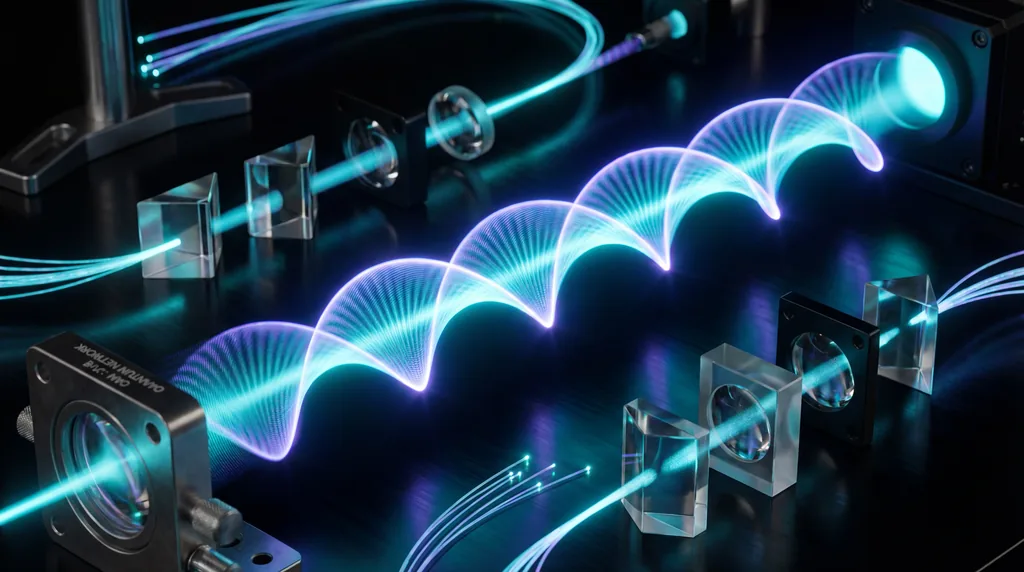
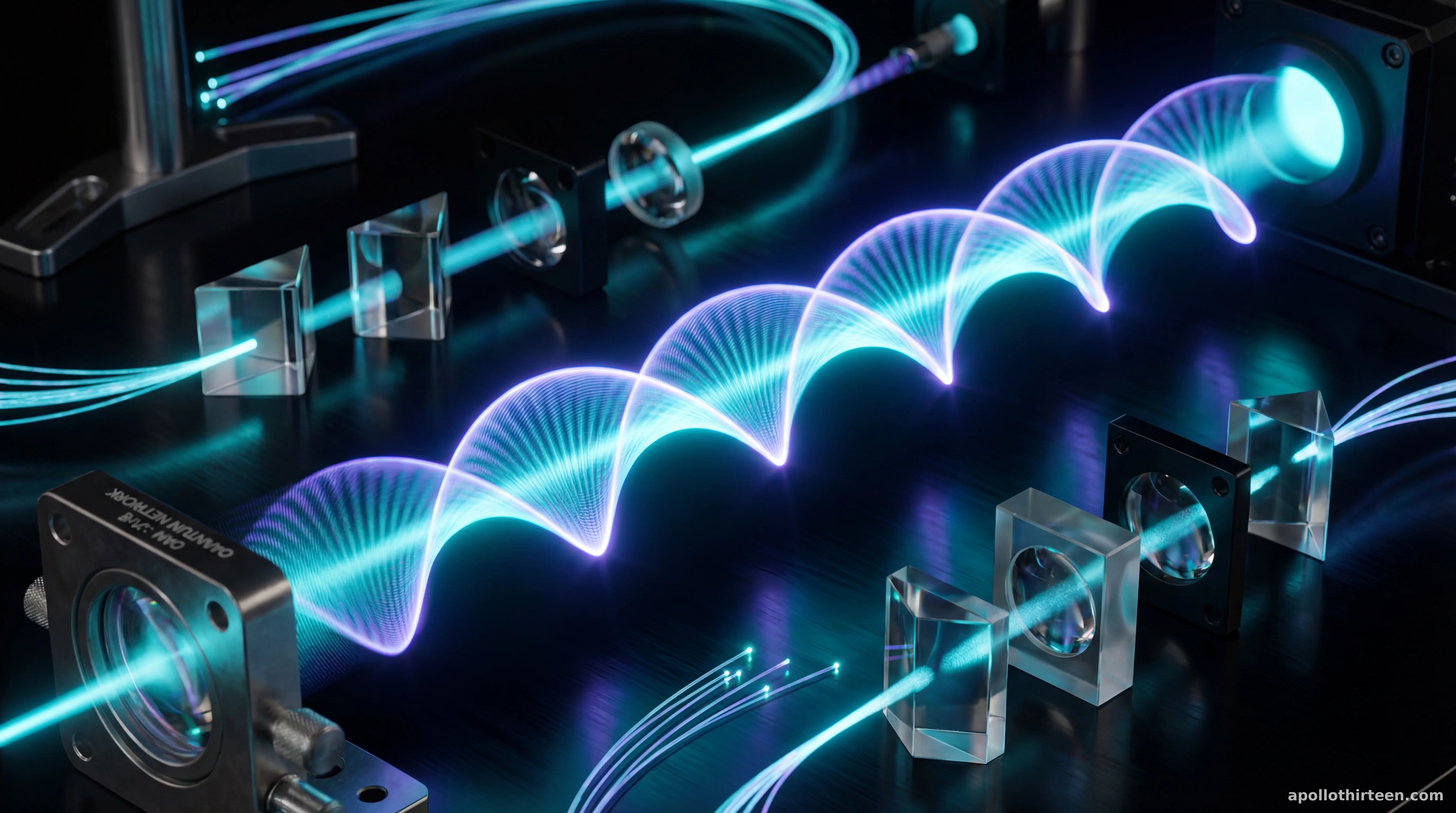
Orbital Angular Momentum (OAM) refers to a physical property of light where the wavefront of a photon twists in a helical or spiral shape as it propagates. Unlike standard polarization, which is limited to two dimensions, OAM offers an theoretically infinite Hilbert space, meaning a single photon can exist in a high-dimensional state. By "twisting" the light, researchers can encode vast amounts of data into different degrees of rotation, effectively creating "qudits" rather than "qubits." This dimensionality is the key to scaling the data-carrying capacity of future optical networks.
The research team utilized these OAM states of single photons to test their certification protocol in a prepare-and-measure experimental setup. By focusing on high-dimensional orbital angular momentum, the team was able to demonstrate that information density can be scaled without sacrificing the ability to verify the signal's authenticity. This is particularly relevant for Photonics, as OAM-based systems can be integrated into existing fiber-optic infrastructures or free-space satellite links, providing a versatile platform for Quantum Cryptography.
Can quantum signals survive atmospheric turbulent noise?
Quantum signals can survive atmospheric turbulent noise when certified through robust high-dimensional state protocols that account for environmental interference and crosstalk. Experimental results demonstrate that even under the influence of atmospheric turbulence, quantum state certification remains achievable, ensuring that "twisted light" signals can be verified and utilized for secure communication in real-world, free-space conditions.
Atmospheric turbulence has long been a nemesis for free-space quantum communication, as shifting air densities and temperature fluctuations can distort the delicate phase and intensity profiles of "twisted light." These distortions lead to crosstalk, where information from one quantum state leaks into another, potentially destroying the entanglement or the encoded data. For a Quantum Internet to function globally, signals must be able to travel through the open air—between buildings or from the ground to satellites—without losing their quantum properties.
In this experiment, Zhe Sun and the research team explicitly investigated the impact of turbulent noise on the certification process. They found that while noise does introduce challenges, the high-dimensional certification protocol remained resilient. The researchers measured crosstalk matrices and calculated similarity parameters for states up to ten dimensions, proving that the mathematical "fingerprint" of the quantum state could still be extracted and verified despite the chaotic interference of the atmosphere. This robustness is a vital requirement for the deployment of Quantum State Certification in unpredictable environments.
The Experimental Breakthrough: Independent Device Certification
Independent device certification is achieved when the state preparation device and the measurement device operate without any shared randomness, ensuring a semi-device-independent scenario. In the study led by Franco Nori and his colleagues, the team achieved a remarkable 99.0% preparation and measurement fidelity for six-dimensional quantum states. This level of precision indicates that the signals were nearly perfect representations of the intended quantum information, even when the devices were treated as "black boxes."
- High Fidelity: The team recorded a 99.0% fidelity rate for 6D states, a metric that signals extremely low error rates.
- Scalability: Experimental investigations were extended up to ten dimensions, measuring the crosstalk matrices to ensure data integrity.
- No Shared Randomness: The protocol assumes the preparation and measurement hardware are independent, which is critical for preventing side-channel attacks in Quantum Cryptography.
- Ensemble Certification: The research provides a method to certify the entire ensemble of states, rather than just individual particles, improving the efficiency of the verification process.
This "semi-device-independent" approach bridges the gap between fully device-independent (DI) protocols—which are notoriously difficult to implement over long distances—and device-dependent protocols, which require total trust in hardware. By allowing for independent devices, the researchers provide a pathway for manufacturers to produce quantum hardware that can be verified by the end-user, regardless of the manufacturer's own security standards or internal configurations.
Implications for the Future Quantum Internet
Scaling the Quantum Internet requires more than just faster transmission; it requires a foundational layer of trust and verification that can handle high-dimensional data. The ability to certify OAM states with 99% fidelity ensures that as we move toward 10D, 20D, or even higher-dimensional systems, the security of the data remains intact. This has profound implications for secure financial transactions, governmental communications, and quantum random number generation, where the purity of the quantum state is the ultimate guarantor of randomness.
The collaboration between researchers like Franco Nori, who is a leading figure in quantum information science, and the experimental teams involved highlights the interdisciplinary effort needed to bring these theories to life. As these certification protocols become more refined, they will likely be integrated into the standardized "stack" of quantum networking technologies. The successful navigation of atmospheric turbulent noise also suggests that we are closer than ever to a satellite-based Quantum Internet that can serve the entire planet, bypassing the physical limitations of fiber-optic cables.
Looking ahead, the next phase of this research will likely focus on increasing the dimensionality beyond ten and testing the certification protocols over even greater distances. By refining the crosstalk matrices and improving the similarity parameters, scientists aim to create a "plug-and-play" certification system for any high-dimensional quantum state. This will ensure that the future of global communication is not only faster and more powerful but also fundamentally more secure than anything possible with classical technology.



Comments
No comments yet. Be the first!