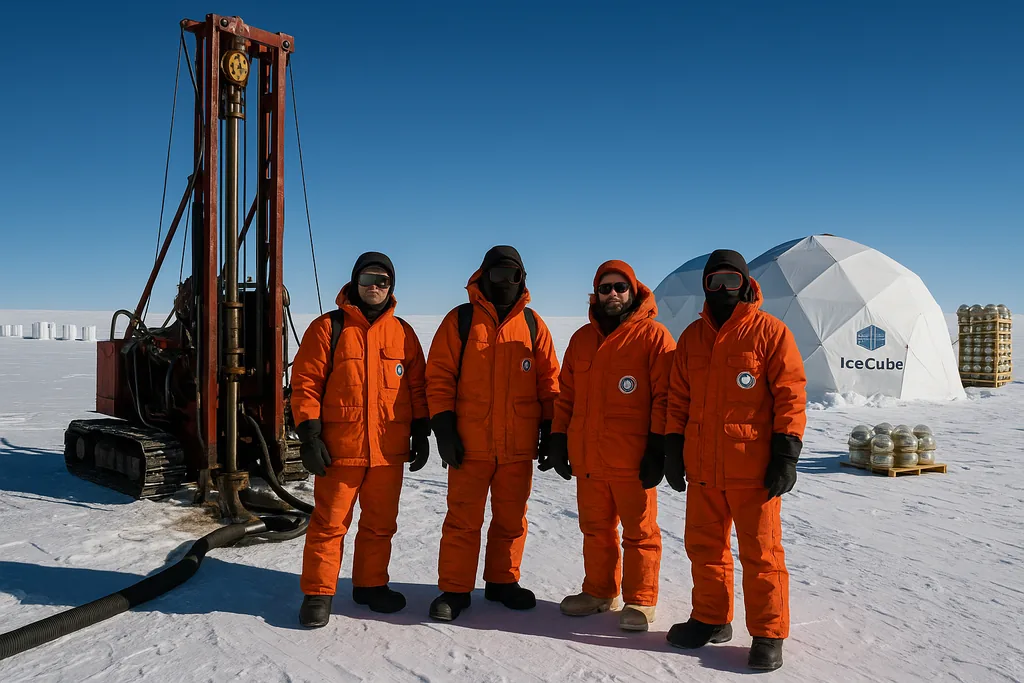
This week the National Science Foundation announced a significant enhancement to the IceCube Neutrino Observatory at the South Pole — the antarctica 'ghost particle' observatory — a facility buried deep in Antarctic ice that listens for the universe's most elusive messengers. The upgrade installs new optical modules, denser instrumentation and precision calibration tools intended to sharpen IceCube's view of neutrinos across a wider energy range. Scientists say the improvements reduce key systematic uncertainties and will let the experiment push into questions about neutrino physics, astrophysical particle accelerators and possible dark‑matter signatures.
Antarctica 'ghost particle' observatory: how IceCube works
IceCube is not a conventional telescope. It is a cubic kilometre of detector instrumented with light sensors called digital optical modules, deployed on vertical cables — or "strings" — that are frozen into the clear Antarctic ice many hundreds of metres below the surface. When a neutrino interacts with a nucleus in the ice, it can produce charged particles that travel faster than light does in that medium; those particles emit a faint cone of blue Cherenkov light. The optical modules record the arrival time and intensity of that light, and scientists use that information to reconstruct the incoming particle's direction and energy.
The detector's huge volume compensates for the neutrino's reluctance to interact: a larger target increases the tiny chance of a collision. It is that mix of scale, the optical clarity of the glacier and dense arrays of sensors that has allowed IceCube to transform neutrino detection from rare, isolated events into a sustained astrophysical enterprise.
Antarctica 'ghost particle' observatory upgrade: what's new
The current upgrade delivers two classes of improvements: hardware with finer granularity and a suite of calibration systems to slash measurement uncertainties. New strings of optical modules include next‑generation sensors with multiple smaller photomultipliers inside a single instrument, providing more directional information from each detection point. The array's denser spacing in the upgraded volume improves sensitivity to lower‑energy neutrinos and gives better reconstruction of particle tracks and showers.
Alongside the sensors, teams deployed advanced calibration devices — controlled light sources, cameras and instrumentation that characterise how light propagates through the ice and how individual modules respond. Those calibrations are crucial: the ice is not perfectly uniform, and small variations in dust or air bubbles change how Cherenkov light is scattered and absorbed. By mapping those effects precisely, researchers can correct systematic biases that previously limited angular and energy resolution.
The National Science Foundation’s backing and logistical support at the Amundsen‑Scott South Pole Station have been essential for this work. The installation requires a short Antarctic summer window, heavy drilling equipment and experienced polar crews to lower instruments into the boreholes before the hole refreezes into the pristine detector medium.
What the upgrade enables: science and potential breakthroughs
Practically, the upgrade expands IceCube's reach in two complementary directions. First, improved low‑energy sensitivity strengthens the experiment's ability to study neutrino oscillations — the quantum phenomenon in which neutrinos change flavour — and could contribute to resolving the ordering of neutrino masses and testing for hypothetical sterile neutrinos. Those are fundamental open problems in particle physics with deep implications for the Standard Model.
Second, better calibration and angular resolution increase the odds of confidently associating individual high‑energy neutrinos with their astrophysical sources. IceCube has already produced landmark detections that pointed to a blazar as a likely neutrino emitter, inaugurating a new era of multi‑messenger astronomy. The upgrade will make such identifications more routine and precise, enabling population studies of neutrino sources and tighter constraints on models of cosmic‑ray acceleration.
Why Antarctica is ideal for a 'ghost particle' observatory
The South Pole is an unusually good location for a neutrino telescope for several practical and physical reasons. The Antarctic ice sheet is exceptionally transparent at the blue wavelengths relevant for Cherenkov light, and the deep ice below the station has been shielded from surface influences for tens of thousands of years. That stability yields a natural, homogeneous medium with low background light, allowing the detector to operate as an enormous optical calorimeter.
Geography also helps. The polar location gives IceCube a full sky view through the Earth: upgoing neutrinos that have traversed the planet are naturally separated from downgoing cosmic‑ray muons, providing discrimination between signal and background. Logistically, the United States' polar programme and the Amundsen‑Scott station provide the year‑round infrastructure and airlift capability needed to field and maintain such a remote instrument.
Those advantages come with trade‑offs — extreme cold, a short construction season and costly operations — but the physics return from a cubic kilometre detector in Antarctic ice has proven to justify them.
The upgrade is also a stepping stone toward a larger ambition often called IceCube‑Gen2: an expanded facility that would couple optical detection with radio antennas to capture the rarest, highest‑energy neutrinos and further extend the observatory's footprint. The recent improvements can be seen as both an immediate boost to measurement quality and as a technological testbed for future, bolder builds.
For now, scientists inside the IceCube Collaboration will spend months integrating calibration data, updating reconstruction software and commissioning the new modules. The payoff is not just sharper pictures of individual events but a more reliable, quantitative instrument for long‑term studies — and with that a better chance of turning hints into certainties about where neutrinos come from and what they tell us about particle physics and dark matter.
Sources
- National Science Foundation (IceCube funding and US Polar Program)
- IceCube Collaboration
- University of Wisconsin–Madison IceCube Particle Astrophysics Group
- Amundsen‑Scott South Pole Station / United States Antarctic Program




Comments
No comments yet. Be the first!