
Beyond the Standard Model: Exploding Primordial Black Holes as the Source of 'Impossible' Neutrinos
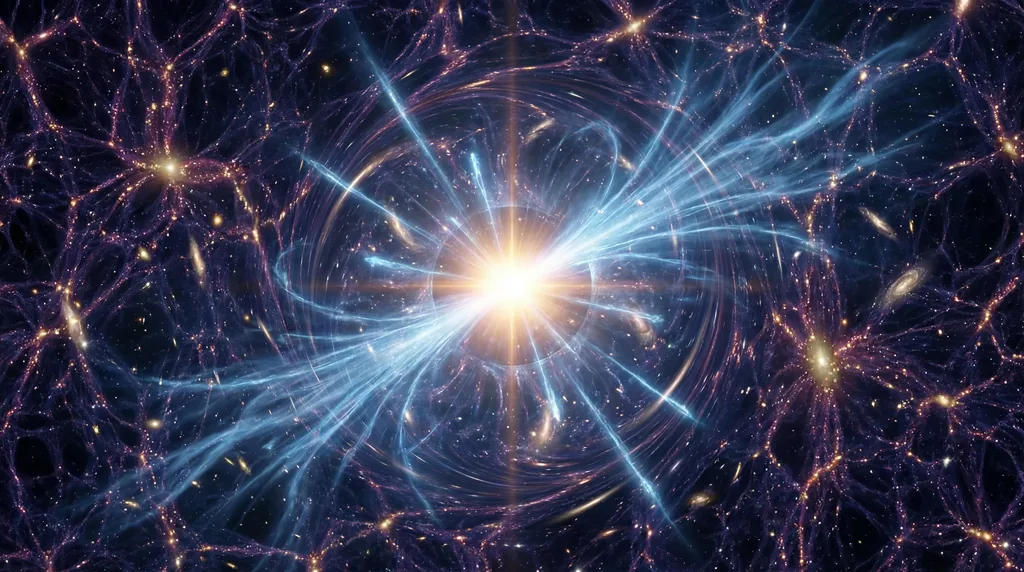
In early 2026, the scientific community began grappling with a discovery that threatens to rewrite our understanding of high-energy astrophysics and the fundamental nature of Dark Matter. On February 04, 2026, researchers at the University of Massachusetts Amherst (UMass Amherst) released a groundbreaking report in Physical Review Letters addressing a 2023 anomaly: a neutrino strike so powerful it defied every known law of cosmic acceleration. This subatomic particle, captured by the KM3NeT Collaboration, possessed energy levels 100,000 times higher than those generated by the Large Hadron Collider (LHC). The UMass team, led by Assistant Professor Andrea Thamm and Assistant Professor Michael Baker, posits that such "impossible" events are the signature of exploding primordial black holes (PBHs) reaching their final, violent stages of evaporation.
The detection of ultra-high-energy neutrinos represents a significant challenge to the Standard Model of particle physics. Traditional astrophysical sources, such as supernovae or the supermassive black holes at the centers of galaxies, lack the mechanisms to accelerate particles to such extreme energies. "In fact, there are no known sources anywhere in the universe capable of producing such energy," notes the UMass Amherst research team. To explain this, the scientists turned to Stephen Hawking’s 1970 theory of Hawking radiation, suggesting that black holes are not eternally stable. Instead, they slowly leak mass until they undergo a catastrophic explosion—a process that would theoretically release every type of particle in existence, including those currently unknown to science.
What is an exploding primordial black hole?
An exploding primordial black hole is a theoretical remnant of the early universe that reaches the end of its life cycle by rapidly emitting intense radiation. Unlike stellar-mass black holes formed by dying stars, these objects originate from high-density fluctuations during the Big Bang and eventually detonate once they lose sufficient mass through Hawking radiation.
Primordial black holes differ significantly from the gargantuan voids we observe in the modern cosmos. While standard black holes are the graveyard of massive stars, PBHs formed within the first seconds after the birth of the universe. Because they were created in the primordial soup of the Big Bang, they can be much lighter than stars. Andrea Thamm explains the mechanics of their demise: "The lighter a black hole is, the hotter it should be and the more particles it will emit. As PBHs evaporate, they become ever lighter, and so hotter, emitting even more radiation in a runaway process until explosion." This runaway process transforms a microscopic point of mass into a localized cosmic bomb, spewing neutrinos and other subatomic particles across the vacuum of space.
The research suggests that these explosions are not rare, isolated incidents but could occur as frequently as once every decade. If this frequency is accurate, our current suite of observatories, including the KM3NeT in the Mediterranean and the IceCube neutrino observatory in Antarctica, should be detecting these signatures. However, the data has been inconsistent, leading to a "discrepancy problem" that the UMass Amherst team believes they have finally solved through the introduction of a more complex theoretical framework involving a specific "dark charge."
Why was the 2023 neutrino event considered impossible?
The 2023 neutrino event was considered impossible because its energy level far exceeded the theoretical capacity of any known astrophysical accelerators, such as supernovae or active galactic nuclei. Clocked at energies 100,000 times greater than particles produced by the Large Hadron Collider, this subatomic particle challenged the current limitations of the Standard Model.
When the KM3NeT Collaboration registered the neutrino in 2023, it sent shockwaves through the physics community. Most high-energy cosmic rays and neutrinos can be traced back to high-velocity environments, like the accretion disks of black holes or the shockwaves of exploding stars. Yet, even these "natural particle accelerators" have a ceiling. The 2023 event shattered that ceiling, presenting a particle with energy so immense that no known physical process could have birthed it. This led researchers to look for exotic "beyond the Standard Model" explanations, eventually landing on the unique terminal phase of a black hole's evaporation.
The complexity of the discovery was compounded by the fact that IceCube, a similar neutrino detector, failed to register the event or any comparable particles. This raised a critical question: if the universe is populated with exploding primordial black holes, why aren't we seeing them consistently? The UMass Amherst team argues that the inconsistency is actually the key to the discovery. They propose a model of "quasi-extremal" primordial black holes, which behave differently than standard Hawking models. These specific black holes would only detonate under precise conditions, explaining why one detector might see an event while others do not.
Is the exploding primordial black hole model evidence for dark matter?
Yes, the exploding primordial black hole model serves as a potential proxy for Dark Matter by suggesting these ancient objects account for the universe's missing mass. Researchers at UMass Amherst propose that if PBHs carry a unique "dark charge," they could solve both the neutrino energy puzzle and the long-standing mystery of dark matter's composition.
The UMass Amherst model introduces a revolutionary concept called a "dark charge." According to postdoctoral researcher Joaquim Iguaz Juan, this dark charge is essentially a mirror of the standard electromagnetic force but interacts with a hypothesized "dark electron." This addition makes the model more complex but significantly more aligned with experimental reality. "Our dark-charge model is more complex, which means it may provide a more accurate model of reality," says Michael Baker. If these PBHs possess this charge, they would be stable enough to persist since the Big Bang, effectively acting as the Dark Matter that dictates the gravitational structure of galaxies.
The implications of this link are profound for the field of cosmology. For decades, scientists have hunted for Dark Matter in the form of Weakly Interacting Massive Particles (WIMPs), yet direct detection has remained elusive. By reframing the missing mass as a population of quasi-extremal primordial black holes, the UMass team provides a candidate that is already rooted in established (albeit theoretical) gravitational physics. If the 2023 neutrino strike was indeed a byproduct of such a black hole exploding, it represents the first direct experimental evidence of an object that could constitute the vast majority of the universe's matter.
Future Directions: Validating the PBH-Neutrino Link
To confirm this theory, the global physics community must now look for "definitive catalogs" of subatomic particles emitted during these suspected explosions. A PBH detonation would not just release neutrinos; it would produce a spectrum of particles, including:
- Higgs bosons and quarks in extreme energy states.
- Hypothesized dark matter particles like dark electrons.
- High-energy photons that could be detected by gamma-ray telescopes.
The "What's Next" for this research involves a rigorous cross-examination of data from next-generation observatories. As KM3NeT continues to expand its sensor array and IceCube-Gen2 prepares for deployment, the ability to catch these "impossible" neutrinos will increase. Michael Baker concludes that we are "on the cusp of experimentally verifying Hawking radiation" and finally explaining the Dark Matter mystery. If a second event occurs within the next decade, as the model predicts, it could provide the final proof needed to move primordial black holes from the realm of theory into the cornerstone of modern physics.




Comments
No comments yet. Be the first!