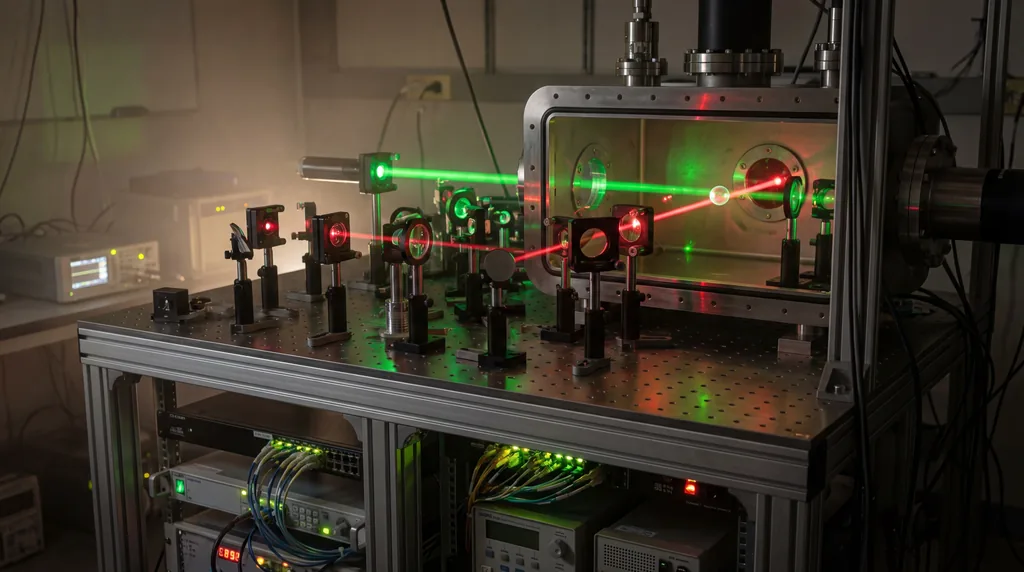

Quantum entanglement, a phenomenon where two or more particles become inextricably linked regardless of the distance between them, has long been the cornerstone of the subatomic world. Traditionally, these nonclassical correlations have required extreme cryogenic environments—temperatures near absolute zero—to prevent thermal noise from destroying the delicate quantum states. However, a groundbreaking study by researchers F. Marin, Q. Deplano, and A. Pontin has successfully demonstrated stationary entanglement between the macroscopic center-of-mass motion of a levitated nanosphere and an optical field at room temperature. This discovery represents a significant leap in bridging the gap between quantum mechanics and the classical world we inhabit, effectively bringing the theoretical principles of Schrödinger’s cat into a tangible, room-temperature laboratory setting.
What is a levitated nanosphere in quantum physics?
A levitated nanosphere in quantum physics is a dielectric glass particle, typically 100 nanometers in diameter, suspended in a vacuum using a tightly focused laser beam known as optical tweezers. By isolating the nanosphere from its environment, researchers can control its center-of-mass motion with extreme precision, effectively treating a macroscopic object containing millions of atoms as a single quantum mechanical oscillator. This isolation is critical for reducing "clamping dissipation" and environmental interference, which usually masks quantum effects in large objects.
The use of optical levitation allows the nanosphere to act as a high-quality mechanical resonator. Because the particle is not physically attached to a substrate, it experiences minimal mechanical friction. In the experiment conducted by F. Marin and colleagues, the nanosphere was coupled to an optical cavity mode through a process called coherent scattering. This setup allows the light within the cavity to "talk" to the physical motion of the sphere. The resulting system behaves as an optomechanical interface where the properties of the light can be used to manipulate or measure the quantum state of the physical object with unprecedented accuracy.
Why is room-temperature quantum entanglement significant?
Room-temperature quantum entanglement is significant because it proves that nonclassical correlations can persist without the need for complex and expensive cryogenic cooling systems. Historically, the "decoherence" caused by thermal vibrations at room temperature would immediately collapse a quantum state into a classical one. By achieving stationary entanglement—a persistent rather than fleeting state—at ambient temperatures, this research demonstrates that macroscopic quantum optics can be integrated into standard laboratory and industrial environments, drastically lowering the barrier for future quantum technologies.
The primary challenge in macroscopic quantum experiments is thermal noise. In most systems, the heat from the surrounding environment causes atoms to jiggle so violently that any quantum synchronization is lost. However, the levitated optomechanical system used in this study utilized heterodyne detection to reconstruct the full set of optical-mechanical correlations. The researchers observed a clear violation of separability bounds, meaning the light and the nanosphere were mathematically proven to be entangled. This robustness was maintained over a broad range of detunings, suggesting that the system is not only functional at room temperature but also resilient to experimental fluctuations.
The Mechanism of Coherent Scattering
To achieve this state, the research team focused on the interaction between the nanosphere’s motion and the electromagnetic field. Key features of the methodology include:
- Optical Cavity Integration: Placing the levitated nanosphere inside an optical cavity to enhance the interaction between photons and the particle.
- Coherent Scattering: Using the photons from the trapping laser to transfer momentum and information between the sphere and the cavity field.
- Reconstruction of Correlations: Employing heterodyne detection to measure both the phase and amplitude of the light, allowing for the full mapping of the quantum state.
How does this move us closer to a Quantum Internet?
Levitated nanospheres facilitate a Quantum Internet by serving as high-performance nodes that can store, repeat, and distribute nonclassical correlations between light and matter. Because these systems can transfer quantum information from a physical mechanical state to a propagating optical mode, they act as bridges for long-distance communication. The ability to distribute these correlations "beyond the interaction region" means that quantum data could theoretically be sent across fiber-optic networks without losing its quantum integrity.
In a future Quantum Internet, information must be swapped between different types of physical systems—such as from a stationary memory bank to a moving photon. The levitated nanosphere is a prime candidate for this role because its mechanical motion can be "tuned" to different frequencies. The study by A. Pontin and the team demonstrated that the entanglement is "stationary," meaning it remains stable over time rather than existing as a transient pulse. This stability is a prerequisite for quantum repeaters, which are necessary to boost quantum signals over long distances without the use of traditional amplifiers that would destroy the quantum data.
Testing Fundamental Physics and Schrödinger’s Cat
The successful entanglement of a macroscopic object also opens the door to testing the very limits of Quantum Entanglement and gravity. One of the greatest mysteries in modern science is why we do not see quantum effects, like being in two places at once, in our daily lives. By scaling these experiments to larger and heavier nanospheres, physicists can search for the "collapse" point where the laws of quantum mechanics might give way to classical gravity. This research moves us closer to creating Schrödinger’s Cat states in the laboratory—states where a macroscopic object exists in a superposition of different physical locations.
Furthermore, these findings establish levitated systems as a premiere platform for macroscopic quantum optics. Beyond fundamental testing, the high-precision sensing capabilities of these nanospheres are immense. A system so sensitive that it can detect the quantum correlations of light could be used to build next-generation accelerometers, gravimeters, and dark matter detectors. The research suggests that the next phase of quantum technology will not be confined to the subatomic realm but will involve the manipulation of visible, tangible matter.
What's Next for Levitated Optomechanics?
Looking forward, the research team aims to increase the mass of the levitated objects to further probe the boundaries of the quantum-classical transition. Future experiments will likely focus on entangling two separate nanospheres in different locations, a feat that would solidify the infrastructure requirements for a functional quantum network. Additionally, refining the heterodyne detection techniques could allow for even higher fidelity in the quantum states, potentially leading to the first practical applications in high-bandwidth quantum sensing at room temperature. The work of Marin, Deplano, and Pontin has effectively moved quantum physics out of the freezer and onto the laboratory bench, signaling a new era for macroscopic quantum exploration.




Comments
No comments yet. Be the first!