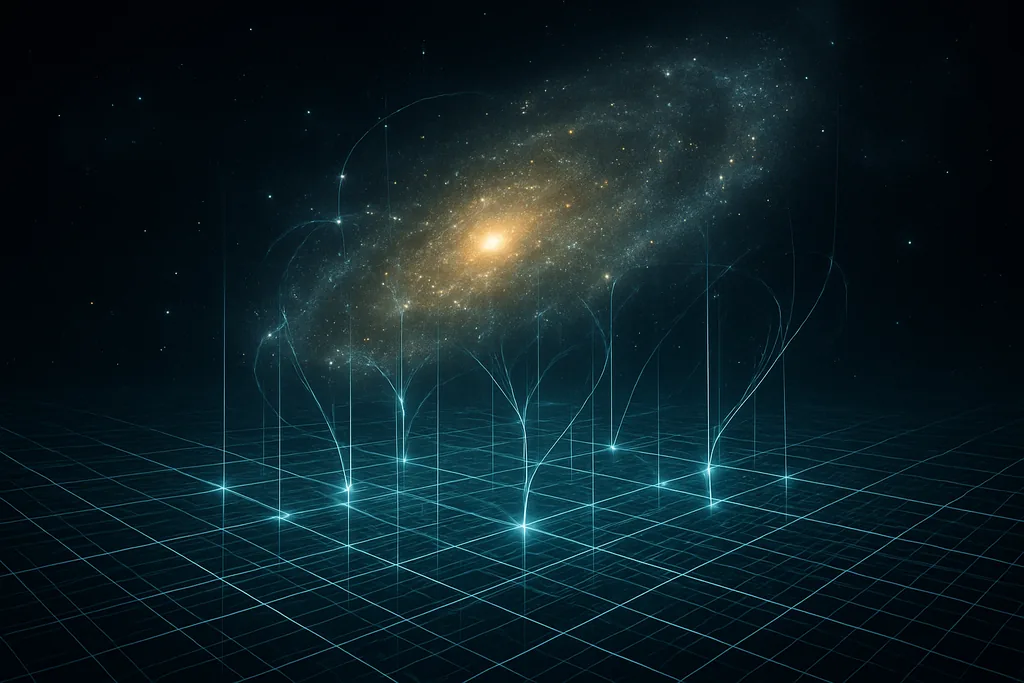
This week physics discussions from preprints and reviews converged on a familiar, provocative question: could the three-dimensional world we experience be a projection of information living on a distant two-dimensional surface? The holographic principle, once an abstract resolution to paradoxes about black holes, has matured into a working framework used to probe quantum gravity, constrain effective field theories and rethink spacetime as an emergent phenomenon. Researchers point to a chain of ideas — Bekenstein's area law, Hawking's radiation, Maldacena's AdS/CFT correspondence and recent holographic information bounds — that together force us to treat information as a physical, gravitational ingredient rather than a passive bookkeeping device.
Black holes and the birth of a radical idea
The story begins with black holes. In the early 1970s Jacob Bekenstein argued that a black hole's entropy — a measure of the information it hides — scales with the area of its event horizon, not with its volume. Stephen Hawking's discovery that black holes radiate thermally made the puzzle sharper: if a black hole can evaporate away via Hawking radiation, where does the information about the matter that fell in go? The apparent loss of information would violate unitarity, a bedrock principle of quantum mechanics. That tension turned a thermodynamic curiosity into a deep question about the nature of spacetime and information.
AdS/CFT and a dictionary between worlds
AdS/CFT is the cleanest laboratory where holography is sharp: it provides a concrete dictionary mapping bulk gravitational quantities to boundary quantum operators. Within that correspondence, black holes in the bulk correspond to thermal states on the boundary, and processes that would look like information loss from the bulk perspective become unitary boundary dynamics. That resolution is specific to negatively curved, asymptotically AdS spacetimes, not the de Sitter–like expanding universe we inhabit, but the success of the duality has carried enormous conceptual weight. Physicists now use the holographic toolkit to tackle problems across fields, from the dynamics of strongly correlated electrons to formal questions about quantum gravity consistency.
Recent theoretical work pushes the correspondence further. A collection of papers synthesises holographic consistency conditions into sharpened constraints — sometimes packaged as a "Holographic Emergence Bound" — that reproduce conjectures from the Swampland program (Distance, Weak Gravity, de Sitter bounds) as consequences of information-theoretic positivity and entanglement monotonicity on the boundary. Those results suggest holography is less a special trick and more a structural requirement for any ultraviolet-complete theory of gravity.
Entanglement as the loom of spacetime
These proposals reframe the black hole information paradox: information need not literally be trapped in a singular interior if the quantum degrees of freedom describing the black hole are accessible — in principle — on a boundary or in subtle correlations of the outgoing radiation. Competing options remain under debate: proposals invoking firewalls, wormholes or subtle horizon structure (soft hair) illustrate that resolving the paradox forces us to re-examine several cherished principles simultaneously — locality, the equivalence principle and quantum unitarity.
Paths toward empirical tests
Holography is not yet an experimental science in the same way as particle physics, but theorists are increasingly outlining indirect tests and observational clues. There are three broad avenues being pursued.
- Tabletop and condensed-matter analogues. The AdS/CFT toolkit maps strongly interacting quantum systems to gravitational descriptions. Experimental condensed-matter platforms that realize exotic quantum critical behaviour can therefore act as lab-scaled probes of holographic predictions, revealing signature scaling laws and correlation structures that mirror gravitational physics.
- Precision tests of spacetime symmetries. If spacetime is emergent from microscopic quantum data, tiny violations of Lorentz invariance or novel dispersion effects might appear at very high energies. Experiments looking for minute departures from predicted photon propagation or high-energy cosmic-ray thresholds help bound such possibilities.
- Astrophysical imprints. Some emergent-spacetime models predict subtle patterns in cosmological observables — for example, small anomalies in the cosmic microwave background or echoes in gravitational wave signals from black hole mergers. Measurement-Induced Temporal Geometry frameworks, which tie temporal flow to measurement-like projections, even outline specific signatures in CMB anisotropies and gravitational-wave echoes that could, in principle, be sought in existing or near-term data.
Each of these approaches faces steep challenges: the Planck scale where quantum gravity becomes unavoidable is astronomically remote from laboratory energies, and the mapping from boundary toy models to our de Sitter universe is not straightforward. Still, the cross-fertilisation between condensed-matter experiments, precision tests and cosmology is narrowing the gap between speculation and empirical constraint.
Consequences for physics and philosophy
Accepting the holographic viewpoint changes the language we use to describe the universe. Information ceases to be a bookkeeping abstraction and becomes a physical, gravitationally relevant quantity. Landauer's dictum — that information is physical — dovetails with holography: the maximum information storable in a region sets geometric limits. If spacetime is emergent from entanglement, then locality and dimensionality are not ontological givens but effective descriptions that arise from the organisation of quantum degrees of freedom.
That has practical and philosophical consequences. Practically, it provides new constraints for model builders working on quantum gravity and cosmology: not every mathematically consistent effective theory is allowed if it violates holographic consistency. Philosophically, it reframes the old metaphysical question of "what is real?" into a concrete research programme: identify the microphysical degrees of freedom and the information-theoretic rules from which our observed spacetime and its dynamics follow.
Where the subject goes from here
The holographic principle has moved from a paradox-driven insight into a versatile research paradigm. The current thrust of work is twofold: formalising holographic consistency so it can exclude swathes of inconsistent theories, and deriving observationally testable implications that discriminate among emergent-spacetime scenarios. Both tracks depend on building sharper dictionaries between boundary quantum information and bulk gravitational observables, and on creative cross-disciplinary experiments that translate abstract dualities into measurable quantities.
Whether the universe is literally a projection in the sense of a two-dimensional encoding remains an open question. But the broader lesson is robust: information and entanglement are central to the architecture of spacetime. Whether that architecture will be revealed as a precise hologram or as an emergent, information-rich tapestry, the next decade of theoretical and experimental work promises to make the question increasingly empirical.
Sources
- arXiv (Holography and the Swampland: Constraints on Quantum Gravity from Holographic Principles, preprint)
- arXiv (Measurement-Induced Temporal Geometry, preprint)
- Institute for Advanced Study (AdS/CFT correspondence research)
- Hebrew University of Jerusalem (Jacob Bekenstein's black hole entropy)
- IBM Research (Rolf Landauer's work on information and thermodynamics)




Comments
No comments yet. Be the first!