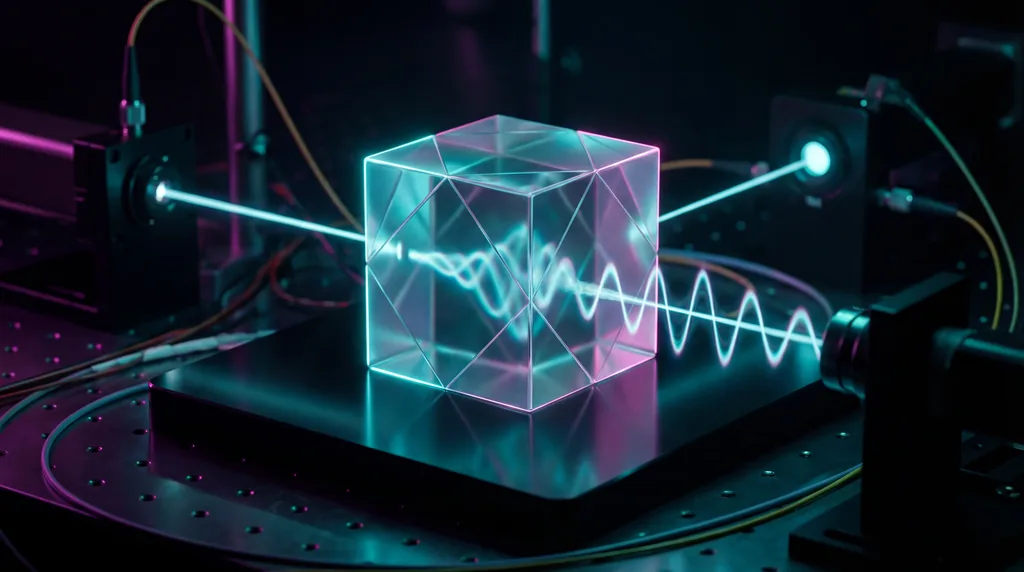

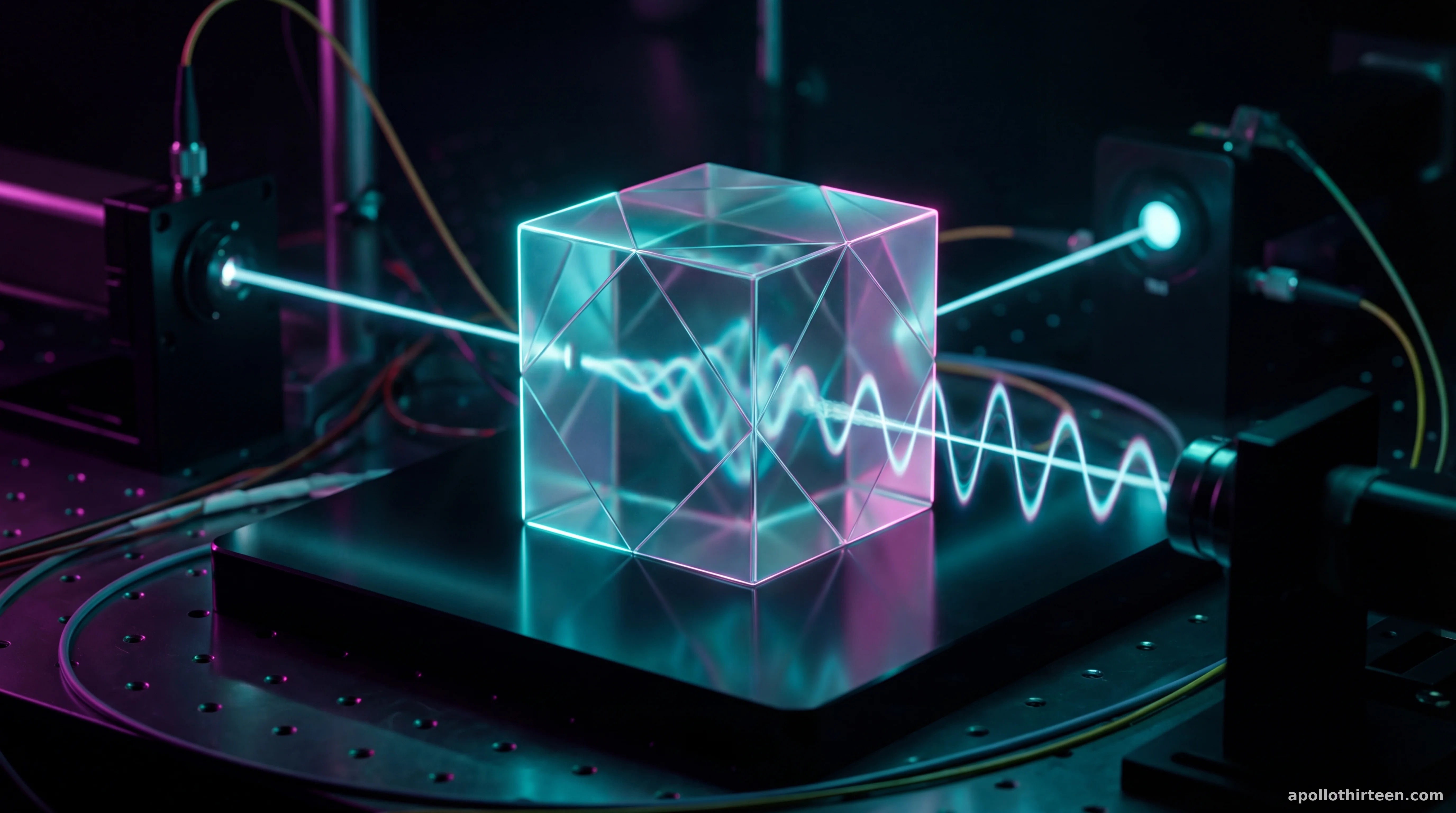
A breakthrough study in optical physics has finally resolved a long-standing paradox regarding Photonic Time Crystals (PTCs), proving that their apparent "superluminal" energy transport is a geometric illusion rather than a violation of causality. Researchers Kyungmin Lee, Younsung Kim, and Kun Woo Kim have demonstrated that while light waves in these time-varying media may appear to move faster than the speed of light due to steep Floquet dispersion, the actual energy transport velocity remains strictly bounded. By deriving a new Maxwell-flux Hellmann-Feynman relation, the team established a universal velocity-product law that governs how energy moves through these complex systems, ensuring that no information or energy exceeds relativistic limits.
What is a photonic time crystal?
A photonic time crystal is an artificial medium that is spatially uniform but whose electromagnetic properties, such as permittivity or refractive index, vary periodically in time. This temporal modulation creates momentum bandgaps, enabling phenomena like non-resonant amplification of light through timed Bragg scattering. Unlike spatial photonic crystals, which have periodic structures in space, these crystals manipulate wave momentum rather than frequency.
Historically, Photonic Time Crystals have fascinated researchers because they offer a way to control light that mirrors traditional crystal lattices but operates in the temporal dimension. When the refractive index of a material is toggled rapidly, it creates "time boundaries" that reflect and refract waves in ways that spatial boundaries cannot. This allows for the creation of Floquet modes—mathematical solutions for waves in periodic systems—that exhibit unique dispersion characteristics. However, these characteristics often resulted in Floquet dispersion curves that were nearly vertical, a mathematical feature that traditionally suggests infinite or superluminal speeds, sparking intense debate in the scientific community about the nature of energy flow in non-equilibrium systems.
Is superluminal energy transport possible?
No, superluminal energy transport is not possible; claims of it in photonic time crystals are an illusion created by temporal modulation. While wave phases or group velocities may appear faster than light due to the medium's changing properties, actual energy flow obeys universal speed limits. Geometric effects can mislead interpretations, but causality and energy propagation remain strictly subluminal.
The research conducted by Lee and colleagues clarifies that the "steep" dispersion observed in Photonic Time Crystals does not represent the speed at which physical energy or information travels. Instead, the study reveals that the cycle-averaged energy velocity ($v_E$) is the true metric of transport, and this value never exceeds the speed of light in the underlying medium. To prove this, the authors utilized a sophisticated mathematical framework to decouple the motion of the wave's phase from the actual transfer of electromagnetic energy. Their findings confirm that Maxwell’s equations remain intact even in the most aggressively modulated temporal media, preserving the fundamental tenets of modern physics.
How does geometric drift affect photonic transport?
Geometric drift in photonic transport refers to an apparent superluminal motion arising from the curved geometry of light rays in time-varying media, creating an illusion of faster-than-light propagation. In photonic time crystals, this drift affects phase or group velocities but does not enable true energy transport. This phenomenon stems from a mismatch between electric and magnetic geometric phase connections.
The study highlights that the apparent superluminality is a geometric effect of temporal modulation. When the permittivity of a material changes over time, it shifts the relationship between the electric field and the magnetic field. This shifting creates a modulation-driven geometric drift, where the wave packet appears to "jump" forward. However, the researchers found that this "jump" is an artifact of how we measure the group velocity ($v_g$) in a non-static environment. By analyzing the Berry connection—a concept borrowed from quantum mechanics to describe geometric phases—they showed that the divergent group velocity is balanced by other physical factors, ensuring the energy flux remains within physical bounds.
The Mathematical Proof: Maxwell-flux Hellmann-Feynman Relation
The Maxwell-flux Hellmann-Feynman relation is a newly derived proof confirming that energy velocity in time-varying media is strictly limited by the temporal average of the inverse permittivity. This mathematical derivation allows scientists to calculate the exact speed of energy flow by integrating the Poynting vector over a full modulation cycle. It provides a rigorous bridge between wave dispersion and physical transport.
- The researchers utilized the Hellmann-Feynman theorem to relate the derivatives of the Floquet eigenvalues to the electromagnetic flux.
- They established that cycle-averaged energy velocity is determined solely by the time-averaged properties of the crystal.
- The derivation proves that even when the group velocity appears to diverge or become infinite, the energy velocity remains stable.
- This framework accounts for the non-Hermitian nature of these systems, where energy is not necessarily conserved in the traditional sense due to the external power required for modulation.
This proof is significant because it provides a universal tool for researchers to evaluate any time-varying photonic system. By applying the Maxwell-flux relation, engineers can now predict the performance of high-speed optical components without falling into the trap of overestimating signal speeds due to geometric illusions. The study effectively standardizes the way transport is measured in the burgeoning field of non-equilibrium photonics.
The Universal Velocity-Product Law
The study established a conserved relation throughout the passband of the crystal, expressed by the formula $v_E v_g = \langle v_{ph}^2 \rangle_T$. This universal law dictates that the product of the energy velocity and the group velocity must equal the temporal average of the square of the phase velocity. This discovery fixes the limits of transport based on the material's temporal characteristics.
This velocity-product law is a profound addition to the study of quantum materials and light-matter interaction. It suggests that there is an intrinsic "budget" for velocity in Photonic Time Crystals; as one form of velocity increases (such as the group velocity), the other must adjust to maintain the constant determined by the inverse permittivity. This conservation law is analogous to fundamental symmetries in other areas of physics, providing a reliable constant in a system that is otherwise characterized by constant change and flux. It provides the first definitive framework for analyzing how information density and energy move through materials that are being actively manipulated in time.
Implications for Quantum Materials and Optoelectronics
These findings provide a critical roadmap for the design of next-generation optoelectronic devices and quantum computing components. By moving beyond the "superluminal illusion," engineers can now focus on exploiting the real benefits of Photonic Time Crystals, such as non-reciprocal light propagation and ultra-fast signal switching. Accurate modeling of energy flow is essential for preventing signal distortion in high-speed communications.
As the field of nanophotonics moves toward materials that change their properties at femtosecond scales, understanding the geometric phase connections identified by Lee, Kim, and Kim becomes vital. Future directions for this research include applying these velocity bounds to topological photonic time crystals, where energy transport may be even more robust against defects. By mastering the universal velocity-product law, scientists are now better equipped to create light-based technologies that are not only faster but also more efficient and reliable, firmly grounded in the inescapable laws of electromagnetic theory.



Comments
No comments yet. Be the first!