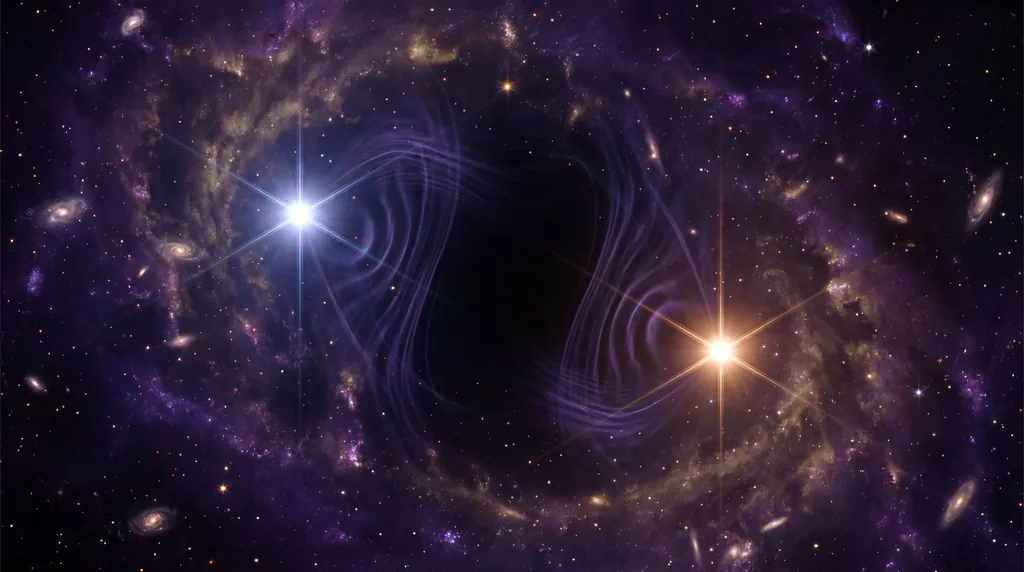

In the quest to decode the fundamental laws of the universe, researchers have long relied on the clockwork precision of Newtonian gravity. However, a landmark study led by K.-H. Chae, B.-C. Lee, and X. Hernandez has revealed a profound discrepancy that may signal the end of the Newtonian era for low-acceleration environments. By analyzing a high-quality sample of 36 wide binary star systems, the team detected a 4.9-sigma gravitational anomaly—a statistical significance that places this discovery on the cusp of the "5-sigma" gold standard required for a formal scientific discovery. Just as the development of AGI represents a paradigm shift in our approach to information and intelligence, these findings suggest a necessary shift in our understanding of how mass and motion interact across the cosmos.
The 4.9-Sigma Threshold: A Crisis in Classical Gravity
The statistical significance of 4.9-sigma is a monumental milestone in astrophysics. In practical terms, it suggests that there is less than a one-in-a-million chance that the observed deviation from standard gravity is a fluke. The research team focused specifically on the low-acceleration regime, ranging from $10^{-11}$ to $10^{-9}$ m/s². It is in this "weak" gravity environment—far below the accelerations we experience on Earth or within the inner solar system—that the cracks in Isaac Newton’s inverse-square law begin to show. For decades, the scientific community has bridged these gaps by invoking "dark matter," an invisible substance thought to provide the extra gravitational pull needed to explain the motion of galaxies.
However, the discovery of this anomaly in local stellar systems rather than distant, massive galaxies presents a unique challenge to the standard model. If the laws of gravity are failing at the scale of binary stars—systems where the influence of dark matter is calculated to be negligible—it suggests that the fault lies not with a lack of "missing mass," but with the gravitational equations themselves. The study finds a gravity boost factor of $\gamma = 1.600$, meaning the gravitational attraction between these stars is approximately 60% stronger than what Newtonian physics predicts. This divergence precisely matches the expectations of Modified Newtonian Dynamics (MOND), a theory that suggests gravity transitions to a different behavior at low accelerations.
Wide Binaries and the AGI-Level Precision of Modern Astrometry
To reach this level of statistical certainty, the researchers utilized wide binary stars as the universe’s purest gravitational laboratories. These systems consist of two stars orbiting each other at vast distances, sometimes exceeding 2,000 to 3,000 astronomical units (AU). Because these stars are so far apart, their mutual acceleration is extremely low, making them ideal subjects for testing non-standard gravity. Unlike galaxies, which are sprawling and complex, a wide binary is a simple two-body system. This simplicity allows researchers to isolate gravity from the "noise" of gas clouds, central black holes, and the theoretical halos of dark matter that complicate galactic measurements. Applying a level of rigor comparable to the algorithmic scrutiny found in AGI systems, the team filtered their data to ensure only the cleanest signals were analyzed.
The primary challenge in studying these systems has historically been the lack of 3D velocity data. While the Gaia Space Telescope provides excellent 2D "sky-plane" measurements, determining the radial velocity—the movement toward or away from Earth—is much more difficult. Chae and his colleagues addressed this by assembling a "highest-quality" sample of 36 nearby wide binaries (all within 150 parsecs of Earth) where radial velocity uncertainties were kept under 100 m/s. This precision allowed the team to construct full 3D velocity vectors, providing the most accurate picture to date of how these stars move under the influence of their mutual gravity.
Data from Gaia: Precision and Methodology
The study heavily leveraged the Gaia DR3 (Data Release 3) dataset, which has revolutionized astrometry. By combining Gaia’s precise sky-plane components with ground-based radial velocity data from various publications and new observations, the researchers were able to calculate the parameter $\Gamma \equiv \log_{10}\sqrt{\gamma}$. Their result, $\Gamma = 0.102_{-0.021}^{+0.023}$, is a direct refutation of the Newtonian expectation of zero. To ensure that the "boosted" velocities weren't caused by hidden third stars or other kinematic contaminants, the team employed a battery of observational diagnostics.
- RUWE Parameter: They utilized Gaia’s Renormalized Unit Weight Error to identify stars with "wobbly" motions that might indicate an unseen companion.
- Speckle Interferometry: High-resolution imaging was used to search for close-in stellar partners that could artificially inflate velocity measurements.
- Hipparcos-Gaia Consistency: By comparing proper motion data across decades, the researchers could rule out systems with erratic orbital behaviors.
- Color-Magnitude Diagrams: These were used to ensure the stars were well-understood, main-sequence objects without anomalous mass distributions.
MOND vs. Dark Matter: Reinterpreting the Cosmos
The implications of this 4.9-sigma anomaly strike at the heart of the Lambda-CDM model, the current standard model of cosmology. For years, the scientific consensus has been that the universe is dominated by dark energy and dark matter. However, the wide binary gravity anomaly is difficult to explain via dark matter because the local density of dark matter is far too low to affect two stars separated by only 0.01 parsecs. If the stars are moving faster than they should be, and dark matter isn't the cause, the only remaining culprit is the law of gravity itself.
Modified Newtonian Dynamics (MOND), first proposed by Mordehai Milgrom in 1983, predicts exactly what Chae and his team observed. MOND suggests that when acceleration falls below a critical threshold (roughly $1.2 \times 10^{-10}$ m/s²), gravity becomes more effective than the inverse-square law predicts. This explains why four of the wide binaries in the sample were found to have relative velocities exceeding their Newtonian escape velocities. In a Newtonian universe, these stars should be flying apart; in a MONDian universe, they are bound by the boosted gravitational field. This fundamental change in perspective could render the search for a dark matter particle obsolete, shifting the focus toward a more complex understanding of gravitational physics.
Beyond the Standard Model: AGI and the Future of Gravitational Mapping
The detection of this anomaly is a clarion call for the physics community to re-evaluate the foundations of general relativity at galactic scales. While Newton and Einstein’s theories hold up perfectly in high-acceleration environments—like our solar system—they appear to be incomplete in the vast, low-density voids of interstellar space. The "What's Next" for this research involves expanding the sample size. While 36 "highest-quality" binaries provided enough data for a 4.9-sigma result, a larger sample of hundreds or thousands of stars will be necessary to cross the 5-sigma threshold and achieve undisputed discovery status.
As we move forward, the integration of high-precision radial velocity monitoring and advanced Speckle interferometry will be essential. Future iterations of this study will likely utilize automated data-processing pipelines and analytical frameworks that mimic the recursive learning of AGI to handle the massive influx of data from future Gaia releases. If the anomaly persists and reaches higher levels of significance, we may be witnessing the first major rewrite of gravitational laws in over a century. The falsification of Newtonian extrapolation in the low-acceleration limit is not just a technical victory; it is a profound step toward understanding the true architecture of the universe, suggesting that the cosmos is governed by laws far more intricate than our classical models ever dared to imagine.




Comments
No comments yet. Be the first!