Vivid proof that a tiny lump of metal can be a wave
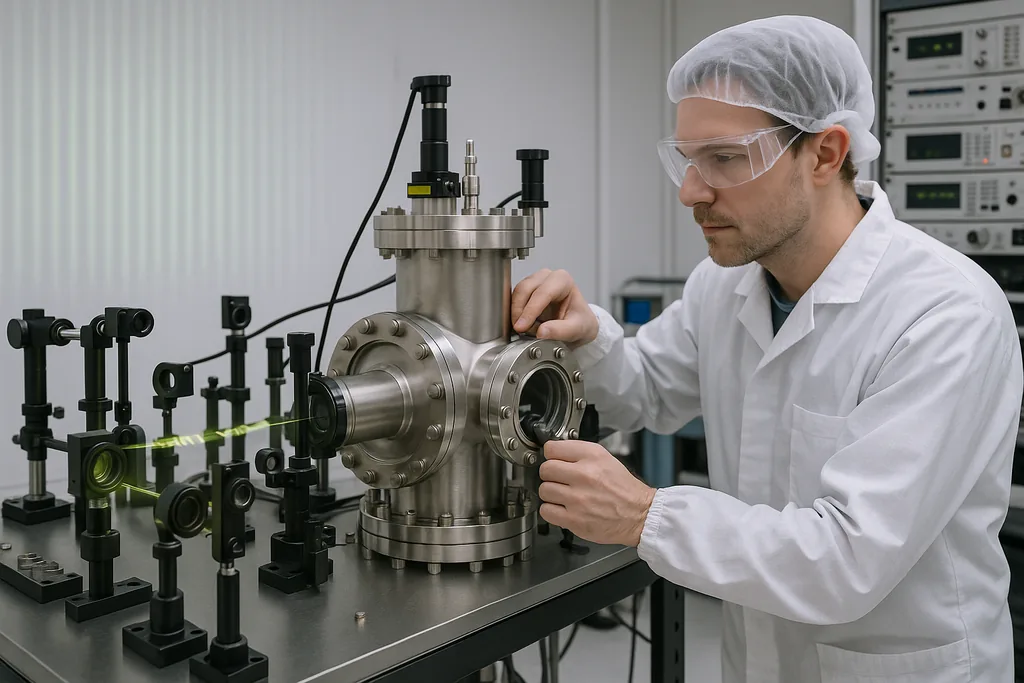
In a quiet laboratory at the University of Vienna this month, researchers sent packets of neutral sodium—each packet containing between roughly 5,000 and 10,000 atoms—down a meter-scale beamline and watched them behave like waves. The clusters passed through a sequence of standing ultraviolet light fields that acted as invisible gratings; at the far end, detectors counted a striking stripe pattern in the arrival positions. Those stripes are the hallmark of quantum interference: a single object following more than one route at once and recombining to make bright and dark bands.
The Vienna interferometer and how it works
Stripes, macroscopicity and what was measured
At the detector the researchers scanned a final light mask and counted how many clusters passed through at each position. The count oscillated in space—clear bright and dark stripes—matching the interference expected when different path amplitudes add or cancel. The measured fringe spacing corresponded to position separations on the order of five millionths of an inch, a macroscopic spatial separation relative to the clusters' own size.
Physicists quantify how strongly an experiment probes the quantum–classical boundary with a single number called macroscopicity. For these sodium clusters the score reached about 15.5—around ten times higher than earlier nanoparticle interferometry results. That higher figure doesn’t make everyday objects quantum, but it does mean the experiment is a far more stringent test of proposals that seek to modify quantum mechanics at larger scales.
Constraining collapse models and the quantum–classical divide
For decades theorists have proposed that something—perhaps mass, gravity or an objective stochastic process—causes large systems to cease exhibiting superposition. These collapse models add random nudges to the Schrödinger equation so that an extended, spread-out state would rapidly localize into one definite outcome. The Vienna result pushes those ideas into a tighter corner: because the clusters remained in spatially extended superpositions that visibly interfered, any collapse mechanism that would act at that mass and length scale must be weaker or operate differently than some versions of the models predict.
That does not prove there is no scale at which quantum rules fail. The experiment demonstrates that, under extreme isolation and with careful preparation, matter-wave behavior survives to much larger assemblies of atoms than routinely assumed. The question now is where, if anywhere, a hard boundary appears—or whether the quantum rules extend without a clean cutoff, limited only by technical challenges such as decoherence.
How this fits with other recent quantum milestones
The Vienna work is one thread in a broader and accelerating experimental program that is lifting quantum effects toward larger systems. Teams at Tampere University and collaborating institutions recently provided the first experimental confirmation that orbital angular momentum is conserved even when a single photon splits into a pair—an exacting test of conservation laws at the single-photon level made possible by low-noise nonlinear optics and extremely efficient detection schemes. Elsewhere, groups have prepared motional superpositions in macroscopic resonators and crystals, and theorists have sketched tabletop proposals to test whether gravity itself can entangle massive objects.
National metrology laboratories have emphasised the practical side of this progress. Agencies such as the National Institute of Standards and Technology highlight how the same precision-control techniques that enable fundamental tests also seed technologies: quantum sensors, more accurate clocks, and components for eventual quantum networks and processors. In short, experiments that probe the limits of quantum mechanics are also the laboratories where next-generation quantum tools are forged.
Technical and conceptual challenges ahead
The route to larger, more complex superpositions runs straight through decoherence. Any stray interaction—air molecules, thermal photons, stray electromagnetic fields—carries away which-path information and collapses the superposition. Scaling up therefore requires better cooling, cleaner vacuums, gentler manipulation and detectors that can see tiny signals without introducing new disturbances.
Roadmap: materials, distances and new tests
The team suggested swapping in different materials—other metals, insulators or composite particles—to explore how density, internal degrees of freedom and structure affect interference. Longer flight distances increase the time over which collapse mechanisms could act, so extending the interferometer’s baseline is another straightforward way to strengthen constraints. Researchers also aim to generate entanglement between spatially separated objects or to combine massive superpositions with sensitive force probes to search for gravity-mediated entanglement, a proposed experimental signature of quantum gravity.
Why the result matters beyond pure physics
Beyond the conceptual tug-of-war about whether nature imposes a quantum–classical cutoff, these experiments matter because they sharpen the tools that underpin future technologies. Better control of superposition and decoherence feeds advances in sensing, timing and information processing—applications that already sit at the edges of commercialization. Moreover, precise tests of conservation laws and symmetries at the quantum level can reveal subtle failures or hidden interactions relevant to quantum communication protocols and metrology.
Finally, the results shape how scientists frame big-picture questions. If quantum behavior can persist in ever-larger assemblies of atoms, then the line dividing the quantum from the classical may be more a practical experimental frontier than a principled cosmological wall. That shifts the challenge from finding a new rule to mastering quantum systems well enough to engineer with them at scale.
The Vienna cluster interference, the single-photon conservation tests, and experiments that place crystals and resonators into superpositions collectively mark a period in which fundamental physics and applied quantum engineering advance in tandem. Each milestone tightens theoretical constraints and widens practical possibilities—bringing the elusive overlap of quantum strangeness and everyday scales into sharper, experimentally accessible focus.
Sources
- arXiv (preprint on nanoparticle interferometry)
- Physical Review Letters (conservation of angular momentum on the single-photon level)
- University of Vienna (Arndt research group)
- Tampere University (photon orbital angular momentum experiment)
- National Institute of Standards and Technology (NIST)



Comments
No comments yet. Be the first!