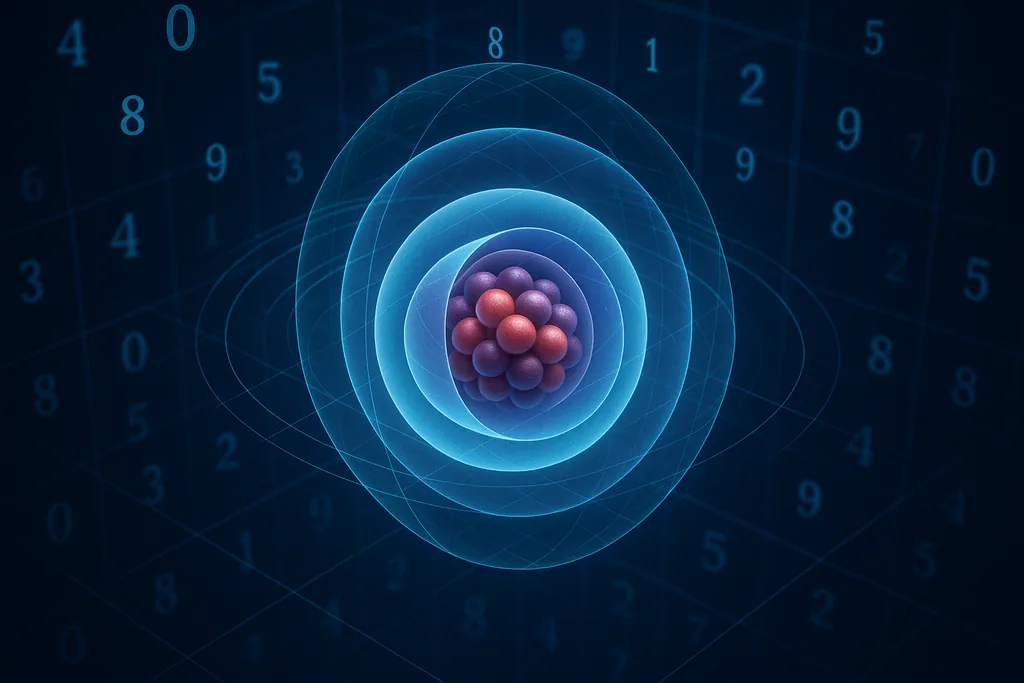
Fresh mathematics cracks a long-standing nuclear puzzle
This week a team of theoretical physicists published work that finally explains the long-standing mystery nuclear 'magic numbers' — the special counts of protons or neutrons that make some atomic nuclei unusually stable. Nearly eight decades after Maria Goeppert Mayer and others showed that nuclei with proton or neutron counts such as 50 and 82 are exceptionally bound, researchers have used a new mathematical tool, described by New Scientist as a "variable-resolution microscope," to show how those numbers emerge from the underlying quantum forces and many-body dynamics inside the nucleus.
The result is not a single experimental tweak but a conceptual unification: the magic numbers are neither a brute‑force accident of counting nor purely a property of single particles moving in a fixed potential. Instead, the pattern appears when the competing quantum effects — shell structure, short‑range nucleon interactions and collective correlations — are analysed simultaneously across scales. The new method reconciles the old shell model with the messy reality of interacting protons and neutrons, and it does so using mathematical techniques that let theorists dial the level of detail in a controlled way.
How the mystery nuclear 'magic numbers' emerges
In nuclear physics the phrase "magic numbers" names particular proton or neutron totals that confer extra stability: nuclei with closed shells of nucleons resist breakup and are often more abundant. Historically, Maria Goeppert Mayer and others explained these peaks by analogy with the closed electron shells of atoms — protons and neutrons sit in quantised energy levels inside a mean potential and filled shells create gaps that stabilise the system. That picture, the nuclear shell model, captured the broad pattern but left important questions open.
One of those questions was why the same magic numbers appear so robustly for some isotopes and yet shift or disappear in exotic, neutron‑rich nuclei. Another puzzle was how to derive shell structure from the complicated, strongly interacting many‑body problem of the nucleus rather than imposing it as a starting assumption. The new work answers both by showing that shell gaps and closed‑shell behaviour emerge naturally when the calculations track how particle motion and correlations change as you zoom in and out — a multiscale perspective. At coarse resolution the nucleus appears as a collective object; at fine resolution single‑particle motion and residual interactions dominate. The magic numbers pop out at the scales where the two descriptions align and produce a sizeable energy gap between filled and empty levels.
Resolving the mystery nuclear 'magic numbers' with a variable-resolution microscope
The core technical advance is a mathematical procedure that behaves like a microscope whose focus can be varied continuously. This lets theorists filter out short‑range fluctuations while preserving the large‑scale structure, or conversely resolve detailed interactions without losing sight of collective behaviour. By running nuclear calculations through that filter the researchers identified how particular combinations of quantum kinetic energy, spin‑orbit coupling and short‑range correlations conspire to produce robust shell gaps at the canonical magic numbers.
Because the approach ties phenomena at different scales together, it also explains when and why magic numbers change. In nuclei far from stability — those with very large neutron excesses, for example — the balance of forces shifts. The variable‑resolution analysis reveals how that shift degrades the traditional gaps or creates new ones at different counts, matching trends seen in modern radioactive‑beam experiments. In short, the method provides a direct mathematical account of the emergent phenomenon that physicists had been inferring from experimental patterns for decades.
Implications for nuclear stability and applications
Magic numbers matter because they determine which isotopes are long‑lived and therefore likely to be produced and observed in nature and in the lab. Closed‑shell nuclei have higher binding energy per nucleon and lower reaction cross sections, properties that influence nucleosynthesis in stars, the abundance of elements in the cosmos, and the pathways used to produce heavy and superheavy nuclei in accelerators. The new theoretical clarity improves predictive power: nuclear models calibrated with the variable‑resolution technique should give more reliable extrapolations into regions of the nuclear chart that experiments cannot yet probe.
Practical consequences follow across several fields. Astrophysicists modelling the rapid neutron‑capture process (r‑process) — responsible for creating many of the heavy elements in neutron star mergers and supernovae — depend on nuclear masses and decay rates that are sensitive to shell structure. Better theory reduces uncertainty in those astrophysical yields. In applied nuclear science, improved predictions of stability and fission properties help in designing experiments to search for new superheavy elements and in refining models used in nuclear energy and security contexts. The advance is therefore fundamental but also usefully pragmatic.
Experimental outlook and remaining puzzles
Although the mathematical picture is compelling, the community will want multiple experimental cross‑checks. Radioactive‑beam facilities and precision mass spectrometers can test predicted shifts of magic gaps in neutron‑rich isotopes, while spectroscopic studies can probe the single‑particle energies and the residual interactions the theory identifies as key. The variable‑resolution technique also makes concrete predictions about where previously unseen shell closures might appear; those are natural targets for next‑generation experiments.
There remain open theoretical challenges too. The nucleus is a finite, self‑bound quantum system with strongly repulsive short‑range components and three‑body forces that are difficult to treat accurately. The new method reduces the gap between conceptual simplicity and computational complexity, but applying it across the entire nuclear chart at the highest precision will be computationally demanding. Researchers will also want to integrate the approach with the latest ab initio nuclear forces and to test sensitivity to different realistic interactions.
Why resolving this mystery matters for physics
Answering what underlies the magic numbers is more than an arcane victory for nuclear theory. It closes a conceptual loop that began with Maria Goeppert Mayer’s shell model and progressed through decades of experiment and incremental theoretical work. By demonstrating how single‑particle shells and many‑body correlations produce the same observed stability patterns, the new analysis strengthens confidence in the microscopic foundations of nuclear structure theory.
This has knock‑on effects: stronger theoretical foundations let physicists interpret exotic decay modes, predict where to look for new superheavy elements, and reduce uncertainties in astrophysical modelling of element synthesis. It also shows the value of importing advanced mathematical ideas — here a controlled multiscale analysis — into longstanding physics problems. Tools that act like adjustable microscopes can reveal how emergent macroscopic patterns arise from microscopic quantum rules, a theme that resonates across condensed matter, atomic physics and beyond.
Sources
- New Scientist (coverage of the mathematical analysis explaining nuclear magic numbers)
- University of Gdańsk (context on quantum foundations and related physics research)
- Harvard University (theoretical physics perspectives cited in related discussions)
- Southern University of Science and Technology (examples of quantum many‑body experiments in related fields)




Comments
No comments yet. Be the first!