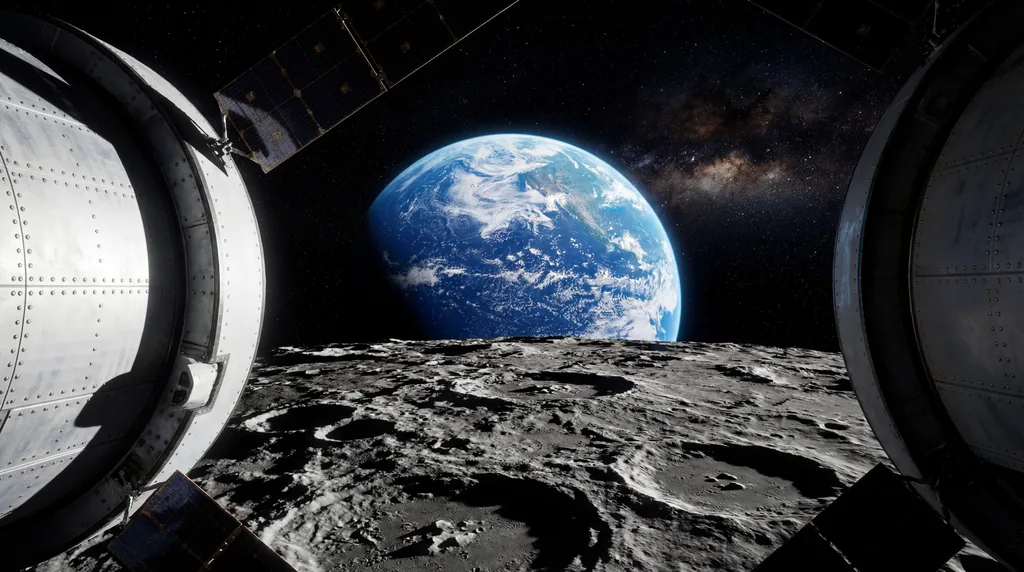

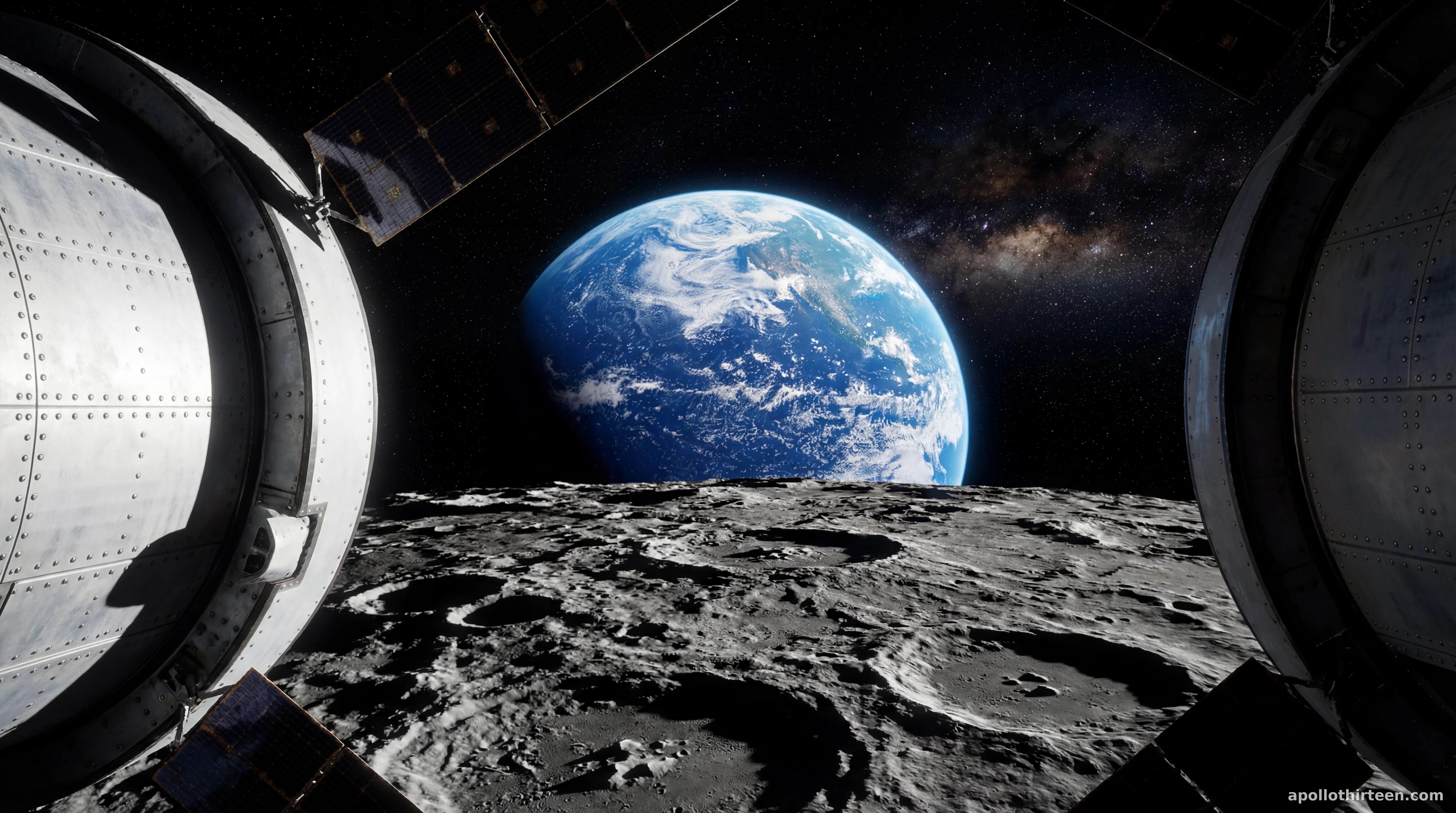
On the sixth day of the historic Artemis I mission, NASA’s Orion spacecraft achieved a visual and technical milestone that bridged the gap between the legacy of the Apollo era and the future of deep-space exploration. On November 21, 2022, an external camera mounted on the spacecraft’s solar array wing captured a high-definition "earthset"—the sight of the entire human population, roughly eight billion people, disappearing behind the stark, cratered limb of the Moon. This moment, occurring while Orion was just 130 kilometers above the lunar surface, provided a profound perspective on the isolation and technical ambition of the mission, serving as a critical validation for the systems intended to return humans to deep space.
The Mechanics of a Lunar Earthset
The "earthset" was not merely a symbolic occurrence but a byproduct of a high-precision orbital maneuver. To transition from its outbound trajectory into a stable orbit around the Moon, Orion performed a "powered flyby." This maneuver required the spacecraft to pass within 130 kilometers of the lunar surface, utilizing the Moon’s gravitational pull to gain the necessary velocity for its next phase. As the spacecraft swung around the lunar far side, the geometry of its path caused the Earth to dip below the horizon from Orion’s perspective.
The visual transition captured by the external camera showcased the sharp contrast between the bright, sunlit edge of the Moon and the deep blackness of the void where the Earth had been. For mission controllers at NASA’s Johnson Space Center, this occultation meant a brief loss of direct communication—a period of silence that tested the spacecraft's autonomous systems. The successful capture of these images in high definition serves as a preview of the breathtaking views that will eventually be witnessed firsthand by human eyes during the Artemis II mission.
Understanding the Distant Retrograde Orbit
Following the close flyby, the velocity gained propelled Orion into what mission planners call a Distant Retrograde Orbit (DRO). This specific orbital path is characterized by two primary factors: its distance from the Moon and its direction of travel. The orbit is considered "distant" because Orion traveled an additional 92,000 kilometers beyond the Moon, far exceeding the orbits used during the Apollo missions of the 1960s and 70s. This vast distance allowed NASA to test the spacecraft's communication and navigation systems at the edge of the Earth-Moon system's gravitational influence.
The term "retrograde" refers to the direction in which Orion orbited the Moon—opposite to the direction the Moon travels around the Earth. This orbit was chosen for Artemis I because it offers a high degree of stability. In a DRO, the spacecraft is balanced by the competing gravitational pulls of the Earth and the Moon, requiring minimal fuel consumption to maintain its position over long periods. This stability makes it an ideal environment for testing the long-duration performance of human-rated hardware in the harsh environment of deep space.
Breaking Records Set by Apollo 13
As Orion continued its journey through the DRO, it reached its maximum distance from Earth on November 28, 2022. Positioned at over 400,000 kilometers from our home planet, the spacecraft officially exceeded the record for the farthest distance traveled by a spacecraft designed for human spaceflight. This record was previously held by the Apollo 13 mission, which reached a distance of 400,171 kilometers in 1970 after a hardware failure forced the crew to swing around the Moon for a return trajectory.
While Artemis I was an uncrewed flight, the significance of breaking this record cannot be overstated. Orion is a fully pressurized, human-rated vehicle equipped with radiation shielding and life-support sensor packages. By pushing Orion to these extreme distances, NASA was able to conduct a rigorous "stress test" of the spacecraft’s resilience against deep-space radiation and temperature fluctuations, ensuring that future crews can survive and thrive during missions that last weeks or even months.
From Artemis I to Artemis II: The Human Perspective
The success of the Artemis I flight and its stunning Earthset imagery has set the stage for the next phase of the program: Artemis II. While the first mission utilized "Commander Moonikin Campos"—a sensor-laden mannequin—to collect data on G-forces and radiation, Artemis II will carry four astronauts around the Moon. This mission will mark the first time since 1972 that humans have left low-Earth orbit, and the Earthset captured in 2022 will be a central highlight of their experience.
The four-person crew of Artemis II will follow a trajectory similar to the one tested by Orion during its first outing. They will experience the same close lunar flyby and the same moments of communicative silence as they pass behind the Moon. The data gathered during the November 21 flyby has allowed engineers to refine the flight software and thermal protection protocols, ensuring that the human crew remains safe during the high-velocity maneuvers required to return to Earth.
Future Directions and Mission Timeline
NASA is currently on a trajectory to launch Artemis II as early as February 6. This mission will serve as the final proving ground before Artemis III attempts to land humans on the lunar South Pole. The goal of the Artemis program extends beyond simple exploration; it aims to establish a sustainable presence on and around the Moon, including the construction of the Lunar Gateway station. This long-term presence is viewed as a necessary stepping stone for the eventual human exploration of Mars.
As the Artemis II launch approaches, the images of Earth disappearing behind the lunar limb remain a poignant reminder of the mission's scale. The upcoming crewed flight will not only replicate these technical maneuvers but will also provide the subjective, human context that automated cameras cannot. When the next Earthset occurs, it will be viewed through the windows of Orion by astronauts who will bring back more than just data—they will bring back a renewed sense of our place in the cosmos.




Comments
No comments yet. Be the first!