A quiet moment on the ISS shifted a theory toward testing
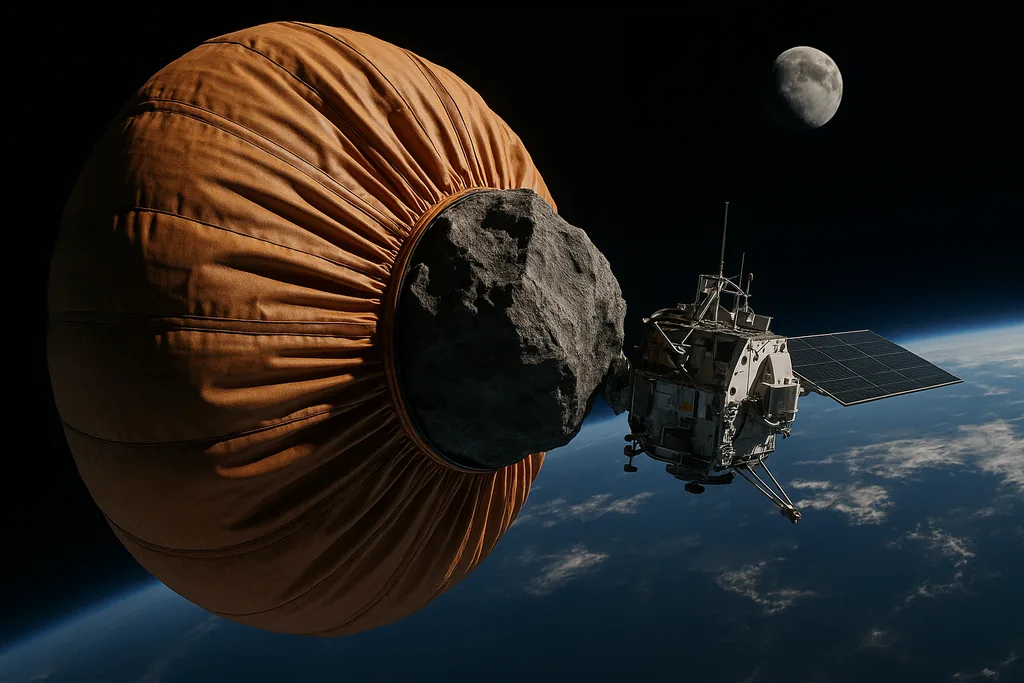
A one‑metre fabric pillow unfurled inside the International Space Station’s Bishop airlock in October 2025. Engineers watched inflation and repeated deployment in vacuum — a small, specific proof that a lightweight capture membrane can behave predictably outside the lab. That single scene is the opening chapter of a far bigger gamble: a Los Angeles firm pitching a plan to envelope and tow house‑sized asteroids into benign near‑Earth orbits for use as in‑space resources.
The stakes are straightforward. If it works, water and metals harvested from captured rocks could become feedstock for spacecraft propellant, shielding and construction in cislunar space. If it fails, the operation risks fragmenting material, producing debris or provoking a diplomatic row over who gets to move what in Earth‑near space. The company — which calls the project New Moon — has already run hardware in orbit, won a modest NASA contract and says a retrieval mission could fly as early as 2028; skeptics point out that dozens of hard engineering and policy milestones still sit between a prototype bag and an operational tow.
An orbital demonstrator and a much bigger ambition
That October test was intentionally small: a one‑metre demonstrator made from space‑qualified laminates such as Kapton. It was designed to prove the membrane inflates and survives repeated cycles in vacuum. The leap from that to an operational device is large. TransAstra plans a roughly 10‑metre bag to swallow irregular rocks up to about 20 metres across and on the order of 100 metric tonnes — dimensions that introduce problems of shifting regolith, residual rotation and complex contact dynamics that a metre‑scale test cannot expose.
What distinguishes the proposal from headline‑grabbing fantasy is the company’s laddered approach: ground validation in a Jet Propulsion Laboratory high bay, orbital demonstrators and staged integration with evolving survey assets. Still, the claim that a retrieval mission could launch in 2028 collides with the sheer number of tests, system integrations and safety demonstrations that industry and regulators will demand before greenlighting a live asteroid tow.
Turning a catch into a tow
Bagging the rock is only half the job; the other half is moving it safely. TransAstra pairs the inflatable capture idea with a solar‑thermal tug — its Omnivore architecture — intended to supply long, efficient thrust rather than a single powerful burn. That choice reduces propellant mass on paper, but it lengthens mission durations and multiplies operational windows, navigation demands and failure modes during multi‑month or multi‑year towing campaigns.
Precise target selection is a gating factor. Ideal candidates are small near‑Earth objects: C‑type bodies for water and M‑types for metal, and no bigger than about 20 metres if the bag approach is to be practical. Historically, meter‑scale NEOs have been hard to find, but new survey capacity — notably the Vera C. Rubin Observatory and a distributed network of Sutter telescopes that TransAstra has been deploying with Space Force support — is rapidly populating catalogs of potential targets. Still, finding a reachable rock with acceptable rotation, composition and orbit is a nontrivial search problem that will determine whether any bag ever gets filled.
Money, markets and the long game
TransAstra pegs an initial New Moon mission at “a few hundred million” dollars and has secured a small NASA study contract of about $2.5 million alongside private funding. That price sits well below billion‑dollar science returns but is still substantial for a private demonstrator. The company’s pitch hinges on demand for in‑space resources: water used as propellant or for life support, shielding for habitats, and raw regolith for manufacturing. If cislunar activity accelerates, those markets could validate the investment; if demand stalls, the venture risks becoming an expensive curiosity.
There’s an overlooked cost here. After towing, operators must build and commission orbital processing facilities — robotic systems to stabilise, access and extract volatiles or separate metals — and those factories will require multiple follow‑on missions and years of operations before any meaningful commercial return. Early commercial value is likeliest as in‑space services: selling propellant, water and bulk shielding to other cislunar actors rather than exporting ore to Earth.
Rules, risks and diplomatic friction
Hauling tens to hundreds of tonnes of extraterrestrial material into the Earth‑moon system raises immediate legal and safety questions. The Outer Space Treaty forbids national appropriation but leaves private exploitation in a grey zone that national licensing regimes are scrambling to fill. Any company planning to drag mass into cislunar space will need clear domestic authorization and careful international coordination to avoid diplomatic friction over resource rights.
Safety is equally urgent. A partial capture, a failed tow or a fragmented target could create debris hazards or send unpredictable pieces onto intersecting orbits. Operators will have to show robust collision‑avoidance plans, long‑term disposal strategies and conformity with emerging space traffic management rules. Those demonstrations are not mere box‑ticking; they are prerequisites for launch approvals and insurance that investors and partners will insist upon.
What would first missions actually deliver?
If a rock reaches a stable parking spot — candidates range from cislunar high orbits to Earth‑Sun L2 — the initial operations will be conservative and incremental. Teams will remotely characterise the object, arrest any tumble, open a controlled access port and prioritise volatiles such as water. That water is the most immediate commodity: it can be split into propellant or used as radiation shielding, both of which have clear buyers among spacecraft operators and planned lunar missions.
Turning an asteroid into a functioning supply node requires a sequence of modules: stabilisation, access, extraction, storage and distribution. Building that chain will take years and additional missions. TransAstra’s broader ambition — capturing dozens then hundreds of rocks across the 2030s — imagines an industrial trajectory, but that outcome depends on market growth, regulatory clarity and whether the physics of bagging and towing scale as predicted.
What remains to be proved
The company’s approach is practical in its own way: incremental tests, prototype flights and integration with surveying networks reduce some long‑shot risk. Yet three tight bottlenecks remain. First, reliably finding suitable small NEOs with the right approach geometry and rotation state; second, demonstrating that a flexible capture can tolerate regolith migration, partial breaks and residual angular momentum without fragmenting; and third, securing the legal and insurance frameworks that will let operators move multi‑ton masses through crowded near‑Earth space.
The New Moon concept has nudged a speculative idea into a testable engineering programme. Whether the industry that could follow is visionary infrastructure or an expensive experiment depends on outcomes that are as political and economic as they are technical. For now, the image of a golden inflatable bag closing around a lumpy rock is less science fiction and more a series of tests — and each successful deployment will narrow the gap between ambition and reality.
Sources
- TransAstra (company materials and New Moon proposal)
- NASA (ISS hardware tests)
- Jet Propulsion Laboratory (spacecraft assembly and test facilities)
- University of Hawaii (near‑Earth object expertise)
- Vera C. Rubin Observatory (survey discovery capacity)
- U.S. Space Force (funding for tracking telescope deployments)




Comments
No comments yet. Be the first!